US coin · series

The Three-Dollar Gold Piece: America's Strangest Coin

One designer, one peculiar value, and a single 1870 survivor worth more than a mansion.

The Three-Dollar Gold Piece: America's Strangest Coin
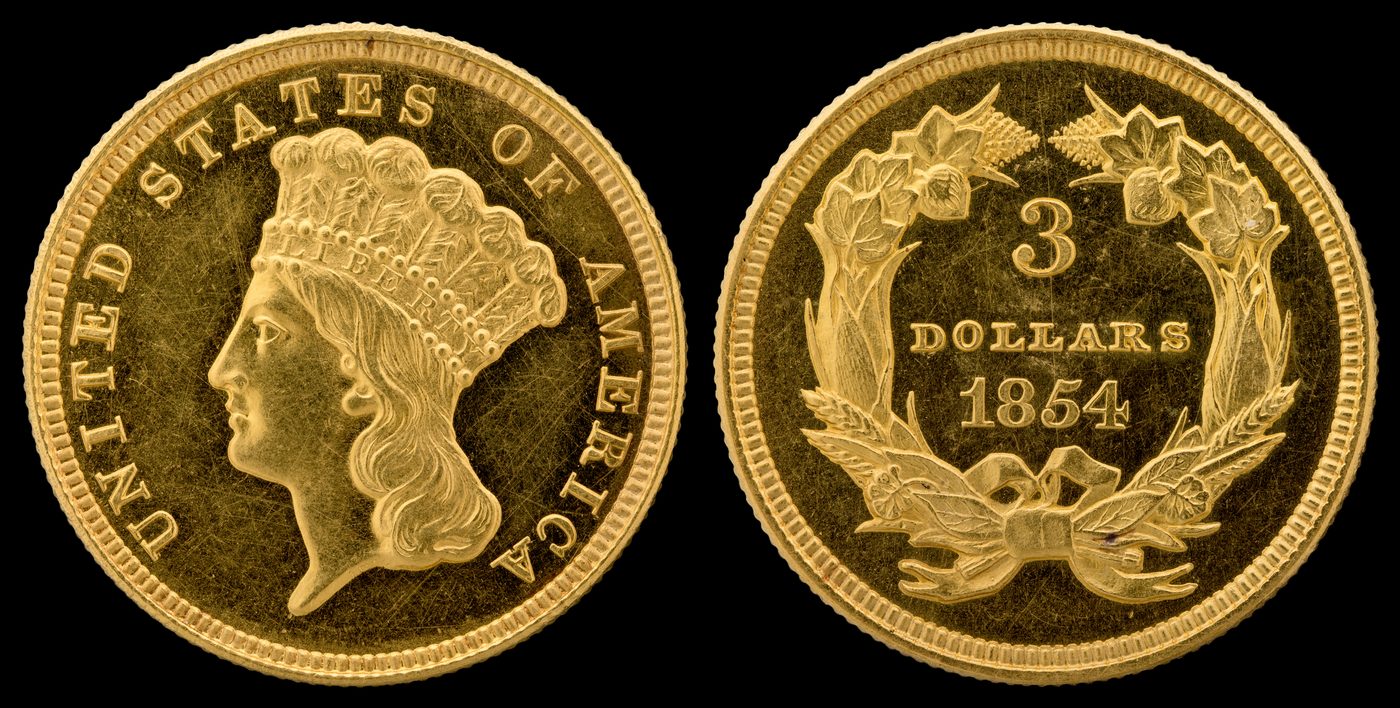
US Mint (coin); photograph by Jaclyn Nash, National Numismatic Collection, National Museum of American History (Smithsonian) · public domain · source

In 1854 the United States made a gold coin worth three dollars — a value nobody had asked for and few would use. It ran for 35 years, its mintages shrinking almost every year, until the Mint quietly admitted it served "no useful purpose." Today there is no such thing as a common one.

The story behind the coin

Three dollars. Of all the round numbers a coin could carry, the United States chose one of the oddest — and minted it in gold.

The three-dollar piece was authorized by the Act of February 21, 1853, and first struck on April 28, 1854. The official excuse was postal: a sheet of 100 of the new three-cent stamps cost exactly three dollars, and a single gold coin could buy one without fishing out a fistful of unloved copper cents. It is a tidy story, and historians have doubted it for over a century. The numismatist Walter Hagans pinned the real reason on something simpler — the flood of California gold after 1849, which gave the Mint more metal than it had denominations to absorb.

Whatever the cause, the coin landed in a country that didn't need it. The quarter eagle ($2.50) already sat right beside it. So the chief engraver, James Barton Longacre, deliberately made the $3 look different — a thinner, wider coin you couldn't mistake for its neighbor in the dark.

Then history finished it off. When the Civil War broke out in 1861, gold vanished from circulation in the East — banks stopped paying it out at face value, and Americans hoarded every yellow coin they could find. The three-dollar piece never came back to Eastern pockets. It limped on for decades anyway, struck in ever-smaller numbers, mostly so collectors could buy fresh examples straight from the Mint. In 1889 the Mint's own director, James P. Kimball, wrote that it "serves no useful purpose, its present coinage being in fact limited to its production for cabinet [collecting] purposes." Congress abolished it the next year.

The design and who made it

James Barton Longacre was the Mint's fourth chief engraver, and the most prolific designer in its early history — the man behind the Indian Head cent, the Flying Eagle cent, the two-cent piece, the Shield nickel, and the gold dollar. He designed both sides of the three-dollar piece.

The obverse — the heads side — shows Liberty wearing a tall feathered headdress, the figure collectors have always called the "Indian Princess." It is a striking choice: an idealized Liberty dressed in a Native American war bonnet, an attempt to make the coin feel rooted in the New World rather than borrowed from Rome. Longacre captured the idea himself in a famous line: "Why not be American from the spring-head within our own domain?"

The reverse is quieter but just as deliberate. A wreath of corn, wheat, cotton, and tobacco — the four crops of the American economy, North and South — circles the value, written out as 3 DOLLARS and the date. There's a small but well-known wrinkle here: in 1854 the word DOLLARS was rendered in small letters; after public grumbling, Longacre enlarged it for 1855 and every year after.

A persistent legend says the Princess was modeled on Longacre's young daughter, Sarah. The story is charming and almost certainly embroidered — it attaches itself to several of Longacre's "Indian" designs — and Longacre's own accounts point instead to a classical Venus sculpture then on view in Philadelphia. Treat it as folklore, not fact.

Key facts

Years struck
1854–1889
Designer
James Barton Longacre (both sides)
Composition
90% gold, 10% copper
Weight
5.015 grams (.1451 troy oz gold)
Diameter
20.5 mm, reeded edge
Mints
Philadelphia, Dahlonega (D), New Orleans (O), San Francisco (S)
Total struck (all years)
539,792 pieces
Famous rarity
1870-S — a single known example, $5.52M in 2023
Authorized
Act of February 21, 1853
Abolished
September 26, 1890

Collecting it: key dates and why high grades are scarce

The dealer Norman Stack put it best in the 1950s: "All are rare. There is no such thing as a common three-dollar gold piece." Over 35 years the entire series totaled just 539,792 coins — fewer than a single common date of many other US types. That alone makes the $3 a collector's coin in every grade.

A few dates stand far above the rest:

1870-S is the summit — and one of the most storied coins in American numismatics. Only one example is confirmed to exist. The San Francisco Mint's coiner, Joseph Breck Harmstead, is recorded as hand-engraving the "S" mintmark directly into the die, and the surviving coin carries a mysterious "893" scratched into its reverse, a notation no one has explained for certain. A second example was reportedly sealed inside the cornerstone of the new San Francisco Mint in 1870 — but that cornerstone has never been opened, so the second coin remains a paper rumor. The known specimen, long held in the Harry W. Bass Jr. collection, sold at Heritage Auctions in January 2023 for $5,520,000.

1854-D is the branch-mint blue chip. The Dahlonega Mint in Georgia struck the three-dollar piece in only one year, and only 1,120 coins — the lowest mintage of any business-strike date in the series. Survivors are few and almost always show the soft, grainy strike typical of that small Southern mint.

The later Philadelphia dates (especially the 1870s and 1880s) were often made in tiny numbers, sometimes as proofs only — coins specially struck for collectors with mirror-like fields. Those years exist precisely because hobbyists, not commerce, kept the denomination alive.

Why are high grades so scarce across the board? Two reasons. First, gold is soft, and the coins that did circulate wore quickly. Second — and this is the cruel part — tens of thousands of three-dollar pieces were melted as obsolete bullion in the 1890s after the denomination died (records show 49,087 melted at Philadelphia alone). Many of the finest, freshest coins went into the furnace. What's left in pristine condition is a fraction of an already tiny population, which is why a high-grade $3 commands attention the moment it surfaces.

Questions collectors ask

Why did the US make a three-dollar coin at all?

It was authorized in 1853, supposedly so a single gold coin could buy a 100-stamp sheet of three-cent postage. Most historians doubt that explanation and credit the real motive to the glut of California gold the Mint needed to turn into coins.

Who designed the three-dollar gold piece?

James Barton Longacre, the fourth chief engraver of the US Mint, designed both sides — the feathered 'Indian Princess' Liberty on the obverse and the corn-wheat-cotton-tobacco wreath on the reverse.

What is the rarest three-dollar gold piece?

The 1870-S. Only one example is confirmed to exist, and it sold for $5.52 million at Heritage Auctions in January 2023 — among the highest prices ever paid for a US coin.

Was the Indian Princess really Longacre's daughter Sarah?

Almost certainly not. It's a charming legend that attaches to several of Longacre's designs. His own accounts point to a classical Venus sculpture shown in Philadelphia, not a portrait of his daughter.

Are any three-dollar gold pieces affordable?

There is no truly common date — the whole series totals about 540,000 coins across 35 years. The more available Philadelphia dates in circulated grades are the entry point, but every example is genuinely scarce.

Why was the three-dollar piece discontinued?

It never found a real use in commerce, and after the Civil War it largely stopped circulating. By 1889 the Mint admitted it was being struck only for collectors, and Congress abolished it in 1890.

Sources