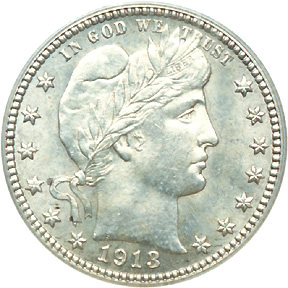
US coin · series

The Barber Quarter (1892–1916)

Born from a public contest the Mint called a 'wretched failure' — and quietly handed to the man judging it.

The Barber Quarter (1892–1916)
Unknown author (via Wikimedia Commons); US coin design by Charles E. Barber · public domain · source

In 1891 the U.S. Mint asked the nation's best artists to redesign the quarter. The entries were so disappointing the Mint director called the contest a "wretched failure." So the job went to the Mint's own chief engraver, Charles Barber — and the coin that resulted carried his name for the next 24 years.

The story behind the coin

For most of the 1800s, U.S. coin designs were nearly impossible to change. Then the Coinage Act of September 26, 1890 quietly rewrote the rules: any design could be replaced once it had been in service for 25 years, without going back to Congress. The dime, quarter, and half dollar — all wearing the same seated figure of Liberty since the late 1830s — were suddenly old enough to retire.

The Mint wanted something better, so it did something unusual: it held a public competition. In 1891 it invited the country's leading artists to submit new designs, with judges that included Augustus Saint-Gaudens, the most celebrated American sculptor of the age. It went badly. The artists balked at the terms, the entries underwhelmed, and Mint Director Edward Leech dismissed the whole effort as a "wretched failure."

So the work fell to the man already inside the building. Charles E. Barber was the Mint's sixth chief engraver — the staff artist responsible for the dies, the hardened steel stamps that strike the design into blank metal. He produced a single Liberty design for all three coins. The first quarters bearing it left the presses in 1892, and collectors have called them "Barber quarters" ever since.

There's a small irony worth noting. Saint-Gaudens had sat in judgment of the contest that produced nothing — and sixteen years later, in 1907, it was Saint-Gaudens who launched the great redesign of American coinage. The Barber coins became, in a sense, the workaday money that era set out to replace.

The design and who made it

Turn a Barber quarter to the obverse — the heads side — and you meet Liberty in profile, facing right. She wears a laurel wreath and a soft cap, with a small band reading LIBERTY across her brow. Thirteen stars ring her (six on the left, seven on the right) for the original states, IN GOD WE TRUST arches above, and the date sits below. It's a deliberately classical, Greco-Roman head — dignified, a little severe, and to some contemporary critics, a little dull.

Flip it over. The reverse — the tails side — copies the heraldic eagle of the Great Seal of the United States: wings spread, an olive branch of peace in one talon and a bundle of 13 arrows for war in the other, a shield on its breast, and a ribbon in its beak reading E PLURIBUS UNUM ("out of many, one"). Barber designed both sides himself.

That reverse hides a first-year quirk. The original 1892 eagle stood in slightly too-high relief — the raised height of the design above the field — so the coins didn't stack neatly in bank tills. Barber re-cut the master hub (the positive master from which working dies are made) partway through the year, nudging the eagle's wingtip to cover more of the "E" in UNITED. Collectors call the early version the Type I reverse and the corrected one the Type II. Philadelphia, New Orleans, and San Francisco all struck both in 1892.

Key facts

Years struck
1892–1916
Designer
Charles E. Barber (obverse and reverse), U.S. Mint Chief Engraver
Composition
90% silver, 10% copper
Weight
6.25 grams (about 0.181 troy oz silver)
Diameter
24.3 mm
Edge
Reeded
Mints
Philadelphia (no mint mark), New Orleans (O), San Francisco (S), Denver (D)
Replaced
Seated Liberty quarter (designed by Christian Gobrecht)
Succeeded by
Standing Liberty quarter, 1916 (Hermon A. MacNeil)
Lowest mintage
1913-S — 40,000 struck
Most famous key date
1901-S — 72,664 struck

Collecting the Barber quarter

Barber quarters are a classic "key-date" series: most dates are common in worn grades and affordable, but a handful are genuinely scarce, and they drive the whole hobby around the set. Collectors call them the Big Three — the 1896-S, the 1901-S, and the 1913-S.

The 1901-S is the most celebrated. With just 72,664 struck at San Francisco — the second-lowest mintage in the series — and almost none saved at the time, it's one of the great chases in U.S. type coinage. A worn, honest example is a trophy in its own right.

The 1913-S has the lowest mintage of any Barber quarter at just 40,000 pieces. But by 1913 collectors had learned their lesson from earlier rarities and deliberately set some aside, so — counterintuitively — more nice survivors exist than for the 1901-S despite the smaller mintage. The 1896-S (188,039 struck) rounds out the trio; it was made in larger numbers but circulated hard in the West, so it's punishingly rare in anything but low grade.

That pattern explains why high grades across the whole series are scarce. These were working coins. They sat in pockets, tills, and trolley fare-boxes for decades, and the design's shallow relief meant the high points — Liberty's wreath, the word LIBERTY on her band — wore away fast. A sharp, fully struck Mint State coin (one that never circulated) survived more by luck than intent. For collectors, a complete legible LIBERTY is the single most-watched detail of grade.

Questions collectors ask

Who designed the Barber quarter?

Charles E. Barber, the U.S. Mint's sixth chief engraver. He designed both the obverse Liberty head and the heraldic-eagle reverse, after a public design competition in 1891 failed to produce a usable result. The coin has carried his name ever since.

Why is the 1901-S Barber quarter so valuable?

Only 72,664 were struck at the San Francisco Mint — the second-lowest mintage in the series — and almost none were saved when new. They went straight into circulation and stayed there. That combination of a tiny mintage and a low survival rate makes it one of the most sought-after dates in U.S. coins.

What is the rarest Barber quarter by mintage?

The 1913-S, with just 40,000 struck, has the lowest mintage of the series. By then collectors had learned to save scarce dates, so more high-grade 1913-S coins survive today than the rarer-in-mintage situation alone would suggest.

What's the difference between the 1892 Type I and Type II reverse?

On the original 1892 (Type I) reverse, the eagle's wingtip only partly reaches the 'E' in UNITED. The early design's relief was too high to stack well, so Barber re-cut the master hub mid-year, moving the wingtip to cover more of that 'E' — the Type II. Philadelphia, New Orleans, and San Francisco all struck both that year.

What is a Barber quarter made of and how much silver is in it?

It's 90% silver and 10% copper, weighs 6.25 grams, and contains roughly 0.181 troy ounces of silver. Even a heavily worn example carries real bullion value on top of any collector premium.

What coin came before and after the Barber quarter?

It replaced the Seated Liberty quarter (designed by Christian Gobrecht) in 1892, and was itself replaced in 1916 by Hermon A. MacNeil's Standing Liberty quarter — one of the celebrated designs of the early-20th-century coinage renaissance.

Sources