Era
Patterns & Experimental Coinage
The coins the United States designed, struck — and then refused to spend.
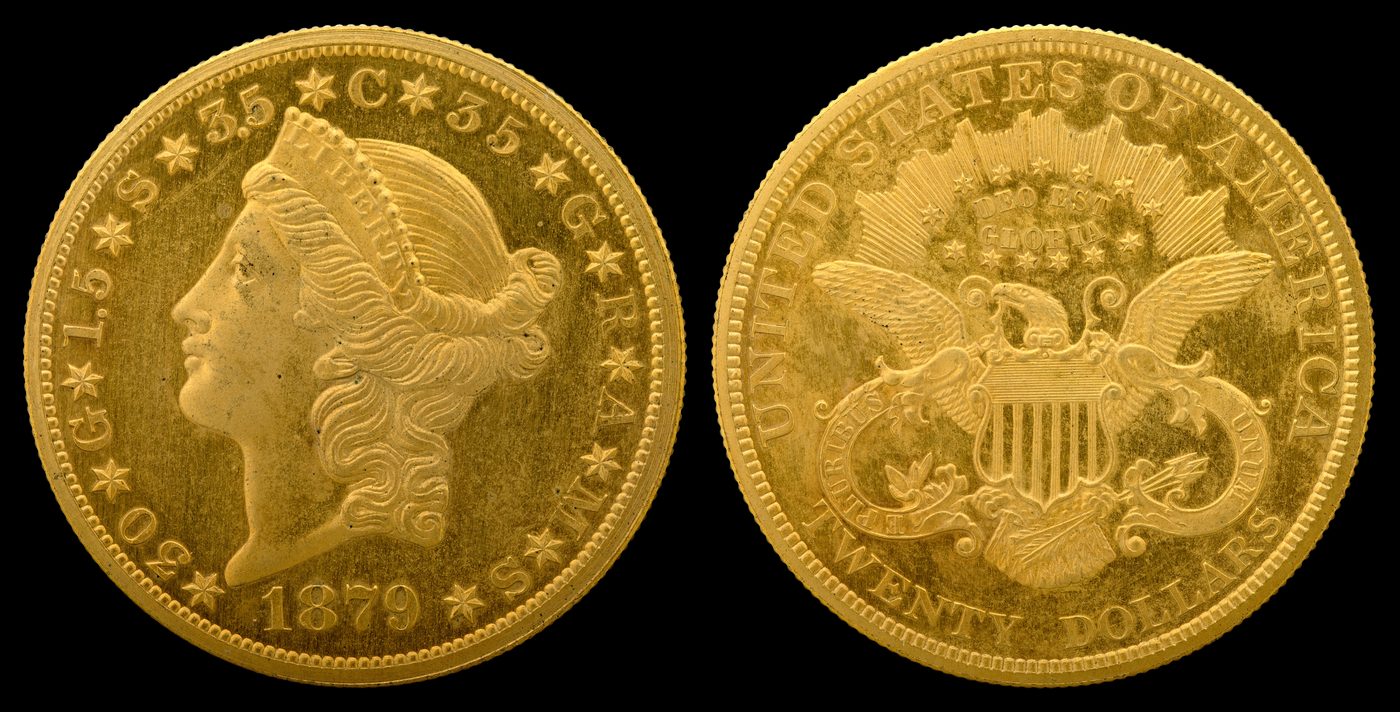
For almost a century, the U.S. Mint kept a private rehearsal hall. In it, engravers struck coins that were never meant for your pocket: a $4 gold piece, a dollar made of three metals at once, a cent with a silver plug in its center. Most were rejected. A handful are now among the most coveted objects in American numismatics.
The world then
A pattern is a coin the Mint strikes to try out an idea before committing to it — a new design, a new metal, a new denomination. It is a proposal you can hold in your hand. Most patterns were rejected, melted, or quietly filed away. That is exactly why the survivors are so rare.
The young United States needed a lot of those proposals. The country went from a wartime patchwork of foreign silver and colonial paper to a national coinage almost from scratch, and the rules kept changing underneath it. Gold and silver kept slipping out of the country whenever world metal prices shifted. The Coinage Act of 1792 set the system up; the Coinage Act of 1857 tore part of it down and shrank the cent. Between and around those acts, the Mint was constantly asking the same question: what should our money actually be?
So Philadelphia became a laboratory. Engravers tested whether Liberty should sit or stand, whether a cent should be big copper or small alloy, whether a single coin could spend on both sides of the Atlantic. The experiments that worked became the coins your great-great-grandparents carried — and now live in their own eras on this site. The ones that failed, the road never taken, are the subject of this page.
The money
The experiments started on day one. In 1792, before the Mint even had a finished building, it struck the silver center cent — a copper coin with a tiny silver plug pressed into the middle. The idea was clever: a cent should be worth a cent in metal, but a pure-copper cent that size would be huge and clumsy. Add a sliver of silver and you could shrink it. The plug was a manufacturing headache, and the design never went into production. A handful survive, and they are spectacular rarities.
Then came the great trial dollars. Silver dollar production had stopped back in 1806. When the Mint wanted to bring the denomination back in the 1830s, it didn't just flip a switch — it tested. The Gobrecht dollar, struck 1836–1839 and engraver Christian Gobrecht's signature work, put a seated Liberty on the obverse (the "heads" side) and a soaring eagle on the reverse. The designs came from Philadelphia artists Thomas Sully and Titian Peale. Roughly 1,900 were officially struck across the run. Some circulated; all were made to a proof finish — the mirror-bright, specially-struck quality usually reserved for showpieces. Gobrecht even signed the obverse "C. GOBRECHT F." ("F." for the Latin fecit, "made it"). The public grumbled the signature was too proud, and the Mint director had him shrink and move it. The seated Liberty he created went on to dominate American silver for the next fifty years.
The boldest experiments came late, when reformers dreamed of money that crossed borders. The gold Stella of 1879–1880 — named for the big five-pointed star on its back — was a proposed $4 coin meant to slot neatly between Europe's gold values, so an American traveler could spend it in Paris or Berlin. Two designs were cut: a Flowing Hair Liberty by Charles E. Barber and a Coiled Hair Liberty by George T. Morgan, the two engravers who would define the Mint's late-century look. Congress never authorized it. Alongside the Stella ran the goloid metric dollars, struck 1878–1880 in a patented three-metal alloy of gold, silver, and copper. The fatal flaw was simple and damning: goloid looked exactly like ordinary 90% silver. You couldn't tell them apart without a chemistry lab — an open invitation to counterfeiters — so the idea died.
The coins of this era
Pull these coins together and a single thread runs through all of them: the United States teaching itself, one trial strike at a time, what its money should be. They fall into three acts — and, at the very end, a strange coda.
Act one — inventing a coinage from nothing. In 1792, the Mint had no real building yet. Its first pieces were struck in a Philadelphia cellar, and Mint records place Washington, Jefferson, and the new Mint's own officers near those first trials. The Birch cent and the 1792 silver center cent tested how to make a one-cent coin honest — worth its face in metal — without making it the size of a saucer. The disme and copper disme of 1792 tried out the new ten-cent denomination and locked in the decimal idea that freed American money from the old British pounds-and-shillings tangle; the half disme is so close to a real coin that experts still argue whether it was a pattern or the first true U.S. issue. There was even a 1792 quarter dollar pattern — Joseph Wright's striking "eagle on globe," a powerful bird gripping the earth, a design unlike anything else that year. From these trials grew the workhorse liberty cap cent and the first draped bust dollar. (Reach back one step further and you find the Fugio cent of 1787, the Confederation's first federal coin, its design tied to Benjamin Franklin and its dies cut by Abel Buell — the experiment before the Mint even existed.)
Act two — the denominations that argued for themselves. Through the middle decades the Mint kept proposing coins that never quite made it, or made it only after years of trials. The 1836 two-cent billon pattern floated a small two-cent piece in a copper-silver alloy nearly three decades before the real two-cent piece arrived in 1864 — the bill that would have authorized it was gutted before passage. The flying eagle cent began life as an 1856 pattern struck to win over Congress and the public before the big copper cent was finally retired in 1857 — the rare case where the experiment graduated straight into your pocket. When California gold flooded east after 1849, the country needed a big coin to absorb it; the Liberty Head double eagle ($20) grew from that glut, and its very first 1849 strike survives as a unique prototype, the trial the whole long series descended from. The Civil War five-cent piece had its own dead end: the Shield nickel "with rays," struck 1866–1867, was quietly abandoned when the hard new copper-nickel alloy chewed up the dies, so the rays were dropped — a design killed not by a committee but by the metal itself. After the war the reformers got systematic: the 1871 standard silver pattern dollar, part of a complete proposed set from the half dime up, carried Longacre's Indian-princess Liberty under the word STANDARD. The 1874 twenty-cent pattern tested an awkward new denomination — Joseph A. Bailly drew a seated Liberty so close to the existing quarter that the Mint rejected it before the coin even reached production. Christian Gobrecht's seated Liberty, meanwhile, did spread across the silver that did circulate — the seated liberty half dime and seated liberty quarter among them — turning one tested dollar design into half a century of pocket change.
Act three — the dream of money without borders. The most romantic experiments came last, and almost all of them failed. The coin shortage of the Civil War even pushed the government to try paper "coins" — the postage currency issues, small notes meant to stand in for vanished silver, championed by Treasurer Francis E. Spinner. Then came the great international gambit. The trade dollar (1873), designed by William Barber with extra silver to out-weigh the Mexican peso, was built to buy tea and silk in China — the one "international money" experiment that actually shipped, though it caused havoc at home. The rest stayed in the rehearsal hall: the four-dollar Stella and its larger cousin the quintuple stella ($20) — also catalogued as the metric double eagle — plus the goloid metric dollar, all chasing a coin Europeans and Americans could spend interchangeably. There were even half dollar patterns the Mint tried and dropped along the way. The grandest of all was the half union — a fifty-dollar gold pattern of 1877, William Barber's Liberty enlarged from Longacre's double eagle, of which only two gold pieces survive, both in the Smithsonian. And the liberty head cent pattern of 1881 was a late-hour Charles Barber proposal for a new small cent that simply lost.
The coda — the in-between coins. A few pieces in this set aren't quite patterns and aren't quite regular coins, and that ambiguity is exactly what makes them irresistible. The 1804 draped bust dollar, the "King of American Coins," wasn't struck in 1804 at all — it was made decades later as diplomatic gifts and back-door restrikes. Its gold cousin, the 1804 plain-4 eagle ($10), was likewise produced in the 1830s. The 1818 cent restrike mule is a Mint fantasy: a rusted 1818 quarter die paired with a large-cent die and struck, years later, over a Seated quarter from around 1860 — a coin assembled from spare parts during the era when, as one writer put it, "the Mint would make anything for anybody." And the story didn't even end in 1885. The Mint still pulls the same trick today: the Martha Washington test cent and Martha Washington five-cent test piece carry a fictitious portrait and a fake "1759" date precisely so they can never be confused with real money, struck in the modern era to test new presses and alloys — Edward R. Grove and Philip Fowler's quiet stand-in for the real designs. Even the 1971 Eisenhower dollar trial strike belongs here: Frank Gasparro's working prototype for a coin that did circulate, of which only a few are known. The rehearsal hall, it turns out, never closed.
That blur is the point. Every coin here was a question the country asked itself in metal. The answers it kept are the money we recognize. The answers it threw away — and the test pieces it never meant you to see — are the rarest American coins of all.
Timeline
- 1787The Fugio cent — the Confederation's first federal coin, its design tied to Benjamin Franklin — is struck before the Mint even exists.
- 1792The Mint experiments from the start — the silver center cent and Birch cent try an honest one-cent coin; the disme, half disme, and Joseph Wright's eagle-on-globe quarter test the new silver denominations.
- 1836The Gobrecht dollar revives the silver dollar after a 30-year gap; the same year, a two-cent billon pattern floats a small two-cent coin nearly 30 years early.
- 1856The Flying Eagle cent is struck as a pattern to win over Congress and the public before the large copper cent is retired.
- 1871The Standard Silver pattern set — half dime to dollar — proposes a reformed silver coinage under the word STANDARD.
- 1873The Trade dollar — heavier than the Mexican peso — ships to China, the one international-money experiment that actually reaches commerce.
- 1874A twenty-cent pattern by Joseph A. Bailly is rejected for looking too much like the quarter, just before the real (and short-lived) coin appears.
- 1877The half union, a $50 gold pattern, is struck; only two gold pieces survive, both now in the Smithsonian.
- 1878Goloid metric dollars test a gold-silver-copper alloy; it looks identical to ordinary silver and is rejected.
- 1879The $4 gold Stella and its $20 cousin, the quintuple stella, are struck — coins designed to spend across Europe. Congress never authorizes them.
- 1881Charles Barber's Liberty Head cent pattern proposes a new small cent — and loses.
- 1885Roughly the close of the era's clandestine pattern-and-restrike trade out of the Philadelphia Mint.
- 1971Frank Gasparro's working prototype Eisenhower dollar shows the rehearsal hall never truly closed.
Key facts
- Region
- United States (Philadelphia Mint)
- Span
- 1792–1885 (with modern test pieces continuing the tradition)
- What a pattern is
- A trial coin struck to test a design, metal, or denomination — most never adopted
- Signature coins
- Gobrecht dollar (1836–1839), $4 gold Stella (1879–1880), goloid metric dollar (1878–1880), 1856 Flying Eagle cent
- Experiments that became money
- Small cent (1857, from the Flying Eagle pattern); the two-cent piece arrived in 1864, decades after its 1836 trial
- Strange in-betweens
- 1804 dollar & 1804 eagle (struck later), the 1818 restrike mule, Martha Washington test pieces, the 1971 Eisenhower prototype
- Key designers
- James B. Longacre, Christian Gobrecht, William Barber, Charles E. Barber, George T. Morgan
- Catalog system
- Judd numbers (after numismatist J. Hewitt Judd)
Why it fascinates collectors
Patterns are history's road not taken. Every one is a decision the country almost made and then didn't — a $4 coin, a metric dollar, a cent with a silver heart, a twenty-cent piece nobody could tell from a quarter. Holding one is holding a parallel United States that never quite happened. And because they were trials, they were made in tiny numbers. The 1879 Coiled Hair Stella is thought to have started with about 20 pieces struck, of which perhaps 14 or 15 survive today; the 1880 Coiled Hair is rarer still. Numbers like that put a single coin in a room with a few collectors, forever.
There's a darker thread that makes the chase even more irresistible. Through roughly the 1860s to the mid-1880s, Mint insiders quietly struck extra patterns and restrikes and fed them to favored dealers and collectors. Coin historians have documented the trade — names like William Idler and J. W. Haseltine recur — and it means the line between "official rarity" and "back-door rarity" can be genuinely blurry. The 1818 restrike mule is the era's purest example: a coin built from mismatched spare dies and struck over an existing quarter, years after both dies were retired. That ambiguity is half the fun: collectors and cataloguers still argue over which pieces were sanctioned, which were restruck years later, and which are something else entirely. Buy a pattern and you buy into the detective story.
The Stella carries the era's most famous legend. Collectors love to tell that congressmen pocketed the gold $4 coins and spent them at the parlors of Washington madams, who mounted them in jewelry — which is why some show wear and solder marks. It's a great story. It is also unverified, and the numismatic writers who repeat it usually do so with a raised eyebrow. Enjoy the tale; don't mistake it for the ledger.
Questions collectors ask
What exactly is a pattern coin?
A pattern is a trial coin the Mint strikes to test a proposed design, metal, or denomination before deciding whether to make it for real. Most patterns were rejected and never circulated, which is why surviving examples tend to be rare. Collectors catalog them by 'Judd numbers,' a reference system named for the numismatist J. Hewitt Judd.
Why is the $4 Stella so famous and valuable?
The Stella was an experimental gold coin of 1879–1880 designed to spend across Europe, where it could be exchanged easily for French, German, and other gold coins. Congress never authorized it, so it was struck only in tiny pattern quantities — and demand from officials drove the Mint to make a few hundred more. The combination of a beautiful design, a romantic 'international money' idea, and very low survival makes it one of the most coveted U.S. coins.
Was the Gobrecht dollar a real coin or just a pattern?
Both, in a sense. The Gobrecht dollar (1836–1839) was struck to revive the silver dollar after a 30-year pause and to test Christian Gobrecht's seated Liberty design. Some pieces were intended for circulation, but only about 1,900 were officially struck and all were made with a proof (mirror-finish) quality. It sits right on the line between a pattern and a regular issue — and its design went on to define U.S. silver for half a century.
What was a goloid coin and why didn't it work?
Goloid was a patented alloy of gold, silver, and copper used in experimental 'metric' dollars from 1878 to 1880. The idea was a more honest, internationally friendly money. The fatal problem was that goloid looked identical to ordinary 90% silver — you couldn't tell them apart without chemical analysis — which would have made counterfeiting easy. The Mint rejected it.
Did any of these experiments actually become real coins?
Yes — a few. The small Flying Eagle cent began as a pattern in 1856 and became official money in 1857. The two-cent piece was floated as a billon pattern in 1836 and finally arrived in 1864. But most patterns here never circulated at all — the Stella, the goloid dollar, the half union, the 1874 twenty-cent design and the 1881 Liberty Head cent were all proposals the country considered and turned down. A pattern was a question; only some of the answers became coins your great-great-grandparents carried.
What are the Martha Washington test pieces, and why a fake 1759 date?
They're modern test coins. The Mint needs to trial new presses, alloys, and planchets without producing anything that could be mistaken for spendable money, so it strikes pieces with a deliberately fictitious Martha Washington portrait and an impossible '1759' date. Designed by Mint engravers Edward R. Grove and Philip Fowler, they're the same idea as the 1792 silver center cent — the rehearsal hall, still in use today.
Were these coins struck legally?
The original patterns were authorized trials. But coin historians have documented that, from roughly the 1860s into the mid-1880s, Mint insiders also struck extra patterns and restrikes off the books and sold them privately to favored collectors. As a result, the provenance of some pieces — including the famous 1804 dollar and the 1818 restrike mule — is genuinely debated to this day.
Sources
- Gobrecht dollar — Wikipedia
- Christian Gobrecht: Part Two – His Work — PCGS
- Stella Four-Dollar Goloid Coin, 1879–1880 — CoinWeek
- 1879 $4 Flowing Hair $4 Stella — PCGS CoinFacts
- 1879 $4 Coiled Hair $4 Stella — PCGS CoinFacts
- Goloid — Wikipedia
- Silver Center Pattern Cents of 1792 — U.S. Mint
- The United States Pattern Coinage of 1792 — PCGS
- 1792 Birch Cent: America's First Cent Pattern — CoinWeek
- 1792 half disme — Wikipedia
- Million Dollar Coins, Part 1: 1792 Patterns (disme & eagle-on-globe quarter) — CoinWeek
- Fugio cent — Wikipedia
- Adam Eckfeldt — Wikipedia
- The Transition from Large Cent to Small Cent: The 1856 Flying Eagle — Blanchard and Company
- Flying Eagle Cent, 1856–1858 — CoinWeek
- Two-cent billon — Wikipedia
- U.S. Coin Patterns for Less than $5,000 Each, Pt. 2: Two Cent Pieces — CoinWeek
- Two-cent piece (United States) — Wikipedia
- 1871 $1 Standard Silver Dollar, Judd-1120 — Heritage Auctions
- Twenty-cent piece (United States coin) — Wikipedia
- Trade dollar (United States coin) — Wikipedia
- Trade Dollar, 1873–1885: America's Ambitious Silver Experiment — CoinWeek
- Half union — Wikipedia
- The King of Coins: The Story of the 1804 Silver Dollar — PCGS
- 1818 piece fantasy strike, not mule — Numismatic News
- 1 Cent (Private Restrike Mule) — Numista
- The Martha Washington Experimental Coin Trials — PCGS
- Martha Washington and Experimental Coin Trials — CoinWeek
- Two Unique Prototype Eisenhower Dollars Certified By PCGS
- How Postage Became Uniquely Collectible Currency During the Civil War — Antique Trader
- Shady stories for U.S. coins add mystery to their background — Coin World