US coin · series

The 1804 Dollar — the King of American Coins

A coin dated 1804 that nobody made in 1804, struck to charm two kings, and faked by the Mint that made it.

The 1804 Dollar — the King of American Coins
Source image credited to Stack's (http://www.stacks.com/) via coinfacts.com; coin design is U.S. Mint / U.S. government, public domain · public domain · source

The most famous silver dollar in America was never spent, never circulated, and was not even made in the year stamped on its face. Fewer than two dozen exist. One sold for $7.68 million. This is how a diplomatic gift became a legend.

The coin that lied about its own birthday

Here is the strangest fact about the most famous coin in America: no 1804 silver dollar was made in 1804.

The U.S. Mint did strike silver dollars in 1804 — but every one of them was stamped 1803. The Mint used up old dies that year. Then, in 1806, the government stopped making silver dollars entirely. The denomination went dark for thirty years. So where did the 1804 dollar come from?

It came from a state dinner that never happened. In the early 1830s, President Andrew Jackson sent a diplomat named Edmund Roberts to Asia to open trade routes. Roberts needed gifts worthy of royalty — and a complete set of U.S. coins, gleaming in a velvet-lined case, was exactly the kind of thing one sovereign gave another. Jackson ordered that "a complete set of the coins of the United States" be prepared for the King of Siam (modern Thailand) and for Said bin Sultan, the Sultan of Muscat and Oman.

There was a problem. A complete set needed a silver dollar, and the Mint hadn't made one in decades. So in 1834 the Mint cut fresh dies — and rather than date them 1834 with a long-dead design, it reached back to the last "official" year a dollar should have existed: 1804. The coins were backdated to look like history. Roberts handed sets to the Sultan of Muscat in 1835 and to Siam in 1836. The 1804 dollar was born — three decades after its own date.

That alone would make a good story. The rest of it made a legend.

What it shows, and the three men who made it

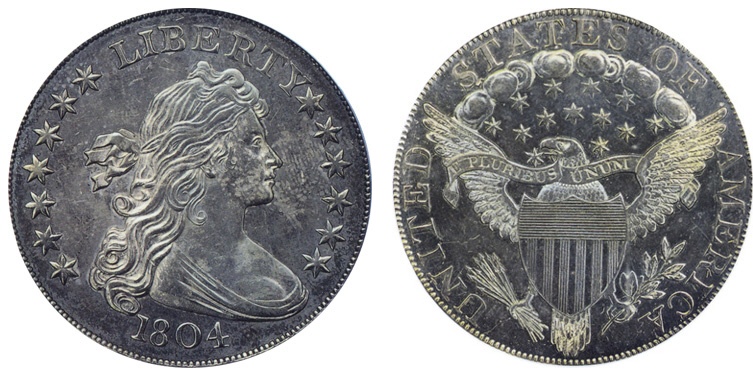
The 1804 dollar wears one of the most admired American designs of its age — the Draped Bust, which had run on the silver dollar from 1795 to 1803.

The obverse — the heads side — shows Liberty as a graceful woman, hair tied back in a ribbon, the word LIBERTY arching above her and stars around the rim. That portrait passed through three hands. The painter Gilbert Stuart — the same artist whose Washington portrait is on the dollar bill — drew Liberty (tradition holds the model was the Philadelphia socialite Ann Willing Bingham, though that link is traditional, not documented). The sculptor John Eckstein of Providence turned Stuart's drawing into a plaster model. And Robert Scot, the Mint's first Chief Engraver, cut the working dies by hand.

The reverse — the tails side — is Scot's. He engraved a heraldic eagle modeled on the Great Seal of the United States: wings spread, a shield on its breast, an olive branch in one talon for peace and a bundle of arrows in the other for war. The edge of the coin is lettered — pressed with the words HUNDRED CENTS ONE DOLLAR OR UNIT before striking.

One small detail betrays the whole forgery-of-time. Look at the 4 in the date. The dollars carry a plain 4 — a numeral style the Mint used when it cut these dies in the 1830s and later, not the crosslet 4 (a 4 with a tiny bar across its top) that a die-cutter would have used back in 1804. The date numeral is a fingerprint, and it points straight at the 1830s. That plain-4 style is why the coin is catalogued the way it is.

Key facts

Date on the coin
1804 (actually struck 1834 and later)
Design
Draped Bust Liberty (obverse) / Heraldic Eagle (reverse)
Obverse art
Gilbert Stuart (drawing), John Eckstein (model), Robert Scot (dies)
Reverse engraver
Robert Scot — eagle after the Great Seal
Composition
89.24% silver, 10.76% copper (the era's .8924 fineness)
Weight / diameter
~26.96 g (about 416 grains) / ~39–40 mm
Edge
Lettered: HUNDRED CENTS ONE DOLLAR OR UNIT (Class I & III); plain edge (Class II)
Date numeral
Plain 4 (the later die style)
Total known
15 specimens across all three classes
Nickname
The King of American Coins

Why collectors call it the King

Most rare coins are rare by accident — a low mintage, a melted hoard, a die that broke early. The 1804 dollar is rare on purpose, and it comes in three flavors that tell three different stories.

Class I — the "originals." These are the eight coins struck around 1834 for the diplomatic sets. They are proofs (mirror-finish presentation strikes) with lettered edges. Among them sit the most storied coins in the country: the King of Siam set's dollar, the Sultan of Muscat specimen, and pieces named for the collectors who owned them — Dexter, Mickley, Stickney.

Class II — the unique one. A single coin, struck around 1858, on a plain edge — and struck over the top of an 1857 Swiss shooting thaler, which is how we date it. It lives in the Smithsonian and will never come to market.

Class III — the "restrikes." Six coins (a seventh surfaced only in 2025) that Mint insiders made secretly in the late 1850s to sell to collectors who would pay almost anything for the 1804 they'd read about. When the scandal broke around 1859 — the Mint had been quietly manufacturing rarities — it became one of the great embarrassments in U.S. coinage history.

So why does the King still rule? Two reasons. First, the supply is fixed forever — fifteen coins, full stop, with the most famous locked in museums. Second, the legend compounds. The name "King of American Coins" dates to an 1885 auction, and the prices have only climbed since: the Sultan of Muscat / Childs specimen (a Class I) sold for $7.68 million in August 2021; a newly rediscovered Class III brought a record $6 million in December 2025. When a coin trades that rarely and that high, every appearance is an event — and that scarcity of moments, not just metal, is what makes it the most chased coin in America.

Questions collectors ask

Was the 1804 silver dollar actually made in 1804?

No. The Mint did strike silver dollars in 1804, but it dated them 1803 using leftover dies. The coins we call '1804 dollars' were made starting in 1834 — backdated to 1804 for diplomatic gift sets — with more struck secretly in the late 1850s. The date on the coin is older than the coin itself.

How many 1804 dollars exist?

Fifteen, across three classes: eight Class I 'originals' (struck c. 1834), one unique Class II (struck c. 1858 on a plain edge), and six Class III 'restrikes' — with a long-rumored seventh Class III rediscovered in 2025. Several are held permanently by museums, including the Smithsonian.

Why is it called the King of American Coins?

The nickname dates to an 1885 auction and stuck because no other U.S. coin combines this much fame, scarcity, and price. Top examples have sold for $6 million and $7.68 million, and many of the finest are off the market for good.

What does 'Plain 4' mean on the 1804 dollar?

It describes the style of the 4 in the date. The 1804 dollars carry a plain 4, the numeral form the Mint used when it cut these dies in the 1830s and later — not the 'crosslet 4' (a 4 with a small crossbar) used on coins genuinely struck in 1804. The numeral style is part of how experts confirm when the dies were made.

Who designed the 1804 dollar?

The Draped Bust design behind it came from painter Gilbert Stuart, was modeled in plaster by sculptor John Eckstein, and was engraved into coinage dies by Robert Scot, the Mint's first Chief Engraver. Scot also engraved the heraldic eagle reverse, based on the Great Seal of the United States.

Sources