US coin · series

The 1792 Silver Center Cent: a coin with a silver heart

America's first Mint had a math problem. Its answer was a copper penny with a plug of silver pressed into the middle.

The 1792 Silver Center Cent: a coin with a silver heart
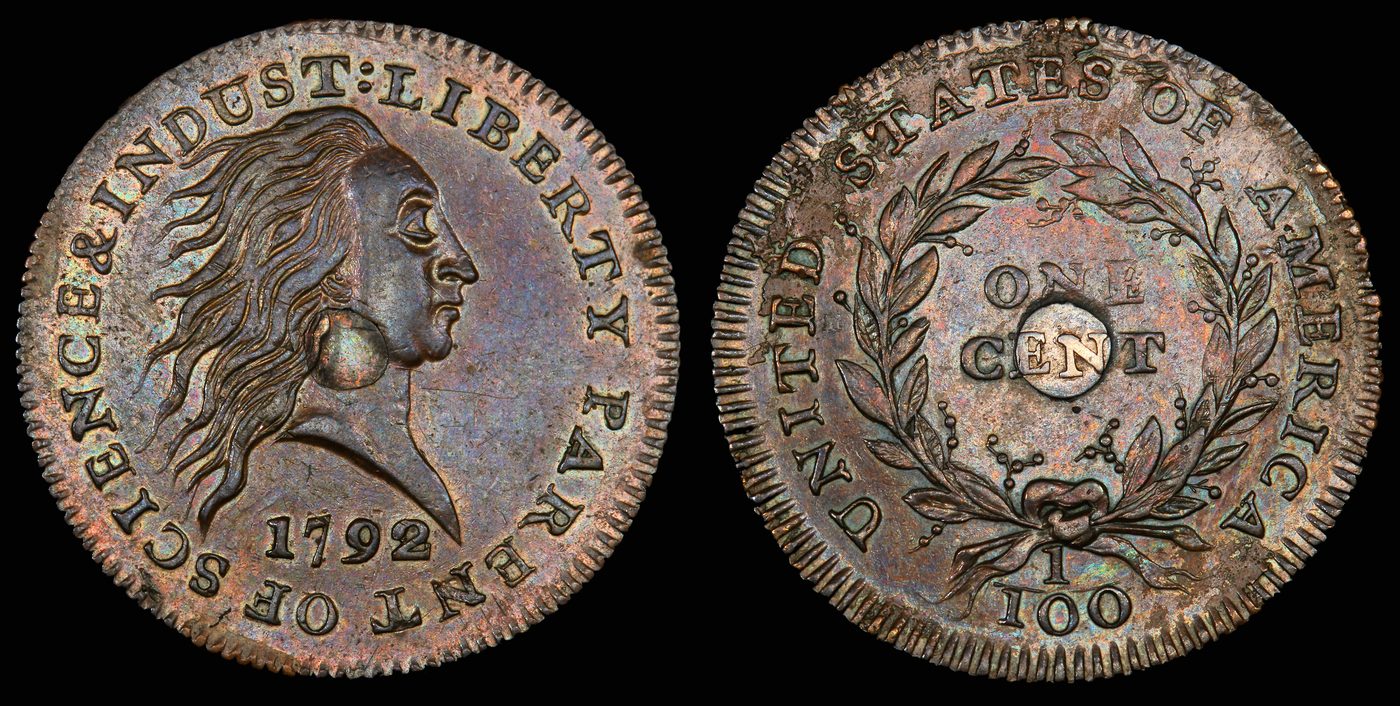
National Numismatic Collection, National Museum of American History (coin engraver Robert Birch). Attribution not legally required (PD) · public domain · source

In December 1792, in a brand-new building in Philadelphia, the United States Mint struck a one-cent coin with a dot of silver embedded in its center. It was a clever fix for a flaw written into the law — and today about a dozen survive, each one worth more than a small house.

The story behind the coin

Congress had a problem it didn't know it had. The Coinage Act of 1792 — the law that created the U.S. Mint and the dollar — said a cent should hold a full cent's worth of copper. On paper that sounds fair. In your hand it was a disaster: a copper coin that honest meant a coin the size and heft of a slab, far too heavy and bulky to carry around.

The Mint's first chief coiner, Henry Voigt, set out to keep the cent both honest and usable. (The "chief coiner" was the man in charge of actually turning metal into money — the head of the machinery, not the artist.) His fix was strange and brilliant. Shrink the copper blank to a sensible size — roughly the size of a modern quarter — then drill a small hole in the middle and press in a tiny plug of silver. The silver, worth about three-quarters of a cent, plus the surrounding copper, worth about a quarter-cent, added up to a full cent of real metal in a coin small enough to spend.

Voigt's own account book records the first of these struck on December 17, 1792. The next day, Secretary of State Thomas Jefferson wrote to President George Washington about the experiment. These were among the very first coins ever made inside the new federal Mint — a working model of an idea, not money for your pocket.

It never went into production. Plugging each blank with silver by hand was slow, fiddly work, and the government soon chose a simpler path. Within a couple of years the cent became a big, all-copper coin — the "large cent" — and Voigt's silver-hearted experiment was set aside. That, more than anything, is why it's so rare: it was a test, made in tiny numbers, that history walked right past.

The design and who made it

The obverse — the heads side — shows Liberty as a young woman facing right, her hair loose and flowing, with the date 1792 below. Around the rim runs a motto that reads like a young nation's mission statement: "LIBERTY PARENT OF SCIENCE & INDUST." — Liberty as the mother of knowledge and work. And there, just below Liberty's ear, sits the little silver plug, brighter than the copper around it: the whole point of the coin, hiding in plain sight.

Flip it over and the reverse is plain and confident: "ONE CENT" spelled out inside a wreath, the fraction "1/100" beneath it, and "UNITED STATES OF AMERICA" circling the edge. On the back, the plug shows up again, tucked below the N in ONE.

Who actually engraved the dies — the hardened steel stamps that pressed the design into metal — is one of those small mysteries the hobby loves. Credit traditionally goes to Voigt, but the engraving is fine enough that some scholars doubt a coiner with little carving experience did it alone; names like the artist Robert Birch have long been floated, and more recent research has even tied the underlying concept of a plugged coin to the writer Thomas Paine. The honest answer is that we don't know for certain. What's not in doubt is the idea, the date, and Voigt's hand on the press.

Key facts

Year struck
1792 (first struck December 17, 1792)
Type
Experimental pattern cent (Judd-1)
Chief coiner
Henry Voigt
Composition
Copper planchet with an inserted silver center plug
Diameter
About 23 mm — roughly the size of a modern quarter
Obverse motto
LIBERTY PARENT OF SCIENCE & INDUST.
Reverse
ONE CENT in a wreath, 1/100, UNITED STATES OF AMERICA
Survivors
About a dozen original examples known
Finest known
PCGS SP67 Brown (Garrett–Simpson specimen)
Auction record
$2,520,000 — Heritage Auctions, January 2021 (SP67 BN, Simpson Collection)

Collecting it: why a dozen coins matter

There is no "date run" to assemble here, no affordable circulated example to slot into an album. There is essentially one coin — the 1792 Silver Center Cent, catalogued as Judd-1 in the standard reference on U.S. pattern coins — and only about a dozen genuine originals are known. One of them lives in the Smithsonian's National Numismatic Collection and will never be sold. That leaves a tiny handful for everyone else, which is why each appearance at auction is an event.

A word on the numbers, because the sources don't perfectly agree. Modern catalogers and grading services generally count about twelve original examples. Two additional pieces exist with silver plugs that were inserted later, not at the Mint — so older references that say "fourteen" are usually folding those altered coins into the total. When you read a survivor count for this coin, it's worth knowing which group is being counted.

Condition is the other axis collectors obsess over. Most survivors are worn or have problems — these are 230-year-old experimental pieces, after all. A genuinely well-preserved one is almost unimaginable. The finest known, the Garrett–Simpson specimen graded SP67 Brown by PCGS (a near-perfect "specimen" or special strike, with the brown color of long-aged copper), sold for $2,520,000 at Heritage Auctions in January 2021 — a record for the type. Even battered examples have crossed seven figures: an MS-63+ brown coin brought $1.41 million in 2014. The lesson is simple. When a coin this historic and this scarce comes up, grade sets the price, but rarity sets the floor — and the floor is very, very high.

Questions collectors ask

Why does the 1792 cent have a silver plug in the middle?

The Coinage Act of 1792 required a cent to contain a full cent's worth of copper, which made an all-copper cent too big and heavy to use. Chief coiner Henry Voigt's fix was to shrink the copper blank and press a small silver plug — worth about three-quarters of a cent — into the center, so the coin held a full cent of metal in a manageable size.

Who designed the 1792 Silver Center Cent?

The experiment is credited to chief coiner Henry Voigt, who first struck examples on December 17, 1792. Who actually engraved the dies is debated — names like Robert Birch have been suggested, and recent research links the concept to Thomas Paine — so the design's authorship isn't settled with certainty.

How many 1792 Silver Center Cents still exist?

About a dozen genuine original examples are known, one of them in the Smithsonian's National Numismatic Collection. Two more pieces exist with plugs added later rather than at the Mint, which is why some older sources cite a count of fourteen.

How much is a 1792 Silver Center Cent worth?

Every genuine example is a major rarity. The finest known, an SP67 Brown specimen, sold for $2,520,000 at auction in January 2021, and even circulated examples have brought well over a million dollars. There is no inexpensive way to own this coin.

Did the Silver Center Cent ever circulate as money?

No. It was an experimental pattern — a working model of an idea — made in tiny numbers to test whether a plugged cent was practical. It never went into production; the United States soon adopted the larger all-copper 'large cent' instead.

Sources