Designer

Francis E. Spinner: the man who turned postage stamps into money

A banker's son who couldn't make change for the Union — so he invented a way to.

Francis E. Spinner: the man who turned postage stamps into money
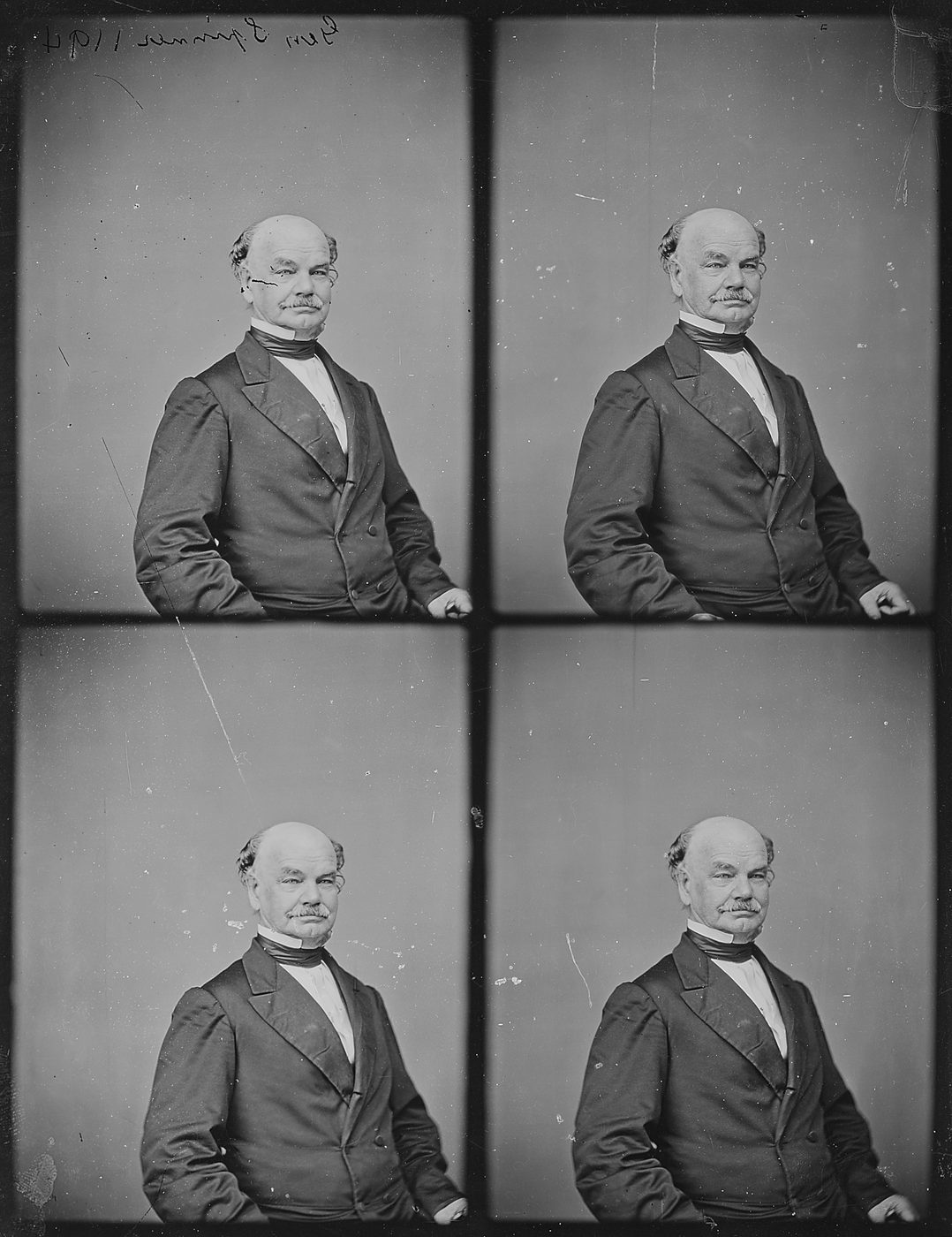
Photograph by Mathew Benjamin Brady; U.S. National Archives and Records Administration (NARA 525351) · public domain · source

In the summer of 1862, with every coin in America vanishing into hiding, the Treasurer of the United States sat at his desk and pasted postage stamps onto a sheet of Treasury paper. That improvised scrap became the country's first "postage currency" — and the idea behind it was Francis Elias Spinner's.

The man who couldn't make change

By the summer of 1862, you could not make change in the United States. The Civil War had people frightened, and frightened people hoard hard money. Gold and silver coins — even humble copper cents — disappeared into mattresses and pockets almost overnight. After New York banks suspended payment in coin late in 1861, small change all but evaporated from daily life. A streetcar fare, a loaf of bread, a glass of beer — everyday transactions ground against a wall, because nobody had the coins to settle them.

Into that mess stepped a man with an unlikely résumé for a financial innovator. Francis Elias Spinner was a saddlemaker's apprentice turned banker turned congressman, and since 1861 he had been Treasurer of the United States. He was not a trained artist. He was not an engraver. But he had a problem to solve, and he reached for the one small, government-backed, universally trusted thing already in everyone's hands: the postage stamp.

Spinner's fix was almost absurdly simple. He took postage stamps — small denominations the public already knew and accepted — and pasted them onto Treasury paper, then added his own signature at the bottom. He passed these improvised slips among the clerks of his department, and the clerks took them. So did the shopkeepers they spent them at. People needed something worth a few cents that they could trust, and a sheet of government stamps over the Treasurer's name fit the bill.

That handmade prototype is the origin of an entire category of American money. On Spinner's recommendation, Congress passed the Act of July 17, 1862, and the first postage currency — paper notes in 5, 10, 25, and 50-cent values — began circulating that August. The country had invented a way to make change out of paper.

The craft: a concept, not a chisel

It's worth being honest about what kind of "designer" Spinner was, because his story is unusual on a site full of sculptors and engravers. He did not carve a die or cut a plate. His contribution was the idea — and the prototype that proved it could work.

The first postage currency notes wore that idea on their faces. They were not abstract banknotes with allegorical figures; they were, quite literally, pictures of postage stamps. The 5-cent note carried a facsimile of the then-current 5-cent stamp bearing Thomas Jefferson. The 10-cent note carried a facsimile of the 10-cent Washington stamp. The larger 25 and 50-cent notes simply showed the same little stamp images repeated across the paper — a quarter or a half-dollar rendered as a row of "stamps." The engraving and printing was done by the National Bank Note Company of New York; the look came straight from Spinner's pasted-up samples.

The notes even tried to behave like stamps. Early sheets were perforated, so a clerk could tear a note free the way you'd tear a stamp from a sheet. But the perforating machines couldn't keep up with demand, so most notes ended up printed on plain sheets and cut apart by hand — which is why surviving first-issue notes are so often crooked and unevenly sized. The mess was a feature of the speed: the country needed change now.

There's one more piece of craft Spinner is genuinely famous for, and it isn't on the postage notes — it's the signature itself. Spinner spent decades perfecting a wildly ornate, near-illegible autograph, and he did it on purpose: a scrawl that elaborate, he reasoned, was nearly impossible to forge. By his own account he began practicing it in the sheriff's office around 1835 and "brought it to its highest perfection" as Treasurer. That signature went onto the nation's Civil War "greenbacks" and fractional notes, and it made Francis Spinner one of the most recognized — if least readable — hands in America.

Career timeline

  1. 1802Born January 21 in German Flatts (now Mohawk), New York, eldest of nine children of a German-born minister.
  2. c. 1820sApprenticed first as a confectioner in Albany, then as a saddle and harness maker; largely self-educated through borrowed libraries.
  3. 1834–1837Serves as Sheriff of Herkimer County; rises to major general in the state militia. Later becomes cashier, then president, of the Mohawk Bank.
  4. 1855–1861Three terms in the U.S. House of Representatives from New York — first as an anti-slavery Democrat, then as a Republican.
  5. 1861Appointed Treasurer of the United States on the recommendation of Treasury Secretary Salmon P. Chase; takes office March 16.
  6. 1862Pastes postage stamps onto Treasury paper to prototype emergency small change. Congress passes the Act of July 17; postage currency begins circulating August 21.
  7. 1861–1875Serves as Treasurer under Lincoln, Andrew Johnson, and Ulysses S. Grant — his ornate signature appearing on Civil War greenbacks and fractional notes.
  8. 1862 onwardHires women as Treasury clerks to replace men gone to war — among the first large-scale federal employment of women.
  9. 1890Dies December 31 in Jacksonville, Florida, aged 88; buried in Mohawk, New York.

Key facts

Born
January 21, 1802 — German Flatts (Mohawk), New York
Died
December 31, 1890 — Jacksonville, Florida
Nationality
American (son of a German immigrant minister)
Role
10th Treasurer of the United States (1861–1875)
Signature work
Postage currency (First Issue, 1862–1863) — the concept and prototype
Also known for
His forgery-proof signature on Civil War paper money; first to employ women in federal clerical jobs

A documented conviction

Spinner cared less about the money than about the people he put to work issuing it. The inscription on his memorial statue quotes him directly:

"The fact that I was instrumental in introducing women to employment in the offices of the government gives me more real satisfaction than all the other deeds of my life."

Questions collectors ask

Did Francis Spinner actually design the postage currency notes?

He designed the idea, not the engraving. Spinner created the prototype by pasting real postage stamps onto Treasury paper, and the first notes copied that look — they're literally facsimiles of postage stamps. The plates and printing were done by the National Bank Note Company of New York. So Spinner is credited as the originator of postage currency, not as its engraver.

Why does postage currency look like postage stamps?

Because that's exactly what it was imitating. With coins hoarded out of circulation in 1862, people already trusted postage stamps as small-value, government-backed tokens. Spinner's prototype used stamps directly, so the first official notes carried facsimiles of the 5-cent Jefferson and 10-cent Washington stamps. Early sheets were even perforated like real stamps.

What is Spinner's famous signature, and why is it so hard to read?

Spinner deliberately cultivated an elaborate, nearly illegible autograph as an anti-counterfeiting measure — he believed a signature that ornate couldn't be faked. By his own account he started perfecting it around 1835 and refined it as Treasurer. It appears on Civil War greenbacks and fractional notes, which is how the public came to know his name.

What's the difference between postage currency and fractional currency?

Postage currency is the first chapter of the story — the 1862–1863 First Issue notes that imitated stamps. The U.S. went on to issue further series of small-denomination paper through 1876; collectors group the whole run as 'fractional currency,' with Spinner's postage currency as Issue One.

Sources