US coin · series

The Eisenhower Dollar Trial Strikes That Weren't Supposed to Exist

The Mint struck them to test its dies, then said it destroyed them. A few survived — and they wear the design Frank Gasparro really wanted.

The Eisenhower Dollar Trial Strikes That Weren't Supposed to Exist
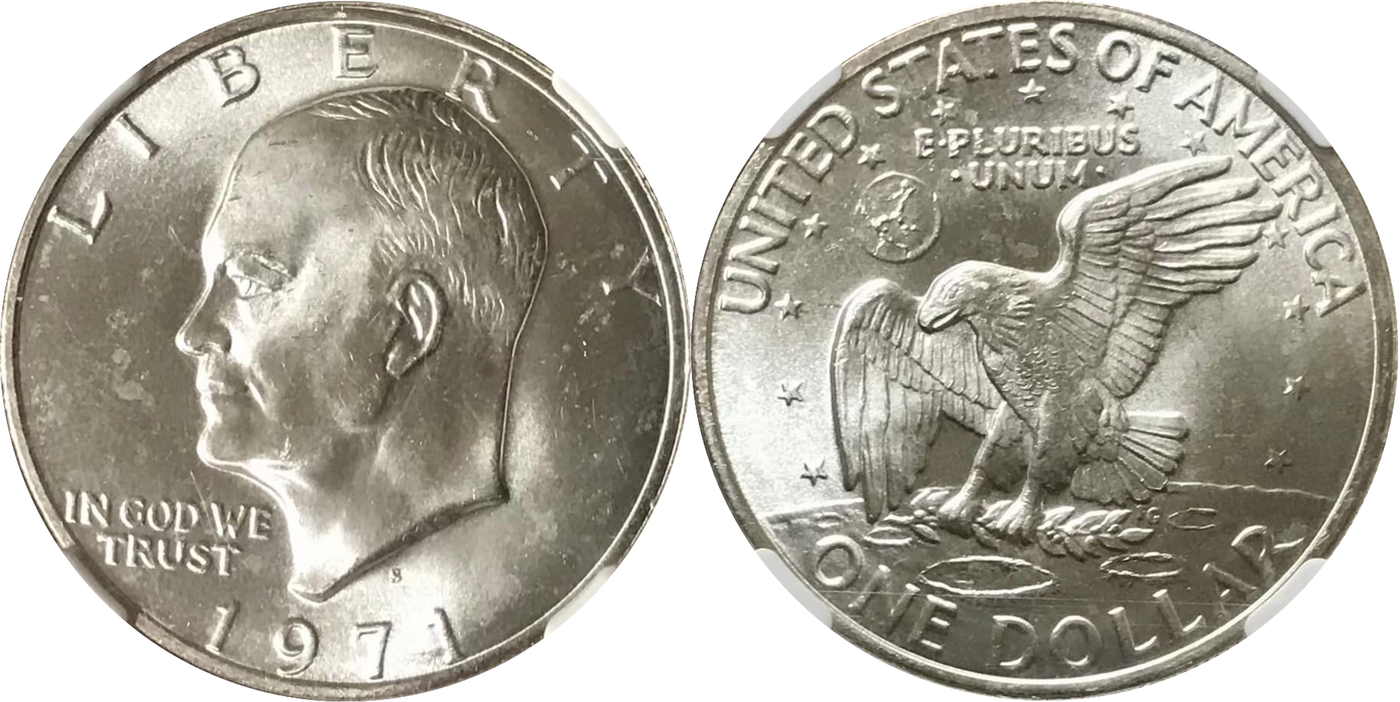
Windrain (own work), via Wikimedia Commons · CC0 · source

On a January morning in 1971, the U.S. Mint pressed a handful of test dollars and announced they would be destroyed. At least three were not. They carry a higher, sharper relief than any coin that ever reached your pocket — the Eisenhower dollar as its designer first imagined it. One of them sold for $264,000.

The coin the Mint promised to destroy

In late 1970, the United States went looking for a new dollar. It had not struck a circulating one since the Peace dollar ended in 1935. When Dwight D. Eisenhower — wartime supreme commander, two-term president — died in March 1969, Congress had its subject. President Richard Nixon signed the coin into law on December 31, 1970, tucked into a bank-holding bill, and the Mint had to move fast.

Before a new coin runs by the millions, the Mint makes trial strikes — test pieces that prove a given pairing of dies (the hardened steel stamps that carry the design), collars (the ring that shapes the rim), and blanks will actually produce a clean coin on a high-speed press. On Monday, January 25, 1971, at 11:00 a.m. in Philadelphia, those first Eisenhower trial strikes were made. Mint Director Mary T. Brooks invited the press to watch. A standing Trial Strike Committee oversaw the work, and the Mint's position was plain: the trial pieces would be destroyed.

Here is the twist. Collectors have since found coins — struck in San Francisco with an "S" mint mark — that match the original, taller version of the design Eisenhower's coin was supposed to wear. Three are known. They are the prototypes the Mint never meant to leave the building. One surfaced in 2008, a second in 2010, a third in 2013.

The design before the press tamed it

The Eisenhower dollar was the work of Frank Gasparro, the Mint's Chief Engraver. The obverse — the heads side — is a stern left-facing portrait of Eisenhower. The reverse is one of the great pieces of mid-century coin art: an eagle clutching an olive branch, coming to rest on the Moon, with Earth small in the field behind it. It is built from the Apollo 11 mission insignia, the patch drawn by astronaut Michael Collins. America had just walked on the Moon; the dollar said so.

Gasparro's first models stood in high relief — the design raised well off the field, with deep, sculptural detail. High relief looks magnificent and strikes terribly: it demands enormous press pressure, wears dies out fast, and won't stack flat. For a coin meant to pour out by the millions, the relief had to come down. So it did, and the production Eisenhower dollar is a flatter, more practical coin.

The surviving prototypes are the high-relief version — Gasparro's design as he first sculpted it. Side by side with a regular 1971-S dollar, the differences are real and checkable. On the prototypes, Florida on the small Earth points almost at the tip of the eagle's beak; on production coins it points toward the eagle's eye. Africa reads more strongly. The Moon's craters are detailed differently, the Moon itself looks unfinished, and there is light doubling on the motto and the date. These are not opinions — they are the fingerprints that let a grading service certify a coin as a true prototype rather than a normal proof.

Key facts

What it is
Trial strike / prototype of the Eisenhower dollar
Trial strikes made
Philadelphia Mint, January 25, 1971
Surviving prototypes
1971-S; three known (found 2008, 2010, 2013)
Designer
Frank Gasparro (Chief Engraver)
Reverse source
Apollo 11 insignia, after astronaut Michael Collins
Distinguishing trait
High relief — Gasparro's original, taller design
Composition
40% silver clad
Diameter
38.1 mm (standard Eisenhower dollar)
Grading designation
PCGS Specimen (SP); cataloged J-2147
Auction record
$264,000 — Heritage, FUN Platinum Night, Jan 14, 2022 (PCGS SP67)

Collecting a coin the records say doesn't exist

This is not a coin you complete a set with. It is one of the rarest objects in the entire Eisenhower series — a population you can count on one hand. With only three known, every appearance is an event. The example graded SP67 by PCGS — the "SP," or Specimen, marks a coin made as a special strike rather than for circulation — brought $264,000 at Heritage Auctions' FUN Platinum Night sale on January 14, 2022, its first time ever offered publicly.

The fascination is twofold. First, scarcity that borders on the impossible: the Mint said these were destroyed, so each survivor is a coin that, on paper, should not be in private hands. Second, the design story they carry. A regular Eisenhower dollar is common — you can hold one for a dollar. These prototypes are the same coin's road not taken, the high-relief version a production press could never sustain. They are how a designer's full ambition looks, frozen before reality filed it down.

A note on naming, because it matters for accuracy. PCGS catalogs the piece under the pattern reference J-2147 (the "Judd" numbering used for U.S. patterns and trial pieces). When the first example came to auction, specialists argued it is better understood as a genuine mint prototype — part of the production-development process — rather than a pattern in the classic sense. The distinction is a live debate among Eisenhower-dollar specialists, not a settled fact, and a serious buyer should read the certification and the cataloger's notes carefully.

Questions collectors ask

Weren't all the Eisenhower trial strikes destroyed?

That was the Mint's stated intent. The official Philadelphia trial strikes of January 25, 1971 were to be destroyed. But three high-relief 1971-S prototypes — struck in San Francisco and matching Frank Gasparro's original design — have since turned up in private hands, discovered in 2008, 2010, and 2013.

How do you tell a prototype from a normal 1971-S dollar?

By the relief and the details. The prototypes are struck in noticeably higher relief. On the small Earth, Florida points toward the tip of the eagle's beak rather than its eye, Africa shows more strongly, the Moon's craters differ, and there is light doubling on the motto and date. These traits let a grading service certify a coin as a genuine prototype.

Why was the design changed for the coins that circulated?

Gasparro's original models were in high relief, which looks superb but strikes poorly at production speed — it wears dies fast and won't stack. The relief was lowered so the dollar could be made by the millions. The prototypes preserve the taller, original version.

How much is one worth?

Far more than a normal Eisenhower dollar, which is common and inexpensive. With only three known, the prototypes are extreme rarities. One graded PCGS SP67 sold for $264,000 at Heritage's FUN Platinum Night sale in January 2022 — its first public appearance.

Is it a 'pattern' or a 'prototype'?

PCGS lists it under the pattern reference J-2147, but specialists have argued it is better described as a true mint prototype from the coin's development, not a pattern in the traditional sense. The point is genuinely debated; rely on the certification and the auction cataloger's notes.

Sources