US coin · series

The 1792 Quarter Dollar Pattern: an eagle on a globe, and a century of arguments

A coin from the first months of the United States Mint — that may not be a quarter, may not be from 1792, and may not be by the man whose name it carries.

The 1792 Quarter Dollar Pattern: an eagle on a globe, and a century of arguments
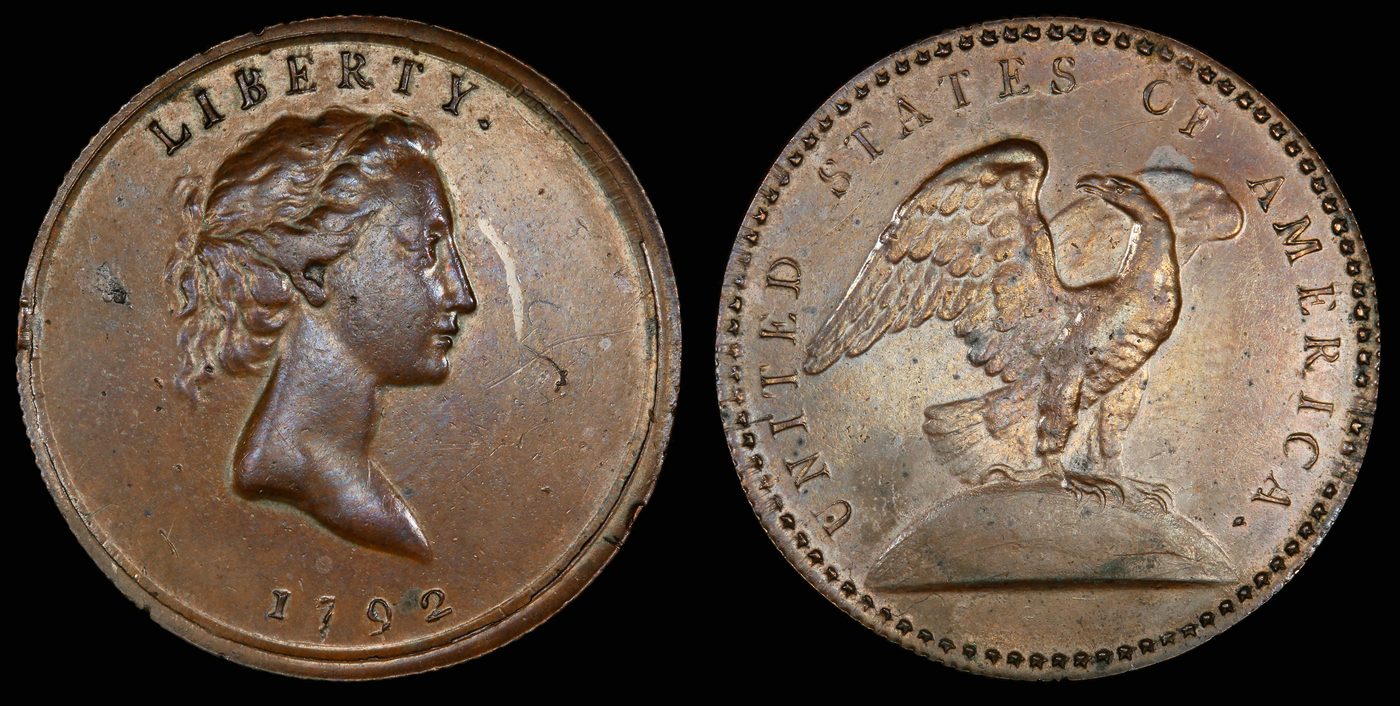
Robert Birch (coin), National Numismatic Collection, National Museum of American History (Smithsonian) · public domain · source

A young eagle stands on a globe, wings half-spread, looking back over its shoulder. It is one of the earliest images the United States Mint ever stamped into metal — and almost everything else about it is disputed. Two copper examples survive. A handful in white metal. One sold for more than a million dollars while experts openly admitted they could not say for certain what it was.

The story behind the coin

On April 2, 1792, George Washington signed the Coinage Act and the United States got the legal right to make its own money. The Act spelled out the denominations — dollar, half dollar, quarter dollar, disme, half disme, and the rest — and ordered a mint built in Philadelphia, the first federal building raised under the new Constitution.

Then came the hard part: actually making coins. Through 1792, the brand-new Mint was less a factory than a workshop full of experiments. Workers tried different metals, different planchet thicknesses, different edges and collars, just to learn how to strike a coin that looked official and held up in a pocket. These trial pieces are called patterns — test coins, never meant for circulation, made to settle a question before the real production begins.

The eagle-on-globe quarter belongs to that first batch of experiments. And it carries a haunting backstory. The design is traditionally tied to Joseph Wright, the talented artist Washington's circle had earmarked as the Mint's first draughtsman and die-sinker. Wright never got to finish the work. He died in 1793 — most accounts say in the yellow-fever epidemic that tore through Philadelphia that summer, which also took his wife, Sarah. He was about 37.

The design — and why nobody can agree on it

The obverse — the heads side — shows the head of Liberty facing right, with "LIBERTY" above and the date "1792" below. The reverse — the tails side — is the memorable one: an eagle with its wings spread, standing on a globe, head turned back, ringed by "UNITED STATES OF AMERICA." It is a striking image, oddly modern, unlike almost anything else in early American coinage.

Here is the honest part. This little coin is one of the most argued-over objects in U.S. numismatics, and a careful page has to say so plainly. Three things are genuinely in doubt:

  • Who cut the dies. The Wright attribution is traditional, not proven. One specialist, Bill Eckberg, has put it bluntly — there is no hard evidence the dies were engraved by Wright. Another, Pete Smith, has summed up the whole subject as having "more questions than answers."
  • When it was struck. "1792" is on the coin, but the contemporary Mint records for that year are, in one cataloguer's phrase, frustratingly incomplete. Some pieces in this family are now thought to be later strikings from the original dies.
  • What it even is. The design carries no mark of value. Because of that, experts have debated whether it was meant as a quarter dollar at all — some have read it as a proposal for a cent, or for a different denomination entirely. The "quarter dollar" name is the convention collectors settled on, not a fact stamped into the metal.

None of that makes the coin less interesting. It makes it more. You are looking at the moment a country was inventing its own money, before the rules — and even the records — were firm.

Key facts

Dated
1792 (U.S. Mint's first year)
Denomination
Quarter dollar by convention — not marked on the coin
Design
Liberty head (obverse) / eagle standing on a globe (reverse)
Traditional designer
Joseph Wright (attribution disputed)
Compositions
Copper (Judd-12) and white metal (Judd-13)
Copper examples known
Two — one in the Smithsonian, one privately held
Catalog references
Judd-12 / Pollock-14 (copper); Judd-13 / Pollock-15 (white metal)
Status
Pattern — never issued for circulation

Collecting it

This is not a coin you complete a date set with. It is a coin that crosses the auction block once in a long while and makes headlines when it does. The whole population is tiny — only two copper pieces are accounted for, plus a small number in white metal — so any sale is a major event.

The numbers tell the story. A copper example, graded Mint State 63 Brown by NGC, sold at a Heritage auction in January 2015 for $2,232,500. A white-metal piece, graded About Uncirculated 58, brought $1.26 million at Heritage in April 2021 — and notably, the firm sold it while openly acknowledging the open questions about its attribution and even its denomination. That is rare honesty in a high-end coin market, and it tells you how the experts actually think about this piece.

A practical note on grades and labels. Brown describes the surface color of an old copper coin that has lost its original mint-red shine — normal and expected for a piece this old. The Judd and Pollock numbers are the standard reference catalog IDs for U.S. patterns; collectors use them to pin down exactly which trial piece they mean, because several closely related variants exist, including single-sided (uniface) trial impressions of just the obverse or just the reverse.

For nearly everyone, this coin is something to understand and admire rather than own. That is reason enough to know its story: it is a direct artifact of the first months of American coinage, when the eagle on the globe was one of the first ideas the country tried — and then quietly set aside.

Questions collectors ask

Is the 1792 quarter dollar pattern actually a quarter?

It is called one by convention, but the coin carries no mark of value. Because of that, specialists have genuinely debated whether it was intended as a quarter dollar, a cent, or something else. The 'quarter dollar' name is the label collectors adopted, not a fact stamped into the metal.

Did Joseph Wright really design it?

The attribution to Wright is traditional and widely repeated, but it is not proven. At least one specialist has stated there is no hard evidence Wright engraved these dies, and the contemporary Mint records for 1792 are incomplete. Treat the Wright connection as the leading tradition, not a settled fact.

How many exist?

Very few. Two copper examples (Judd-12) are accounted for — one in the Smithsonian's National Numismatic Collection, one in private hands — plus a small number of white-metal pieces (Judd-13). This is one of the rarest objects in American numismatics.

How much is it worth?

It trades in the seven-figure range when it appears at all. A copper example sold for $2,232,500 in January 2015, and a white-metal piece brought $1.26 million in April 2021, both at Heritage Auctions.

What does the eagle standing on a globe mean?

It is an early, ambitious emblem of a new nation taking its place in the world. The motif did not carry over into circulating U.S. coinage, which makes this pattern a glimpse of a design idea the Mint tried in its first year and then left behind.

Sources