US coin · series

The Two-Cent Coin America Made — Then Talked Itself Out Of

In 1836 the Mint struck a part-silver two-cent piece, proved it could be faked, and shelved the idea for 28 years.

The Two-Cent Coin America Made — Then Talked Itself Out Of
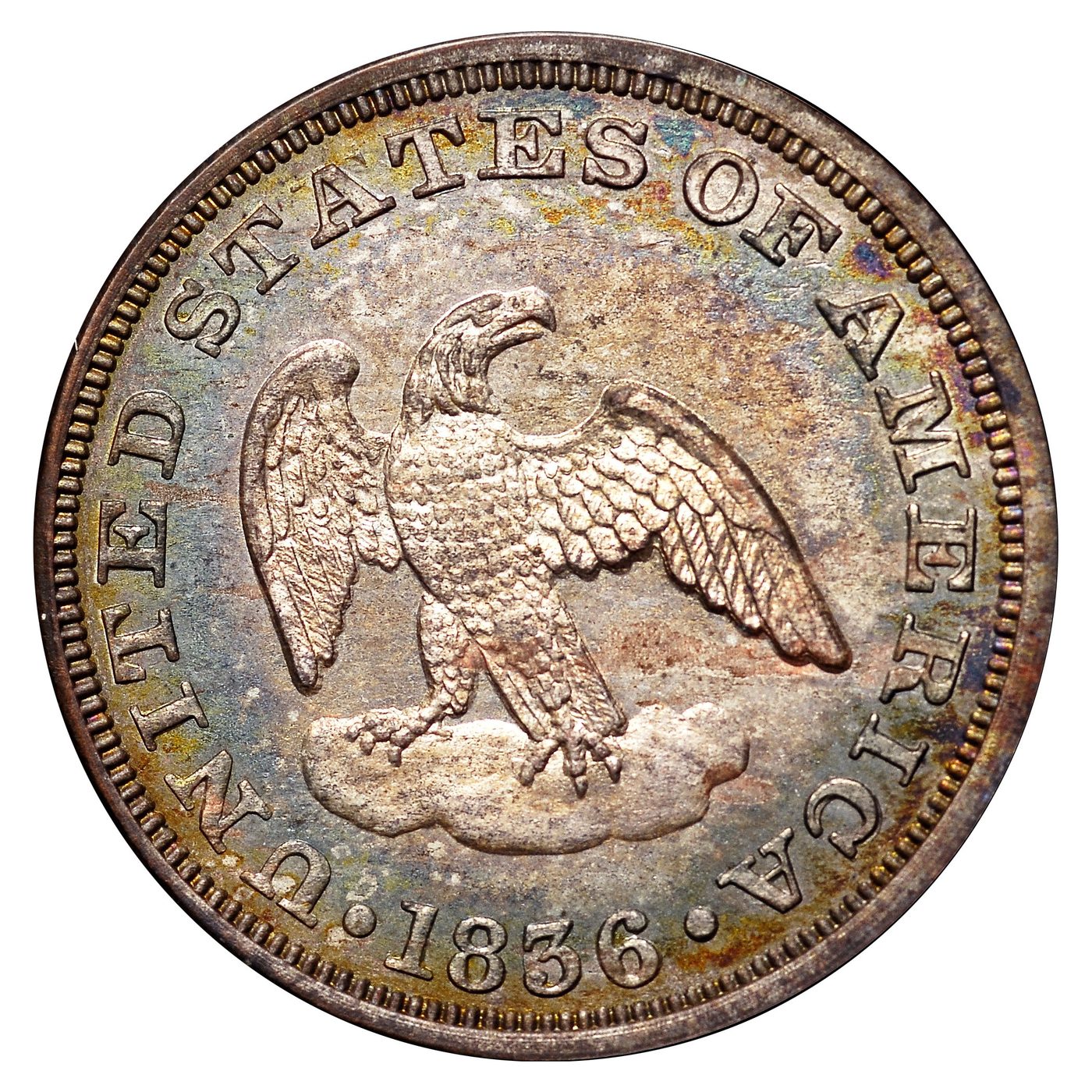
U.S. Mint (pattern coin); Heritage Auctions (image). Credit: Heritage Auctions Lot 3908, 25 April 2013 · public domain · source

In 1836 the U.S. Mint struck a brand-new denomination — a two-cent coin made partly of silver. Then its own people demonstrated how easily it could be counterfeited, and Congress quietly cut it from the bill. The coin you see here was never legal money. It is the evidence of an argument the Mint had with itself.

The story behind the coin

The idea was older than the coin. Back in 1806, a Connecticut senator named Uriah Tracy pushed a bill for two new denominations the country didn't have — a two-cent piece and a "double dime," our twenty cents. His plan was to make the small coins of billon: low-grade silver, mostly copper with a little silver mixed in. The Mint's director, Robert Patterson, didn't like it. Billon was hard to refine back into clean metal once you melted the coins down. Tracy's bill passed the Senate twice and died in the House both times.

For thirty years, nothing. Then in 1835 Treasury Secretary Levi Woodbury dusted the idea off and ordered the Mint to actually make the coins — to strike patterns, trial pieces meant to show lawmakers what a finished coin would look like and what it would be made of. A pattern is a coin the Mint produces to test or sell an idea, not to spend. The director who got that order was Robert M. Patterson — by a quirk of history, the son of the man who had argued against the same coin in 1806.

So in 1836 the Philadelphia Mint struck two-cent patterns in billon. And here the argument came back. To find out whether the alloy could be trusted, engraver Christian Gobrecht and the Mint's melter and refiner, Franklin Peale, ran experiments on it. The conclusion was the coin's undoing: a billon two-cent piece would be easy to counterfeit. A faker could press out a copy in plain copper, with no silver at all, and an ordinary person handling it would never know the difference. The two-cent piece was dropped from the bill before it passed. The denomination would not become real money until 1864 — a different coin entirely, born of a Civil War coin shortage.

The design

Both faces are spare and confident. The obverse — the front, or "heads" side — carries an eagle with its wings spread, standing on a cloud, ringed by UNITED STATES OF AMERICA with the date 1836 below. The reverse — the back — simply reads TWO CENTS inside a laurel wreath. No portrait, no slogan: a coin arguing for itself on craft alone.

The eagle is the link to one of the most admired engravings in American coinage. Christian Gobrecht was the Mint's second engraver, and 1836 was the year he gave the country the soaring "flying eagle" of the Gobrecht silver dollar. The two-cent pattern's eagle belongs to that same moment and the same hand. (Some catalogers note the earlier engraver William Kneass may have had a part in the work as well — the precise division of labor is debated.) What isn't debated is the family resemblance: this little two-cent piece carries a cousin of one of the great American eagles.

The coin is small, struck in billon — an alloy that is mostly copper with a small share of silver, here about 90% copper to 10% silver. To document the experiment, the Mint also struck the design in other metals, including plain copper and copper-nickel, with both plain and reeded (grooved) edges. Those metal-and-edge combinations are how collectors and catalogers tell the varieties apart.

Key facts

Type
Pattern (trial piece) — never circulated
Denomination
2 cents
Date struck
1836 (later restruck for collectors)
Designer
Christian Gobrecht, Mint second engraver
Obverse
Eagle with spread wings on a cloud; UNITED STATES OF AMERICA · 1836
Reverse
TWO CENTS within a laurel wreath
Primary composition
Billon — ~90% copper, ~10% silver
Other metals struck
Copper; copper-nickel
Edge
Plain or reeded, depending on variety
Mint
Philadelphia (no mint mark)
Catalog (billon)
Judd-52 (plain edge), Judd-53 (reeded edge)
Rarity
Scarce — on the order of two dozen known of the main billon variety

Collecting it

This is a pattern, so the rules are different from a circulating coin. There was never a mintage in the millions and never a coin in anyone's pocket. The 1836 two-cent piece is collected as a variety set — the same design across different metals (billon, copper, copper-nickel) and different edges (plain, reeded), each one a separate catalog number under the Judd reference system that organizes U.S. patterns.

There is a wrinkle that shapes the whole market: the question of originals versus restrikes. A restrike is a later impression made from the original dies, often years after the design's own year, frequently to satisfy collector demand. With the 1836 two-cent piece, numismatists have observed that the surviving examples show die cracks — fine fracture lines raised on the coin where the steel die had begun to fail — and the consensus among specialists is that the known pieces are restrikes from the dies rather than first strikes of 1836. Tellingly, the Mint's own cabinet (now in the Smithsonian) has long lacked an example. None of this hurts the coin's standing; it is simply part of the story you are buying.

Survivors are genuinely scarce — roughly two dozen are thought to exist of the principal billon variety — but they are not unobtainable, and pattern collectors prize them precisely because they sit at the crossroads of a famous engraver, a famous eagle, and a denomination that arrived a generation late. Condition and metal drive the price; a sharp, well-preserved billon strike is the centerpiece, with the copper and copper-nickel pieces filling out a specialist's set.

Questions collectors ask

Did the 1836 two-cent piece ever circulate as money?

No. It was a pattern — a trial piece struck to show lawmakers a proposed coin. The two-cent denomination was dropped from the bill before it passed, so no 1836 two-cent piece was ever legal tender. A two-cent coin only became real money in 1864, as a different design.

What does 'billon' mean?

Billon is a low-grade alloy that is mostly copper with a small amount of silver — here roughly 90% copper to 10% silver. The Mint chose it to keep the coin cheap while still putting a little silver in it. That same low silver content is exactly what made the coin easy to fake.

Why was the coin abandoned?

The Mint's own people, engraver Christian Gobrecht and refiner Franklin Peale, showed that a billon two-cent piece would be easy to counterfeit — a forger could strike a copy in plain copper with no silver and few would notice. There were also long-standing worries (going back to 1806) about refining the silver out of melted coins. Congress cut the denomination from the legislation.

Are surviving 1836 two-cent pieces originals or restrikes?

Specialists generally regard the known examples as restrikes — later impressions made from the original dies — rather than coins struck in 1836 itself. The surviving pieces show die cracks consistent with later striking, and the Mint's own cabinet long lacked an example.

Who designed it?

Christian Gobrecht, the Mint's second engraver. The obverse eagle is closely related to the celebrated flying eagle he created for the 1836 Gobrecht silver dollar. Some catalogers note possible involvement by the earlier engraver William Kneass.

Sources