US coin · series

Postage Currency: when America printed money that looked like stamps

The Civil War emptied pockets of coins. The Treasury's answer was paper that wore a postage stamp's face.

Postage Currency: when America printed money that looked like stamps
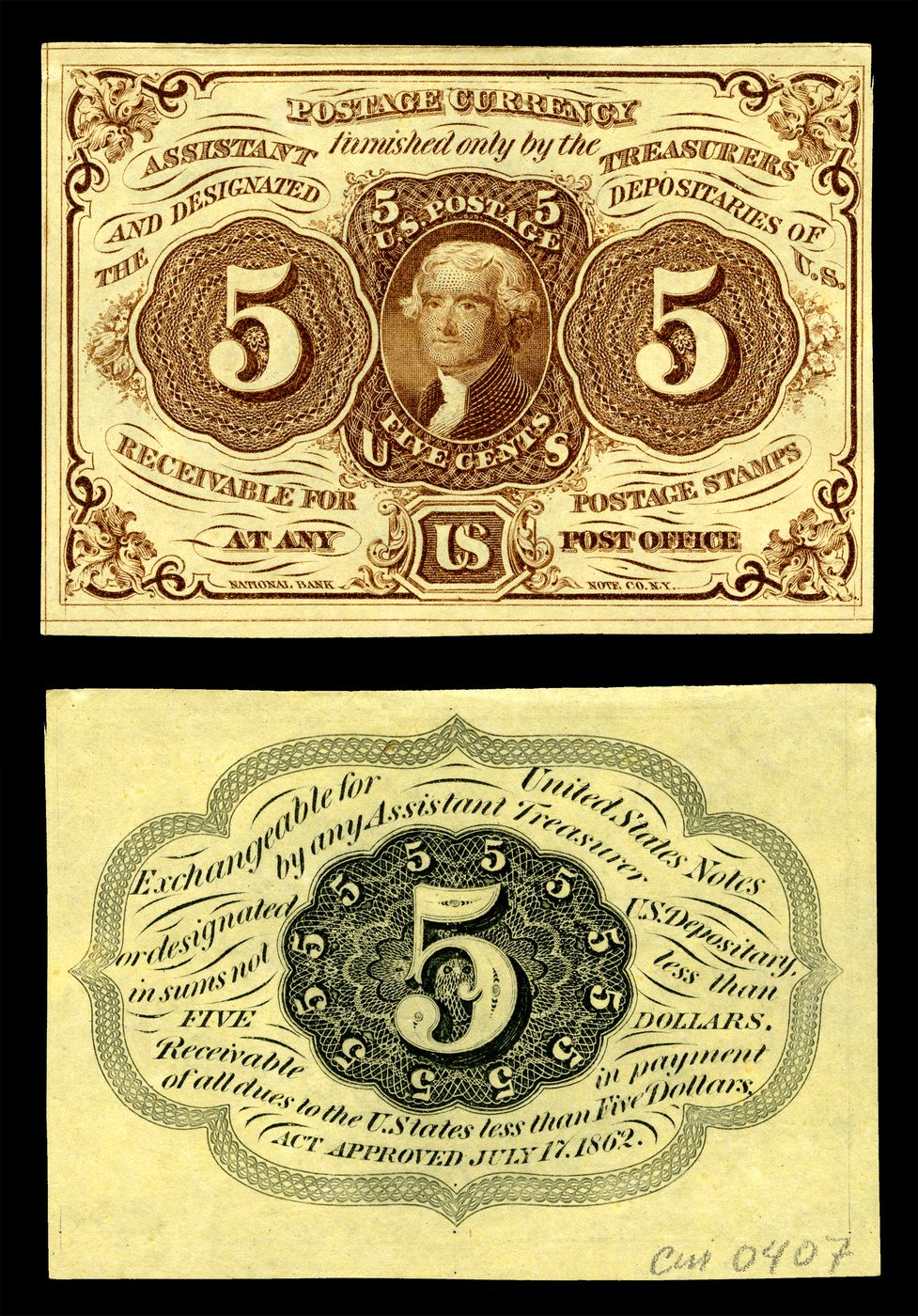
National Museum of American History (Smithsonian); scanned by Wikimedia user Godot13 · public domain · source

In the summer of 1862, the small change of the United States simply vanished. Frightened by war, people hoarded every coin they could find, and pennies, dimes and quarters disappeared from cash drawers across the North. The government's strange, brilliant fix: print money that looked like postage stamps — and call it Postage Currency.

The story behind the coin

In 1862, the United States ran out of change. Not figuratively — literally. As the Civil War turned grim, banks suspended payment in gold and silver, and ordinary people began hoarding hard money. Coins were worth more melted than spent, so they slipped out of circulation and into mattresses and strongboxes. By some estimates, around $25 million in small coin disappeared from the Northern economy. A shopkeeper could not make change for a dollar.

People improvised. They paid each other in privately made tokens, in merchants' paper scrip, and — most tellingly — in postage stamps. A stamp was a tiny, government-backed promise worth a known number of cents, so it began circulating hand to hand as money. The problem was obvious to anyone who tried it: stamps had gummed backs that stuck to everything, they tore, and a wad of them turned to pulp in a sweaty pocket.

Francis Elias Spinner, the Treasurer of the United States, had the idea that solved it. If people wanted to spend stamps, why not print sturdy Treasury paper that simply showed the stamps — official, durable, and worth exactly what it said? On July 17, 1862, President Lincoln signed the act authorizing it. The notes began circulating on August 21, 1862, in denominations of 5, 10, 25 and 50 cents, and everyone called them by the obvious name: Postage Currency.

It worked. These little notes became the everyday small change of a nation at war, the coins-that-weren't-coins that let commerce keep moving while the real silver sat hidden away.

The design and who made it

Postage Currency looks like nothing else in American money because it was never meant to look like money — it was meant to look like stamps. Each note carries the engraved image of a real postage stamp of the day, the very thing people were already spending.

The arithmetic is charming and literal. The 5-cent note shows a single brown five-cent stamp bearing the portrait of Thomas Jefferson. The 10-cent note shows a single green ten-cent stamp with George Washington. To make a quarter, the 25-cent note simply repeats the Jefferson five-cent stamp five times. To make a half-dollar, the 50-cent note lines up five of the Washington ten-cent stamps. You can almost watch someone counting them out.

The concept and the design direction came from Treasurer Francis Elias Spinner, who literally built the first samples by pasting actual stamps onto Treasury paper. The notes themselves were produced by the National Bank Note Company of New York, which printed both faces and backs at first; to tighten security, the government later had the backs printed by the American Bank Note Company, whose small "ABNCo" monogram became a way to tell the printings apart.

One detail gives Postage Currency away at a glance — and explains its rarest pieces. Because the notes were imitating stamps, the earliest sheets were perforated, just like a stamp sheet, so you could tear one off. It was a lovely idea that failed in practice: the perforated notes came apart and got damaged in shipping. The Treasury gave up on the perforations and switched to plain, scissor-cut straight edges. Those perforated survivors are now the prizes of the series.

Key facts

Common name
Postage Currency (First Issue fractional currency)
Authorized
Act of July 17, 1862 (signed by Abraham Lincoln)
In circulation
August 21, 1862 – May 27, 1863
Denominations
5¢, 10¢, 25¢, 50¢
Designs
5¢ & 25¢: Jefferson stamp; 10¢ & 50¢: Washington stamp
Concept & design
Francis E. Spinner, Treasurer of the United States
Printers
National Bank Note Company; backs later by American Bank Note Company
Format
Engraved notes on paper, printed in sheets of 20
Renamed
Became 'Fractional Currency' by the Act of March 3, 1863

Collecting it: varieties and what's scarce

A quick note on the object itself: Postage Currency is paper money, not a struck coin — but like fractional currency generally, it is graded, encapsulated in protective holders, and collected exactly the way classic coins are, which is why it lives here alongside them.

The heart of collecting the First Issue is its four varieties, and they come from that perforation experiment. For each of the four denominations, collectors recognize: a perforated edge without monogram, a perforated edge with the ABNCo monogram, a straight (imperforate) edge without monogram, and a straight edge with monogram. The straight-edge notes are the ones most people find. The perforated notes are the ones most people want — they tore apart so readily in 1862 that intact, fully perforated examples with all their teeth survived in small numbers.

That fragility is the whole reason high grade is hard. These were working money in wartime, handled until they fell apart. A note that survived crisp and uncreased, with margins that never lost a perforation, is a small miracle of preservation — and that scarcity, not the face value, is what drives the price. The most desirable pieces tend to be the perforated varieties in high grade, with full, undamaged perforations and bright, original paper.

For a newcomer, the appeal is rare among American collectibles: you can hold genuine Civil War-era federal money, with a real story stamped right into the design, often for a fraction of what an equivalent-rarity coin would cost. For the specialist, the First Issue is a tidy, finite hunt — four denominations, four varieties each — with a clear summit in the scarce perforated, high-grade pieces.

Questions collectors ask

Why was Postage Currency created?

Civil War hoarding pulled coins out of circulation in 1862 — gold and silver were worth more as metal than as money, so people stopped spending them. With no small change to make a sale, Americans had started paying each other in postage stamps. Postage Currency was the Treasury's durable, official replacement for those makeshift stamp-payments.

Is Postage Currency a coin or paper money?

It is paper money — the first issue of what we now call fractional currency. But it was meant to do a coin's job (it replaced hoarded small change), and today it is graded, encapsulated and collected just like coins, which is why you'll find it cataloged alongside them.

Who designed Postage Currency, and whose faces are on it?

The concept came from Francis E. Spinner, Treasurer of the United States, who literally pasted real stamps onto Treasury paper to make the first samples. The designs are engravings of the postage stamps of the day: Thomas Jefferson on the 5-cent stamp (used on the 5¢ and 25¢ notes) and George Washington on the 10-cent stamp (used on the 10¢ and 50¢ notes).

Why are perforated Postage Currency notes worth more?

The earliest notes were perforated like stamp sheets so you could tear one off, but the perforated notes came apart and got damaged during shipping. The Treasury abandoned the perforations for plain straight (scissor-cut) edges. Because so few perforated notes survived intact, they are the scarce, sought-after varieties — especially in high grade with full perforations.

What's the difference between 'Postage Currency' and 'Fractional Currency'?

They're the same family of money at different moments. 'Postage Currency' was the original name for the first issue (1862–1863). The Act of March 3, 1863 renamed it 'Fractional Currency,' the name used for all five issues that followed through 1876.

Sources