US coin · series

The 1792 Disme: the first American dime, struck before the Mint had walls

A ten-cent prototype from the summer the United States learned to make its own money.

The 1792 Disme: the first American dime, struck before the Mint had walls
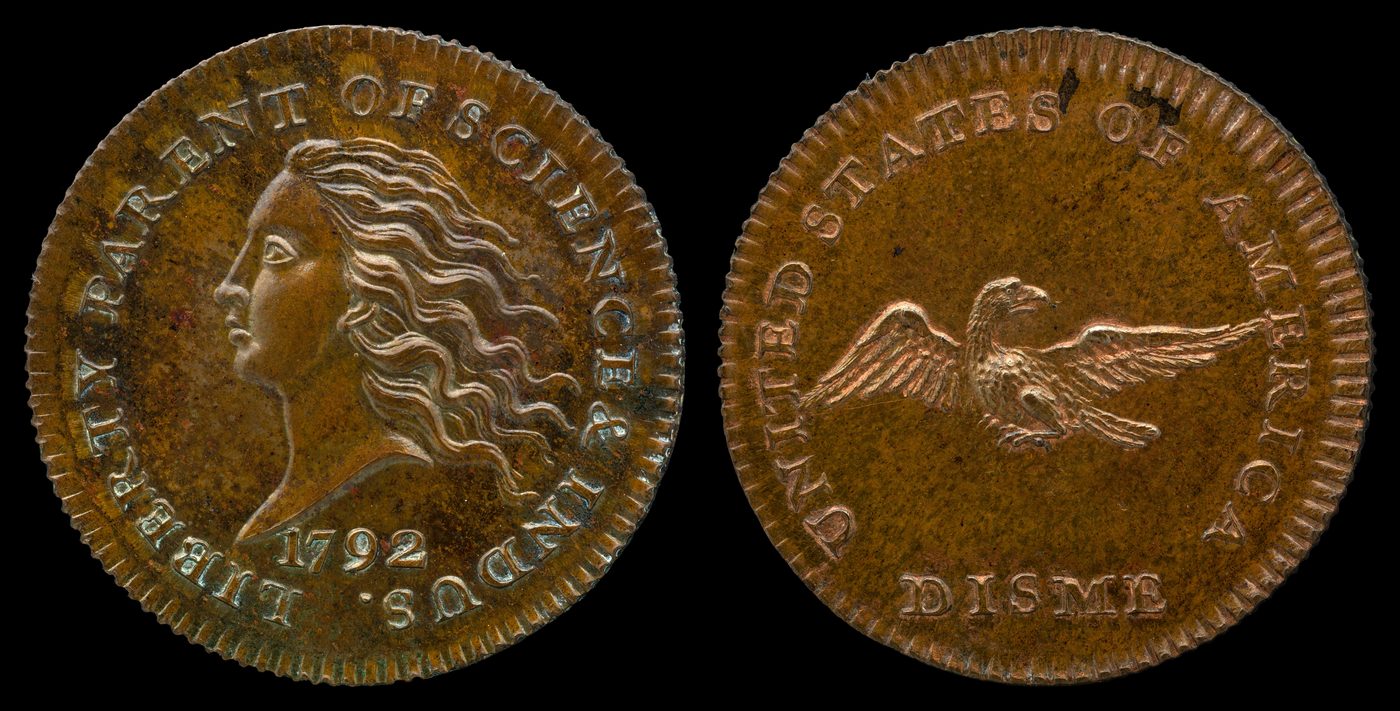
Coin: Robert Birch. Photograph: Jaclyn Nash. Credit: National Numismatic Collection, National Museum of American History (Smithsonian) · public domain · source

In the summer of 1792, the United States had a law authorizing its own coins, a treasurer named David Rittenhouse, and not a single finished Mint building. So the first ten-cent piece was struck in a borrowed cellar. Spelled "disme," it is the direct ancestor of every dime in your pocket — and roughly two dozen are known to survive.

The coin born before its own Mint

On April 2, 1792, Congress passed the Coinage Act and invented the United States dollar as we know it — a decimal system, divided cleanly into tenths and hundredths, with the dollar as the base unit. One of those new coins was the disme: a tenth of a dollar, ten cents, the coin we now call the dime.

There was just one problem. The law existed; the Mint did not. The Philadelphia Mint's first building wasn't even under construction until later that July. So the earliest federal coinage was improvised. The famous 1792 half disme — five cents, the disme's little sibling — was struck that same summer in the cellar of a sawmaker named John Harper, on a press borrowed before the Mint had a home of its own.

The disme — the full ten-cent piece — belongs to that same scramble. It was struck as a pattern: a trial coin, made to test the dies, the metal, and the look of a denomination before committing to mass production. The disme never went into circulation. It was a proof of concept for the dime, and the concept stuck. Every dime since 1796 traces its lineage to this one.

What it shows, and who cut the dies

The obverse — the heads side — carries a bust of Liberty facing left, her hair loose and flowing, with the date 1792 below. Around her runs the motto LIBERTY PARENT OF SCIENCE & INDUS. — "Liberty, parent of Science and Industry." It's an Enlightenment idea in metal: the belief that a free people would naturally produce knowledge and prosperity. The reverse — the tails side — shows a small eagle in flight, ringed by UNITED STATES OF AMERICA and the denomination, DISME.

That spelling is the coin's signature quirk. Disme comes from the French dîme, meaning "tenth," and in the 1790s it was pronounced roughly "deem." The silent middle letter faded over the decade, and by the time dimes circulated for real the word had simplified to the one we use now.

Who actually engraved it is one of numismatics' enduring small mysteries. The obverse is credited to Adam Eckfeldt, who in 1829 stated he "made the first die used in it" — making him, by his own account, the engraver of the first coin struck at the new Mint. The reverse is the puzzle: it's attributed to an engraver named Birch, but exactly which Birch is unsettled (Robert Birch was only a child in 1792), and some accounts credit the Mint's chief coiner, the German-trained clockmaker Henry Voigt, with the coining work. The honest answer is that the dies were a collaboration, and the full roster is lost.

Key facts

Denomination
10 cents (disme)
Year struck
1792
Status
Pattern — never circulated
Obverse engraver
Adam Eckfeldt (reverse attribution disputed)
Metals
Silver and copper
Reference numbers
Judd-9 (silver), Judd-10 (copper, reeded), Judd-11 (copper, plain edge)
Survivors
About 3 silver; roughly 19 copper (Judd-10); 3 copper plain-edge (Judd-11)
Authorizing law
Coinage Act of April 2, 1792
Notable sale
Finest copper disme — about $1.057 million, Heritage Auctions, January 2015

Collecting a coin that barely exists

This is not a coin you complete a set with. It's a coin you spend a career hoping to see. The 1792 disme survives in three forms, and all of them are rare to the point of legend.

The silver disme (Judd-9) is the rarest of the three: only about three examples are reliably traced, with a tradition — likely embroidered — that a few were struck for friends of the founding circle. The copper disme with a reeded edge (Judd-10) is the "available" variety, which here means roughly nineteen pieces are known to exist in the entire world. The plain-edge copper (Judd-11) numbers about three. Put together, the whole population of 1792 dismes is a couple of dozen coins.

Because they were patterns rather than money, the dies sometimes outlasted the experiment — collectors and Mint insiders kept examples as souvenirs of the founding moment, which is part of why any survive at all. When one does cross the auction block, it commands the prices of a historical artifact, not a coin: the finest-known copper disme brought about $1.057 million in early 2015. What you are buying is not silver or copper. It's the physical first draft of the American dime.

Questions collectors ask

Is the 1792 disme the first U.S. dime?

It's the prototype. The disme was struck in 1792 as a pattern — a trial piece — and never entered circulation. The first dimes made for everyday use came in 1796 (the Draped Bust dime). But every circulating dime descends from this experiment, which is why it's treated as the dime's true point of origin.

Why is it spelled 'disme' and not 'dime'?

It comes from the French dîme, meaning 'tenth,' and was pronounced about like 'deem' in the 1790s. The silent letter dropped out over the decade, and the word settled into the modern 'dime.'

What's the difference between the disme and the 1792 half disme?

The disme is ten cents; the half disme is five cents — the disme's smaller companion. The half disme is the more famous of the pair because about 1,500 of them were actually struck and spent in 1792, making them the first federal coins to circulate. The disme stayed a pattern.

How many 1792 dismes still exist?

Roughly two dozen in total: about three in silver (Judd-9), around nineteen in reeded-edge copper (Judd-10), and about three in plain-edge copper (Judd-11). Exact counts vary slightly between references because the population is so small.

Who designed it?

The obverse is credited to Adam Eckfeldt, who claimed in 1829 to have cut the first die used at the new Mint. The reverse is attributed to an engraver named Birch, though which Birch is genuinely uncertain, and Mint coiner Henry Voigt is also tied to the work. The full attribution is one of the open questions of early American numismatics.

Did George Washington own the silver in these coins?

That's a popular story, but it's tradition rather than documented fact. For the related half disme, Thomas Jefferson's own records show he supplied the silver and received the coins — Washington's personal involvement is legend. The same caution applies to the silver disme: a great story, not a proven one.

Sources