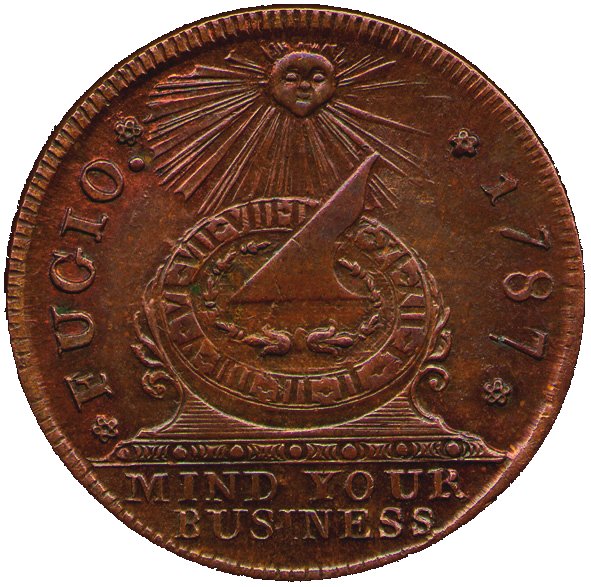
The story behind the coin
The United States had a government before it had money of its own. Under the Articles of Confederation — the loose pact that held the thirteen states together before the Constitution — the country ran on a chaos of foreign silver, state coppers, and worn British coins. So on April 21, 1787, the Congress of the Confederation did something it had never done: it authorized a coin in the name of the United States. That coin is the Fugio cent, and it is the first coin the nation ever officially put its name on.
Congress did not run a mint. It hired one. The contract went to James Jarvis, a Connecticut businessman, who was to deliver roughly 300 tons of copper coinage. Jarvis got the job the old-fashioned way — collectors and historians cite a $10,000 bribe paid to William Duer, the head of the Board of Treasury that awarded it. The dies were cut by Abel Buell, a New Haven engraver of real talent and a colorful past: years earlier he had been convicted of counterfeiting and branded for it. The man who engraved America's first coin had once been punished for faking the colony's money.
It went badly. Jarvis diverted the federal copper to a more profitable side business — striking Connecticut state coppers — and never delivered the cents he had promised. By September 1788 the government had cancelled his contract for non-performance, and Jarvis had fled to Europe to dodge his creditors. The first coin of the United States was born of a bribe, struck by a former counterfeiter, and abandoned by the contractor who made it. And yet it survived — because of a keg in a bank basement (more on that below).