US coin · series

The Draped Bust Dollar: the young republic's silver, and its most famous coin

A dollar struck from 1795 to 1803 — and a coin dated 1804 that no one made in 1804.

The Draped Bust Dollar: the young republic's silver, and its most famous coin
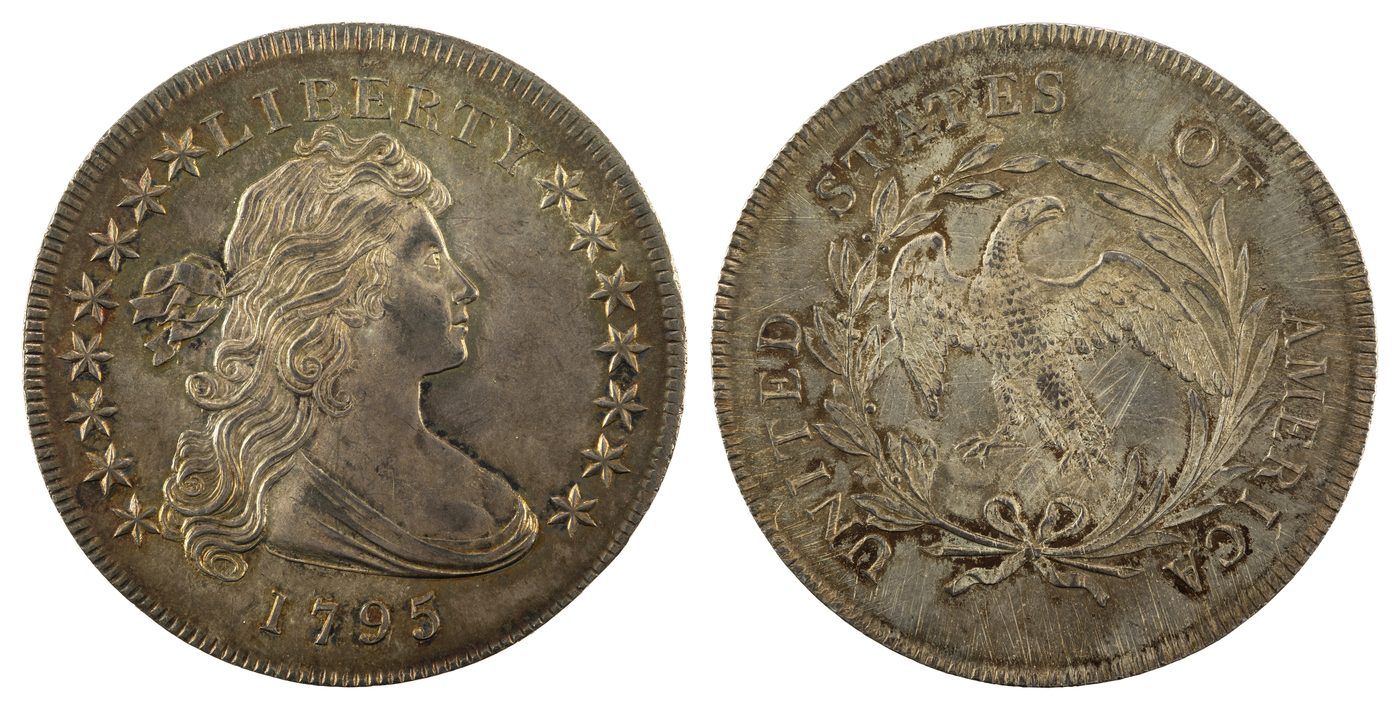
US Mint (coin); National Numismatic Collection, National Museum of American History (photograph by Jaclyn Nash) · public domain · source

In 1834, the U.S. Mint struck a silver dollar and stamped it 1804 — a year in which it had made no dollars at all. That backdated coin became the rarest and most coveted object in American numismatics. But the story starts a decade earlier, with a young mint trying to give the dollar a face worthy of a new nation.

The story behind the coin

The United States Mint was barely three years old and already unhappy with its dollar. The first silver dollars of 1794 and 1795 — the Flowing Hair type — showed a Liberty whose wild, streaming hair struck many as crude, even unflattering. So in the middle of 1795, the Mint did something it would rarely do again: it changed the design of a coin midway through the year.

The replacement was the Draped Bust dollar. Liberty now wore a calm, classical profile, her hair tied back with a ribbon, a drape of cloth across her shoulder. It was a deliberately elegant coin — the look of a country that wanted to be taken seriously among nations that had been minting fine silver for centuries.

These were real working coins, hand-struck on screw presses, each one slightly different from the last. They circulated hard, traded across borders, and were melted abroad for their silver — which is exactly why the next part of the story happened. In the summer of 1803, President Thomas Jefferson ordered the Mint to stop making silver dollars. American silver was flowing out of the country faster than it came in, and the big coins were the worst offenders. The Mint kept striking 1803-dated dollars into 1804 to use up its dies, then stopped. The denomination would not return for circulation until 1836. That single decision — to halt the dollar — is the seed of the most famous coin America ever made.

The design — and who made it

The obverse — the "heads" side — carries Liberty in right-facing profile, the word LIBERTY above, the date below, and a ring of stars for the states. The star count shifted as the Union grew and as the Mint experimented: 15 stars in 1795–1796, 16 in 1797, and a settling to 13 (for the original colonies) by 1798 and after. The work is credited to Robert Scot, the Mint's first Chief Engraver, who cut the dies and is generally named as the designer of both sides.

Collectors love to tell the design's origin story, and it deserves a careful hand. The tradition — gathered in the 1850s from the artist's descendants by a Mint director — holds that the Liberty portrait was based on a drawing by the celebrated painter Gilbert Stuart, with the Philadelphia socialite Ann Willing Bingham as the model. No such Stuart sketch survives, and serious researchers treat the attribution as plausible legend rather than fact. What is documented: a Providence artist named John Eckstein was paid thirty dollars to turn the concepts into the plaster models the engraver worked from.

The reverse — the "tails" side — comes in two distinct types, and telling them apart is the first thing any collector of this series learns.

  • The Small Eagle reverse (1795–1798) shows a slender eagle perched within an open wreath. Graceful, almost fragile.
  • The Heraldic Eagle reverse (1798–1804) replaced it with a bold, spread-winged eagle taken straight from the Great Seal of the United States — a shield on its breast, arrows in one talon, an olive branch in the other, and a banner reading E PLURIBUS UNUM ("out of many, one"). It is heavier, more official, more imperial.

Both types are struck in the same metal: roughly 89.2% silver and 10.8% copper, the fineness the Coinage Act of 1792 set for the dollar, on a broad planchet near 39–40 mm with lettering pressed into the edge.

Key facts

Years struck (circulation)
1795–1803 (1804-dated pieces struck later)
Designer
Robert Scot, Chief Engraver (obverse & reverse); models by John Eckstein
Liberty model
Traditionally Ann Willing Bingham, after Gilbert Stuart — debated
Composition
~89.2% silver, ~10.8% copper
Weight / diameter
26.96 g / ~39–40 mm, lettered edge
Reverse types
Small Eagle (1795–1798); Heraldic Eagle (1798–1804)
Highest mintage year
1799 — 423,515 struck
Lowest mintage year
1797 — 7,776 struck
The legend
1804 dollar — the 'King of American Coins,' 15 known

Collecting it: key dates, varieties, and why high grades are scarce

This is a series defined by two things at once: a handful of genuinely scarce dates that a determined collector can still own, and one coin that almost no one will.

The 1804 dollar — the "King of American Coins." Here is the twist that hooks every newcomer: no silver dollar was struck in the year 1804. Every dollar the Mint made that year was dated 1803. The coins we call "1804 dollars" were born in 1834, when President Andrew Jackson's State Department needed gift sets of U.S. coins for diplomatic missions to Asia. Mint officials, believing 1804 had been the dollar's final year, struck new dollars and dated them 1804 — and accidentally created a rarity. The first of these "Class I" sets reached the Sultan of Muscat in October 1835; another reached the King of Siam in April 1836. Years later, Mint employees struck more 1804 dollars on the sly for wealthy collectors (the "Class II" and "Class III" pieces, made around 1858). All told, just fifteen are known across the three classes. One of them, the Sultan of Muscat specimen, sold for $7,680,000 in August 2021. It is the most studied, most chased coin in American collecting — and a coin almost no living person will ever hold.

The dates you can actually pursue. Set the legend aside and the regular series has its own clear hierarchy:

  • 1797 (7,776 struck) is the lowest-mintage date of the whole type — the genuine key among circulating issues.
  • 1795 Draped Bust matters as the very first year of the design (about 42,000 struck), and the Off-Center Bust variety is a famous early-die curiosity prized by specialists.
  • The Small Eagle reverse only ran four years, so any Small Eagle dollar — especially the scarce 1798 Small Eagle — is harder to find than the later Heraldic type.
  • Within the Heraldic Eagle run, the 1799/8 overdate (an 1799 die cut over an old 1798), the 1800 "AMERICAI" (a stray letter left near AMERICA), and the 1802/1 overdate are the die varieties collectors hunt — each a fingerprint of hand-made coinage.

Why high grades are so scarce. These dollars were big, valuable, and meant to be used. They passed through countless hands, were stacked and counted and shipped, and untold numbers were melted for their silver — Jefferson's export problem was real. A coin that survived two centuries in sharp, lightly-worn condition is the rare exception, not the rule. That is why a well-struck, problem-free Draped Bust dollar in higher grade commands a steep premium over a worn one of the same date: the wear didn't just happen, it almost always happened.

Questions collectors ask

Why is the 1804 dollar so famous and valuable?

Because it's a beautiful accident of history. No dollars were struck in the actual year 1804 — the Mint made 1803-dated coins that year, then stopped. The coins dated 1804 were struck in 1834 as diplomatic gifts, and later restruck quietly for collectors. Only fifteen are known across all three classes, which is why it's called the 'King of American Coins.' One sold for $7,680,000 in 2021.

Were any Draped Bust dollars really struck in 1804?

Not dated 1804 for circulation. The Mint kept striking 1803-dated dollars into the year 1804, then President Jefferson's 1803 order to halt dollar coinage took full effect. No circulation dollar dated 1804 has ever turned up. The famous 1804-dated pieces were made decades later.

What's the difference between the Small Eagle and Heraldic Eagle types?

It's the reverse design. From 1795 to 1798 the dollar showed a slender 'Small Eagle' perched in a wreath. In early 1798 the Mint switched to the bolder 'Heraldic Eagle' — a spread-winged eagle with a shield, arrows, an olive branch, and the motto E PLURIBUS UNUM, copied from the Great Seal. Both types exist for 1798.

Who designed the Draped Bust dollar?

Robert Scot, the Mint's first Chief Engraver, is credited with the design and cut the dies. John Eckstein was paid to prepare the models. A long-told tradition links the Liberty portrait to the painter Gilbert Stuart, with socialite Ann Willing Bingham as the model — but no sketch survives and the attribution is disputed.

What is the rarest regular date in the series?

Among coins actually meant for circulation, the 1797 is the lowest-mintage date, with 7,776 struck. The 1795 first-year issue and the four-year-only Small Eagle dollars are also tougher than the later, higher-mintage Heraldic Eagle dates like 1799.

Sources