Era
The Founding & the First Mint
A new country invents a dollar — and learns how hard it is to keep it.
In 1792 the United States had a name, a constitution, and a flag. What it did not have was money of its own. The coins in American pockets were Spanish. Building a national currency from nothing — that was the first real test of whether the new government could actually govern.
The world then
Picture a country that had just won a war and written a constitution, but couldn't make its own money. That was the United States in 1792.
The coins changing hands in Boston and Charleston were not American. They were Spanish — the Spanish milled dollar, the silver "piece of eight" minted from New World silver and trusted across the entire globe. It was the most widely used coin on earth, and for the new republic it was both a crutch and an embarrassment. A nation that prints its laws but borrows its money is only half a nation.
Under the old Articles of Confederation, each state had been allowed to strike its own coins — a recipe for chaos. The Constitution shut that door in 1788, handing the sole power to coin money to the federal government. But declaring the power and building the machinery to use it were two very different things. Someone had to decide what an American dollar was — how much silver, what it looked like, who would make it. That question landed on the desks of Alexander Hamilton and Thomas Jefferson, and the answer became the founding act of American coinage.
The money
The answer was the Coinage Act of 1792, signed by President George Washington on April 2, 1792. It is one of the most consequential laws the early republic ever passed, and it reads like a country inventing itself line by line.
It built the dollar on a deliberately familiar foundation. An American silver dollar was set at 371.25 grains of pure silver — close to the Spanish dollar people already trusted — so the new coin could slip into circulation without anyone having to relearn what a dollar was worth. Then it did something genuinely radical: it made the dollar decimal. A hundred cents to a dollar, divided into halves, quarters, and the curiously spelled disme and half disme (an old French-rooted spelling of "dime"). No more dividing coins into eighths and "bits." Money you could do arithmetic with.
The Act laid out a full system in three metals. Copper for the cent and half cent. Silver for the dollar, half dollar, quarter, disme, and half disme. Gold for the eagle ($10), half eagle ($5), and quarter eagle ($2.50). Every coin had to carry the word LIBERTY, an "impression emblematic of liberty," and the year; the gold and silver pieces also needed an eagle and "UNITED STATES OF AMERICA" on the reverse — the tails side. The law took counterfeiting deadly seriously: debasing the coinage was made punishable by death.
The first coin actually struck came even before the Mint's machinery was ready. In July 1792, around 1,500 silver half dismes were made in the cellar of a Philadelphia craftsman named John Harper. Washington mentioned them to Congress that November. Jefferson's own records show he supplied 75 Mexican silver dollars to be melted for the silver and took the finished coins home with him. (You'll often hear that the silver came from Washington's own table service, and that the portrait is Martha Washington — both are beloved stories with no documentary support. Treat them as legend.)
Then came the building. President Washington appointed the astronomer David Rittenhouse as the first Mint director. The Philadelphia Mint — a three-story brick structure at Seventh and Arch Streets, then the tallest building in the city — was the first federal building erected under the Constitution. A government that had existed mostly on paper now had a workshop, a furnace, and a press.
The early designs came fast and stumbled at first. The first large copper cents of 1793 showed Liberty on the front and a chain of fifteen links on the back, meant to symbolize the union of the states. The public read it the wrong way entirely — a chain looked like slavery, not unity, to people fresh from a revolution. A Philadelphia newspaper sniffed that Liberty "appears to be in a fright." Within months the chain was gone, replaced by a wreath. The lesson stuck: in a republic, even the picture on a penny is political.
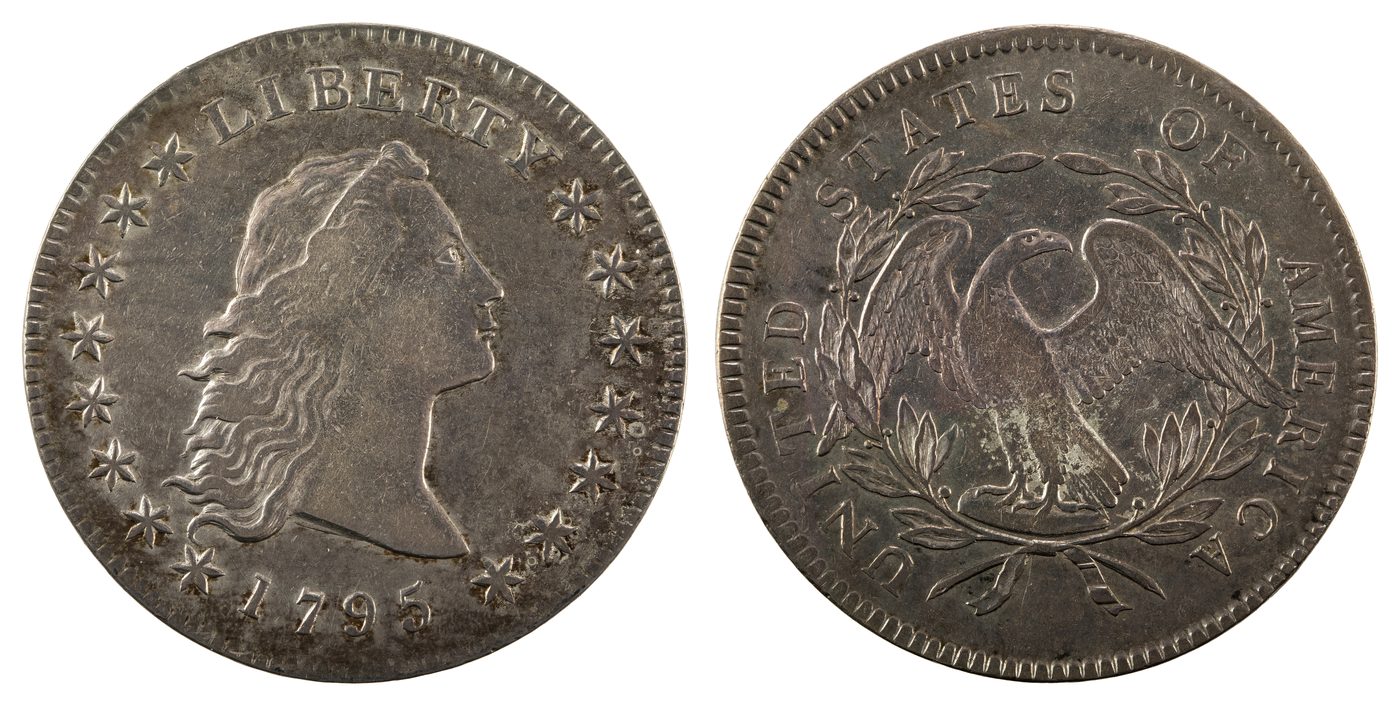
Silver coinage proper began in 1794 with the Flowing Hair design by the Mint's first chief engraver, Robert Scot — Liberty with her hair streaming behind her, ringed by stars for the states, an eagle on the reverse. The very first 1794 silver dollars were struck on a press too small for the job, so the strikes came out soft and uneven. Just over 1,750 were transferred that October. In 1795 the design was already being replaced by the more refined Draped Bust — Liberty shown with drapery across her shoulder, a portrait long linked (on thin evidence) to a drawing by the painter Gilbert Stuart. The Draped Bust would carry American copper and silver through 1807.
But the deepest problem wasn't art. It was arithmetic. The Act fixed the value of gold to silver at 15 to 1, and the world market wouldn't sit still at that number. When silver was worth more abroad, American silver coins flowed out and were melted; when gold was the bargain, the gold went instead. The country was minting beautiful coins and watching them vanish into ships' holds and bullion crucibles. By 1804 the situation was bad enough that the Jefferson administration simply stopped making the two biggest coins — the silver dollar and the gold eagle. The dollar wouldn't return until 1836, the eagle not until 1838. The republic had built its mint; keeping its money at home would take another generation to solve.
The coins of this era
If you laid the founding coins out on a table, you'd be looking at a country teaching itself to make money — and the whole story is in the metal.
It begins with the 1792 experiments, struck before the Mint could really mint. The silver center cent tried a clever trick — a tiny silver plug in a copper coin, so a cent could be small but still hold a cent's worth of value. The Birch cent and the copper disme were trial pieces, the workshop thinking out loud. And the 1792 half disme — about 1,500 silver pieces from a Philadelphia cellar — is the one most people call the first United States coin. These are the prototypes of a nation's currency, and only a handful of each survive.
Then the system arrived, just as the law laid it out: three metals, the full ladder of denominations. In copper came the cent and half cent. The Flowing Hair cent of 1793 — the famous Chain-then-Wreath pieces — was the very first coin off the Mint's own presses; it gave way to the Liberty Cap cent and then the Draped Bust cent. Beneath it ran the smallest coin America has ever made, the half cent — first as the Liberty Cap half cent, later as the Draped Bust half cent.
In silver came the rest of the ladder — the half dime, dime, quarter, half dollar, and dollar — first wearing Flowing Hair on the dollar and the tiny half dime, then settling into the Draped Bust family that runs through the half dime, dime, quarter, and dollar. In gold came the first American coins of their kind: the $2.50 quarter eagle, the $5 half eagle, and the great $10 eagle — the largest and grandest coin the young republic struck. One hand — Robert Scot's — shaped nearly all of it.
The thread tying every one of these together is a single design language. Liberty on the front, an eagle on the back, the year and the country spelled out — the template the Coinage Act demanded, repeated from the smallest copper half cent up to the heavy gold eagle. Watch it evolve and you watch the young Mint grow more sure of itself: Flowing Hair's wild, hurried look gives way to the calmer Draped Bust, and by 1807 a new engraver, John Reich, brings in the Capped Bust style — the Capped Bust half dollar and the redesigned $5 half eagle — that would define the decades to come.
And the era ends on its two ghosts. The Mint stopped striking the silver dollar and the gold eagle in the early 1800s, beaten by the arithmetic of metal values. So the two most famous coins of the period barely existed when they were "made": the 1804 dollar and the 1804 eagle are both later creations carrying an earlier date — diplomatic rarities born from a paperwork quirk. The founding coinage closes not with a flourish but with a problem the country wouldn't fully solve for another thirty years.
A timeline of the founding
- 1788Constitution takes effect
The federal government gains the sole power to coin money; states lose the right to strike their own.
- 1792Coinage Act signed
Signed April 2. Establishes the dollar, the decimal system, the three-metal denominations, and the U.S. Mint.
- 1792First half dismes struck
About 1,500 silver half dismes made in July in John Harper's Philadelphia cellar, before the Mint was finished.
- 1793First federal cents — and a redesign
The Chain cent's reverse is read as a symbol of bondage; public outcry forces a switch to the Wreath cent within the year.
- 1794First silver dollar
Robert Scot's Flowing Hair dollar; the earliest pieces struck on an undersized press, just over 1,750 transferred.
- 1795Draped Bust arrives — and the first gold
Scot's Draped Bust replaces Flowing Hair mid-decade; the same year the Mint strikes its first gold coins, the $5 half eagle and $10 eagle.
- 1804Big coins suspended
With dollars and eagles being exported and melted, the Jefferson administration halts both denominations.
- 1807The Capped Bust era begins
John Reich's Capped Bust design replaces Scot's Draped Bust, closing the founding chapter and opening the next.
Key facts
- Region
- United States
- Span
- 1792–1807
- Founding law
- Coinage Act of 1792 (signed April 2, 1792)
- First mint
- Philadelphia — first federal building under the Constitution
- First director
- David Rittenhouse
- First chief engraver
- Robert Scot
- Money system
- Decimal dollar; copper, silver, and gold denominations
- Silver-to-gold ratio
- 15:1 (fixed by law)
- Signature coins
- 1792 half disme, Flowing Hair dollar, Draped Bust coinage, first $10 eagle
- What it replaced
- The Spanish milled dollar ("piece of eight")
Why it fascinates collectors
These are the coins that were there at the beginning — and that turns out to be a powerful thing to hold.
The numbers are small in every direction. Mintages were tiny, the presses were crude, and two centuries of melting, spending, and loss have left very little behind. Of the first 1794 silver dollars, specialists think only somewhere around 120 to 130 survive. That scarcity collides with the romance of "the first American dollar" to produce some of the most famous coins in the world. The finest known 1794 dollar sold in 2013 for $10,016,875 — at the time, the highest price ever paid for any coin.
Then there's the 1804 dollar, nicknamed the "King of American Coins" — and a perfect lesson in reading a date carefully. The originals were not made in 1804 at all. They were struck around 1834, when the Mint needed presentation dollars as diplomatic gifts and reached back to what its records (wrongly) said was the last dollar date. One of these "1804" dollars, the example given to the Sultan of Muscat, sold for over $7 million in 2021. Only a handful exist.
For a collector, this era is where American numismatics starts: the first designs, the first engraver, the first mint, the moment the country decided what its money would look like. Even a worn, modest example from these years — a Draped Bust half cent, a Liberty Cap cent — is a physical piece of the founding, and that is the appeal that never wears off.
Questions collectors ask
What was the first U.S. coin?
The 1792 half disme is widely considered the first coinage struck under the new Coinage Act — about 1,500 silver pieces made in July 1792 in a Philadelphia craftsman's cellar, before the Mint building was even finished. The first large-scale federal coins followed in 1793 with the copper Flowing Hair cent.
Why did early American coins copy the Spanish dollar?
Because the Spanish milled dollar — the famous 'piece of eight' — was already the trusted coin in American hands. By matching its silver content closely, the new U.S. dollar could circulate without anyone having to relearn what a dollar was worth.
When did the U.S. make its first gold coins?
In 1795. The first American gold was the $5 half eagle and the $10 eagle, both designed by Robert Scot — the eagle being the largest coin the young republic struck. The $2.50 quarter eagle followed in 1796. All three vanished quickly when the metal in them was worth more than their face value abroad.
Why are the 1804 silver dollars so valuable if so many were made?
They weren't. Despite the 1804 date, the originals were actually struck around 1834 as diplomatic gifts, using a date the Mint's records wrongly believed was the last. Only a small number exist, which is why the 'King of American Coins' commands millions at auction.
Why did the U.S. stop making silver dollars and gold eagles in 1804?
The law fixed gold and silver at a 15-to-1 ratio that the world market kept undercutting. American coins were worth more melted or shipped abroad than spent at home, so they kept disappearing. The Jefferson administration halted both the dollar and the eagle; the dollar returned in 1836 and the eagle in 1838.
Who designed the first U.S. silver coins?
Robert Scot, the Mint's first chief engraver, created both the Flowing Hair design of 1794–1795 and the Draped Bust design that followed it through 1807.
Sources
- Coinage Act of 1792 — Wikipedia
- History of the U.S. Mint — U.S. Mint
- History of U.S. Circulating Coins — U.S. Mint
- 1792 half disme — Wikipedia
- Flowing Hair dollar — Wikipedia
- Draped Bust — Wikipedia
- Spanish dollar — Wikipedia
- Chain cent — Wikipedia
- Turban Head eagle (the 1795–1804 $10) — Wikipedia
- 1804 Draped Bust Dollar: A Collector's Guide — CoinWeek
- A King Is Born: The History of the 1804 Draped Bust Dollar — PCGS
- United States Mint (Philadelphia) — Encyclopedia of Greater Philadelphia