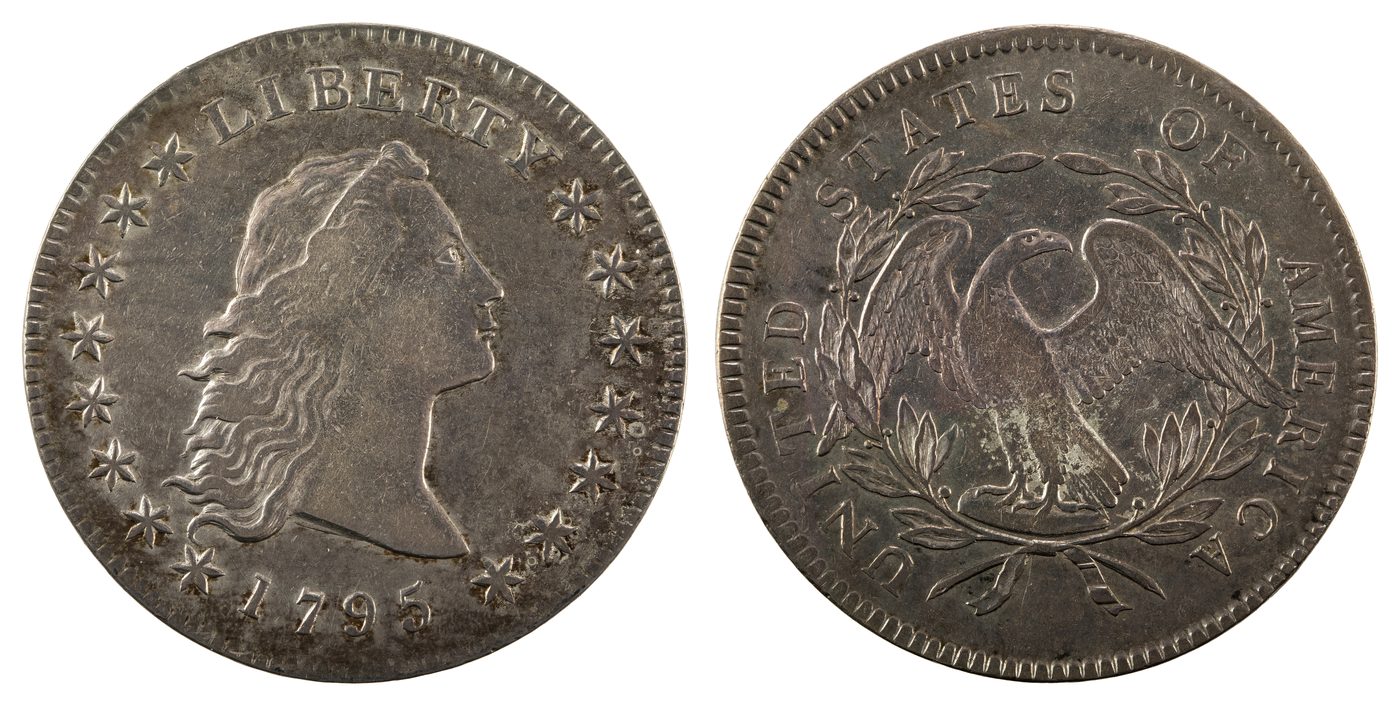
US coin · series

The Flowing Hair Dollar — the first dollar America ever made

1794–1795: a brand-new nation strikes its own silver, by hand, two coins at a time.

The Flowing Hair Dollar — the first dollar America ever made
US Mint (coin), National Numismatic Collection (photograph by Jaclyn Nash); credit: National Numismatic Collection, National Museum of American His… · public domain · source

In October 1794, a clerk at the Philadelphia Mint handed over 1,758 silver coins — the first dollars the United States ever struck. One of them may have sold, two centuries later, for more than ten million dollars.

The story behind the coin

In the autumn of 1794, the United States was barely a country. George Washington was president. The Constitution was six years old. And the young government had a problem that sounds almost quaint now: it had no money of its own.

Americans paid for things with a chaos of foreign coins — mostly the Spanish silver dollar, the "piece of eight" that circulated across the whole Atlantic world. A nation that minted nothing looked, to the rest of the world, only half-real. The Coinage Act of 1792 set out to fix that. It created a federal mint in Philadelphia and defined a national money built around one anchor coin: the silver dollar.

It took two more years to actually make one. The new Mint was tiny, underfunded, and learning on the job — it struck only copper cents and small silver pieces at first. Then, on October 15, 1794, the Mint delivered its first silver dollars. The count was just 1,758. They were the first dollars the United States ever issued — the coin every dollar since descends from.

The design and who made it

The dollar's design fell to Robert Scot, the Mint's first Chief Engraver, a Scottish-born craftsman who cut both sides of the coin. He took the job in late 1793 after the man originally lined up for it, Joseph Wright, died in a yellow-fever epidemic that swept Philadelphia.

The obverse — the "heads" side — shows Liberty in profile, facing right, her hair loose and streaming behind her. That windblown hair is where the series gets its name. Fifteen stars surround her, one for each state in the Union at the time. The reverse — the "tails" side — shows a small, delicate eagle perched on a rock, wrapped in a wreath. There's no denomination stamped on the face of the coin at all. Instead the value is spelled out around the rim: the edge is lettered HUNDRED CENTS ONE DOLLAR OR UNIT, pressed in before striking.

Making the coin was harder than designing it. The Mint's largest press was a screw press built for half dollars — not for a coin nearly the size of the Spanish dollar it was meant to rival. Workers cranked it by hand, one blow per coin, and it simply couldn't deliver enough force to fully bring up the design on so broad a planchet. That's why almost every surviving 1794 dollar looks soft or weak on one side: the press was outmatched by the coin. The Mint only managed full-size dollars in any quantity the following year, in 1795, once a bigger press arrived.

Key facts

Years struck
1794–1795
Denomination
One dollar
Designer / engraver
Robert Scot (obverse and reverse)
Composition
About 90% silver, 10% copper (see note)
Weight
26.96 g (416 grains)
Diameter
39–40 mm
Edge
Lettered: HUNDRED CENTS ONE DOLLAR OR UNIT
1794 delivery
1,758 coins delivered October 15, 1794
Auction record
A 1794 dollar sold for $10,016,875 (January 2013)

A note on the silver

Here's a wrinkle collectors love. By law, the 1792 Coinage Act set the dollar's fineness at .8924 — just under 90% silver. But the Mint's assayer, Albion Cox, found that standard awkward to hit and argued for raising the silver content. Mint Director David Rittenhouse went along with it, and the first dollars were struck at roughly .900 fine instead — about 90% silver — without going back to Congress for permission. So the law on the books and the metal in the coin didn't quite match. It's a small thing, and a very human one: the people running a brand-new mint quietly tuning the rules to make the machinery work.

There's a second silver quirk you can sometimes see with the naked eye. Some planchets came out slightly underweight, so a Mint worker drilled a hole in the center of the blank and tapped in a tiny silver plug to bring it up to legal weight before striking. On a few surviving coins you can spot a faint round patch at Liberty's portrait or the eagle — the plug. These silver plug dollars are prized rarities today.

Collecting it — key dates, varieties, and scarcity

Both years of the Flowing Hair Dollar are scarce, but they are not equally so.

The 1794 is the prize. Probably around 2,000 were struck and only 1,758 delivered, and most circulated hard or were melted; specialists today track on the order of 125 to 150 known survivors. That tiny pool, combined with its status as the very first U.S. silver dollar, makes a 1794 one of the most coveted coins in all of American numismatics. In January 2013 a single, superbly preserved 1794 — the Cardinal specimen, graded Specimen-66 — sold for $10,016,875, the first coin ever to break $10 million at auction. Cataloguers have argued, persuasively but not provably, that this exact coin may be the first silver dollar the Mint ever struck — burnished and carefully set aside. Treat that "first coin struck" claim as a strongly-argued theory, not a settled fact; what's certain is the price and the grade.

The 1795 Flowing Hair is far more available — total 1795 silver-dollar output ran to roughly 160,000 — but it carries the variety hunting that makes early dollars addictive. The reverse comes in two main types: Two Leaves and Three Leaves, named for how many leaves sit under each of the eagle's wings. The Two Leaves reverse is the scarcer of the pair. Across both reverses, specialists catalog around nineteen distinct die marriages (often cited by their Bolender/Bowers "BB" numbers), and a handful of 1795s carry the silver plug described above.

Why are high grades so scarce? Three reasons stack up. These were working coins, spent and worn in a cash-starved economy. The undersized 1794 press meant many were poorly struck to begin with — so even an unworn coin can look weak. And there were never many made. A sharp, high-grade Flowing Hair Dollar had to survive 230 years of melting pots, pockets, and bank vaults to reach a collector's hand. Most didn't.

Questions collectors ask

Why is the 1794 Flowing Hair Dollar so valuable?

It's the first silver dollar the United States ever struck, only 1,758 were delivered, and just 125–150 are believed to survive. That combination of historical 'firsts' status and extreme rarity drove one example to $10,016,875 in 2013 — the first coin ever to top $10 million at auction.

Who designed the Flowing Hair Dollar?

Robert Scot, the U.S. Mint's first Chief Engraver, cut both the obverse and the reverse. He took the work after Joseph Wright, originally slated for the role, died in a yellow-fever epidemic in 1793.

What's the difference between Two Leaves and Three Leaves 1795 dollars?

It refers to how many leaves appear under each of the eagle's wings on the reverse — two or three. They came from different dies. The Two Leaves variety is the scarcer of the two and generally the more sought-after.

What is a silver plug dollar?

When a coin blank came out slightly underweight, a Mint worker drilled a hole in its center and inserted a small silver plug to bring it up to legal weight before striking. On some surviving 1794 and 1795 dollars you can still see the round patch. Plugged coins are scarce and collectible.

Why do so many 1794 dollars look weakly struck?

The Mint's largest press in 1794 was built for half dollars, not for a coin nearly the size of a Spanish dollar. Cranked by hand, it couldn't deliver enough force to fully raise the design, so most 1794 dollars show softness — usually toward the lower left of the obverse.

Is the Flowing Hair Dollar 90% silver?

Roughly. The 1792 law specified .8924 fine, but the Mint's assayer Albion Cox and Director David Rittenhouse used about .900 fine silver instead — close to 90% — without seeking new authorization from Congress.

Sources