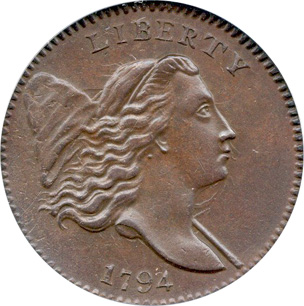
The story behind the coin
Picture a new country trying to invent its own money from scratch. No coins of its own, a public still counting in British shillings and pence, and a Congress that had just bet the republic on a clean decimal idea: one dollar, one hundred cents, math anyone could do.
Thomas Jefferson and the founders worried about the smallest transactions — the ones where pennies still felt too big. The half cent was the answer. Authorized by the Coinage Act of 1792, it was worth exactly one two-hundredth of a dollar: half of one cent. It existed so a working person could buy a single small thing and get honest change. Some early coins even carried the promise spelled out on the edge — TWO HUNDRED FOR A DOLLAR.
The first half cents, struck in 1793, showed Liberty facing left. Then disease rewrote the design. Yellow fever swept Philadelphia and killed the Mint's first engraver, Joseph Wright. When the Mint reopened, its new Chief Engraver, Robert Scot, cut fresh dies — and turned Liberty around to face right. That right-facing portrait is the coin on this page, struck from 1794 through 1797.
It was never an easy coin to make. Copper was scarce, the Mint was tiny, and every die was engraved by hand. The half cent was suspended after 1797, revived in 1800 with a new look, and the whole denomination was finally killed off by Congress in 1857. It is the smallest coin the United States ever made — and one of the hardest to make well.