US coin · series

The Flowing Hair Cent — America's First Coin

In 1793 the brand-new U.S. Mint struck a one-cent piece, and the public hated it so much the design changed twice before the year was out.

The Flowing Hair Cent — America's First Coin
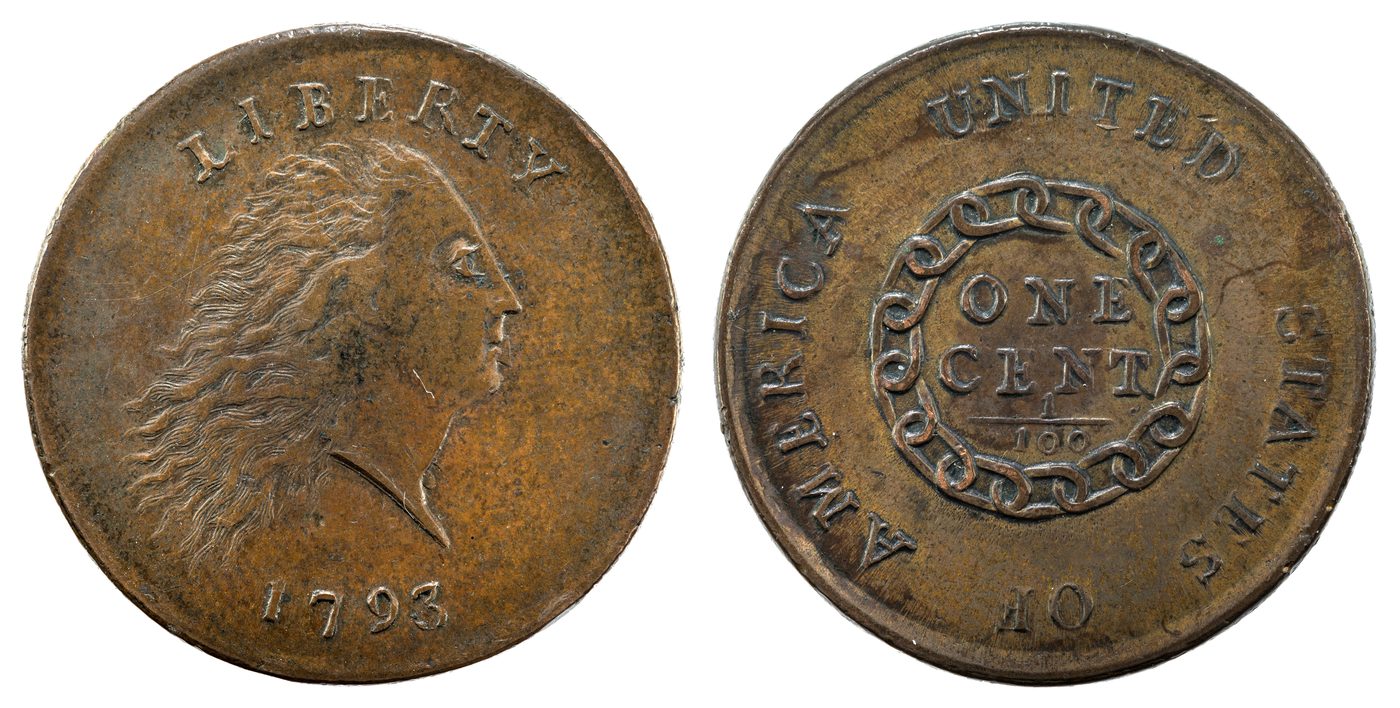
US Mint (coin); photograph by Jaclyn Nash, National Numismatic Collection, National Museum of American History · public domain · source

When the first United States Mint finally struck a coin for circulation in March 1793, it was a big copper cent with Liberty's hair streaming behind her and a chain of fifteen links on the back. Critics said Liberty looked terrified and the chain looked like slavery. The Mint scrapped it within weeks — and that panic gave us three of the most coveted coins in American collecting.

The coin that started everything

For its first four years, the United States had a Mint but no coins of its own coming out of it. The Coinage Act of 1792 had built the place in Philadelphia and written the rules. What it didn't do was make the machines work, the metal flow, and the dies hold up. The cent came first because copper was cheap and the country desperately needed small change — a citizen in 1793 was still making purchases with a chaotic mix of Spanish silver, British coppers, and worn colonial tokens.

On March 1, 1793, the Mint delivered its first batch: 11,178 large copper cents. They were the first coins struck for circulation by the United States Mint — a real milestone, even if not the first coin the federal government ever authorized. (That honor goes to the 1787 Fugio cent, ordered under the Articles of Confederation, five years before the Mint existed.) Each new cent was a hefty disc of pure copper, about the size of a modern half-dollar and meant to carry a full cent's worth of metal.

The design did not go over well. Liberty's wind-blown hair was supposed to read as freedom; one newspaper said she looked "in a fright," as if fleeing. Worse was the back. To symbolize the unity of the states, the engraver ringed the center with a chain of fifteen interlocking links — one for each state. In a nation that had just fought a revolution for liberty, a chain was, as one critic put it, "but an ill omen." To many eyes it read as slavery, not union. The Mint got the message fast.

By April the chain was gone, replaced by a graceful wreath. By the fall, even the flowing hair was retired in favor of Liberty wearing a cap of freedom. Three designs in a single year — a young institution learning, in public and in copper, how to put a nation onto a coin.

The design, and who made it

The Flowing Hair Cent is really two coins sharing one obverse — the heads side. Both show Liberty facing right, her loose hair flowing behind her, with LIBERTY above and the date 1793 below. What changes is the reverse — the tails side.

The first version, the Chain cent, is credited to Henry Voigt, the Mint's first Chief Coiner. Voigt was a watchmaker and mechanic by trade, not a trained engraver, and it shows — the work is blunt and earnest. The flowing-hair portrait echoes a famous French medal, the Libertas Americana, engraved by Augustin Dupré to celebrate the Revolution. The Chain reverse encircles the words ONE CENT and the fraction 1/100 with that fateful ring of links, ringed in turn by UNITED STATES OF AMERICA. (On the very first dies the engraver ran out of room and abbreviated it to "AMERI." — a spacing mistake that became one of the most famous varieties in the series.)

The replacement, the Wreath cent, softened everything. Liberty's portrait was re-cut in higher relief and looks calmer. The chain became an open laurel-and-olive wreath tied with a bow, with a small sprig of leaves added above the date on the front. This redesign is generally attributed to Adam Eckfeldt, an early Mint employee — though, like much of the Mint's earliest record-keeping, the attribution is traditional rather than ironclad, so treat it as the best informed guess rather than a signed fact.

A word on the metal and the size, since they explain why these coins survive looking the way they do. The Flowing Hair cent was struck in pure copper, weighed about 13.48 grams, and ran roughly 26–27 mm across. There were no fancy collars yet, so the edge — the thin band around the rim — was decorated separately, most often with a "vine and bars" pattern, and on some Wreath cents with lettering that reads ONE HUNDRED FOR A DOLLAR. Soft copper, hand-finished dies, and two centuries of pocket wear mean most survivors are dark, worn, and corroded. A sharp one is a small miracle.

Key facts

Year struck
1793 only
Reverse types
Chain (Feb–Mar 1793), then Wreath (Apr–summer 1793)
Obverse designer
Flowing Hair Liberty, after Dupré's Libertas Americana medal
Chain reverse — attributed to
Henry Voigt, first Chief Coiner
Wreath reverse — attributed to
Adam Eckfeldt (traditional attribution)
Composition
Pure copper
Weight
≈ 13.48 g
Diameter
≈ 26–27 mm
Edge
Vine and bars; some Wreath cents lettered 'ONE HUNDRED FOR A DOLLAR'
Chain cent mintage
36,103 (struck March 1–12, 1793)
Wreath cent mintage
≈ 63,353
Mint
Philadelphia (no mint mark)
Famous variety
1793 Chain 'AMERI.' (S-1) — the abbreviated-legend error

Collecting it: key dates, varieties, and why high grades barely exist

Every Flowing Hair cent is rare. There is no common date here — the whole type lived and died in 1793, and copper does not age gracefully. The hierarchy of desire runs roughly: Chain over Wreath, error legends over normal ones, and any sharp, problem-free coin over the worn and corroded majority.

The crown is the 1793 Chain cent. Only about 36,103 were ever struck, and survivors are usually counted in the hundreds, not thousands. Collectors sort them by Sheldon variety (the standard die-by-die numbering for early cents): S-1 is the celebrated "AMERI." abbreviation; S-2, S-3, and S-4 spell AMERICA in full, with S-4 uniquely adding periods after both LIBERTY and the date. The "AMERI." coins are the headline — a genuine engraving slip, frozen on the very first dies the Mint ever used for circulation. At the top of the market a Chain cent graded MS-64+ brown sold for $1.5 million at Heritage's January 2019 sale, a record for a copper coin.

The 1793 Wreath cent is more available — perhaps one to two thousand survive of the roughly 63,353 struck — which makes it the realistic "type coin" most collectors aim for if they want one 1793 cent. But the Wreath hides the rarest prize of all: the Strawberry Leaf variety, on which the sprig above the date carries a distinctive trefoil leaf. Only four are known, all heavily worn, and the finest changed hands for $862,500 in 2009. It is one of the great unsolved puzzles of the series — nobody is certain why those dies were cut differently.

Why are high grades almost nonexistent? Three reasons stack up. The planchets were soft copper that nicked and toned the moment they entered circulation. The hand-made dies struck unevenly, so even fresh coins could look weak. And in 1793 nobody was saving cents — they were spending money, used hard. A Flowing Hair cent that still shows full hair detail and clean fields survived against every odd, which is exactly why grade matters so much more here than mintage alone. For most buyers, an honest, evenly worn, uncorroded example with clear date and legend is the real trophy.

Questions collectors ask

Was the Flowing Hair cent the first U.S. coin?

It was the first coin struck for circulation by the United States Mint, delivered on March 1, 1793. But it wasn't the first coin the federal government authorized — that was the 1787 Fugio cent, ordered under the Articles of Confederation before the Mint existed.

Why was the Chain cent replaced so quickly?

The public disliked it. A newspaper said Liberty looked 'in a fright,' and the chain of fifteen links — meant to symbolize the union of the states — was read by many as a symbol of slavery, an awkward image for a nation founded on liberty. The Mint replaced the chain with a wreath within weeks.

What does 'AMERI.' mean on some 1793 cents?

On the earliest Chain dies the engraver ran out of room and abbreviated UNITED STATES OF AMERICA to 'AMERI.' Later dies spelled it out in full. The 'AMERI.' coins (Sheldon-1) are among the most famous and sought-after early American coins.

Who designed the Flowing Hair cent?

The Chain cent is credited to Henry Voigt, the Mint's first Chief Coiner, with the Liberty portrait drawing on Augustin Dupré's Libertas Americana medal. The Wreath cent's reverse is traditionally attributed to Adam Eckfeldt. Mint records from 1793 are thin, so these attributions are the accepted history rather than signed, documented facts.

What is the Strawberry Leaf cent?

It's the rarest variety of the 1793 Wreath cent, named for the unusual trefoil leaf on the sprig above the date. Only four examples are known, all well-worn, and the finest sold for $862,500 in 2009. Why these dies were cut differently remains a mystery.

What were these cents made of?

Pure copper. Each Flowing Hair cent weighed about 13.48 grams and measured roughly 26–27 mm across — close to the size of a modern half-dollar. The soft metal is one reason so few survive in sharp condition.

Sources