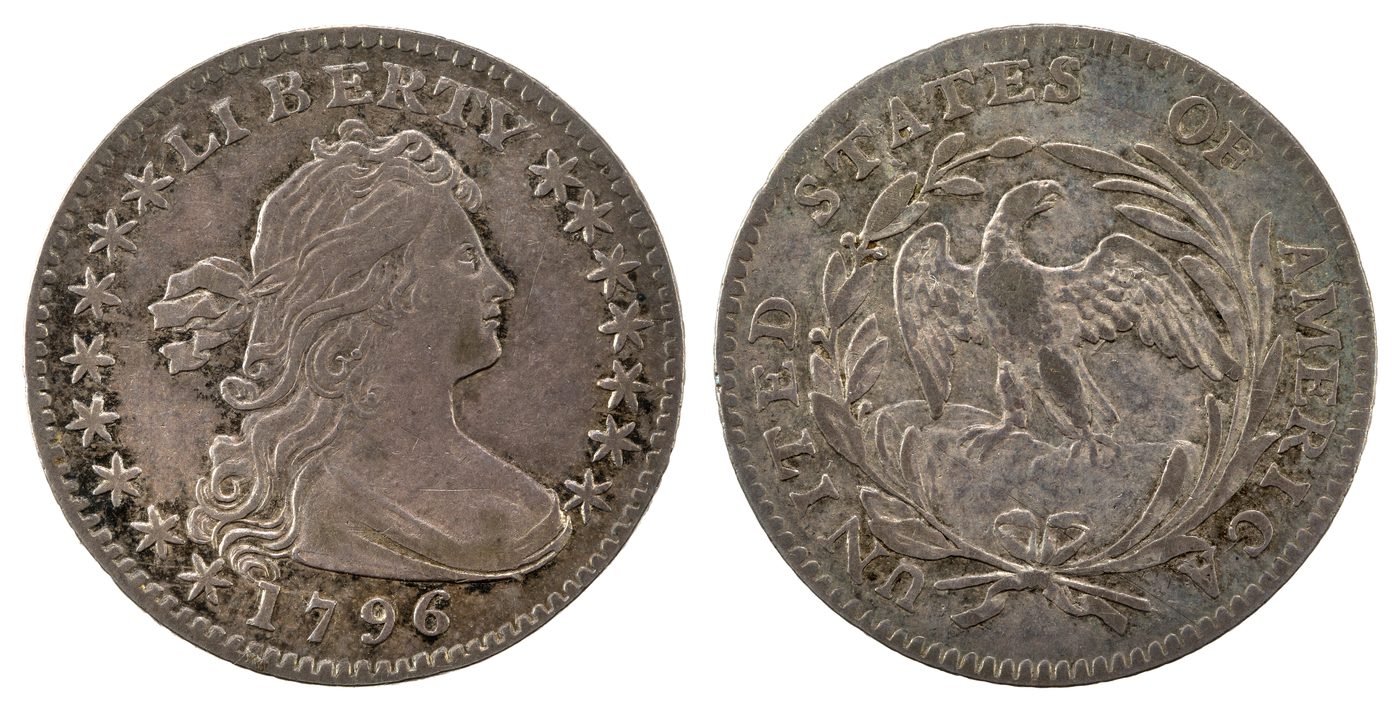
The story behind the coin
In 1796 the United States Mint was four years old and still finding its footing. It had a single building in Philadelphia, horse-and-hand-powered presses, and a chronic shortage of the silver and gold it was supposed to turn into money. Into that struggling shop came a new design — the Draped Bust — meant to make American coins look less crude and more like the confident currency of an established nation.
The half dime was the smallest silver piece the Mint made: five cents, struck in real silver, the size of a fingernail. People needed small coins to make change in a cash economy, and silver was the only metal the law allowed for them. So the Mint produced half dimes whenever depositors brought enough silver to make it worth firing up the presses — and stopped whenever they didn't.
That start-and-stop rhythm is the whole story of this series. The Mint struck half dimes in 1796 and 1797, then made none dated 1798 or 1799. It picked the denomination back up in 1800 and ran it through 1805 — but skipped 1804 entirely, and in 1802 produced a run so tiny it became a legend. After 1805 the half dime vanished again, not returning until 1829. For a coin that was supposed to be ordinary pocket change, the Draped Bust half dime had a remarkably broken life.