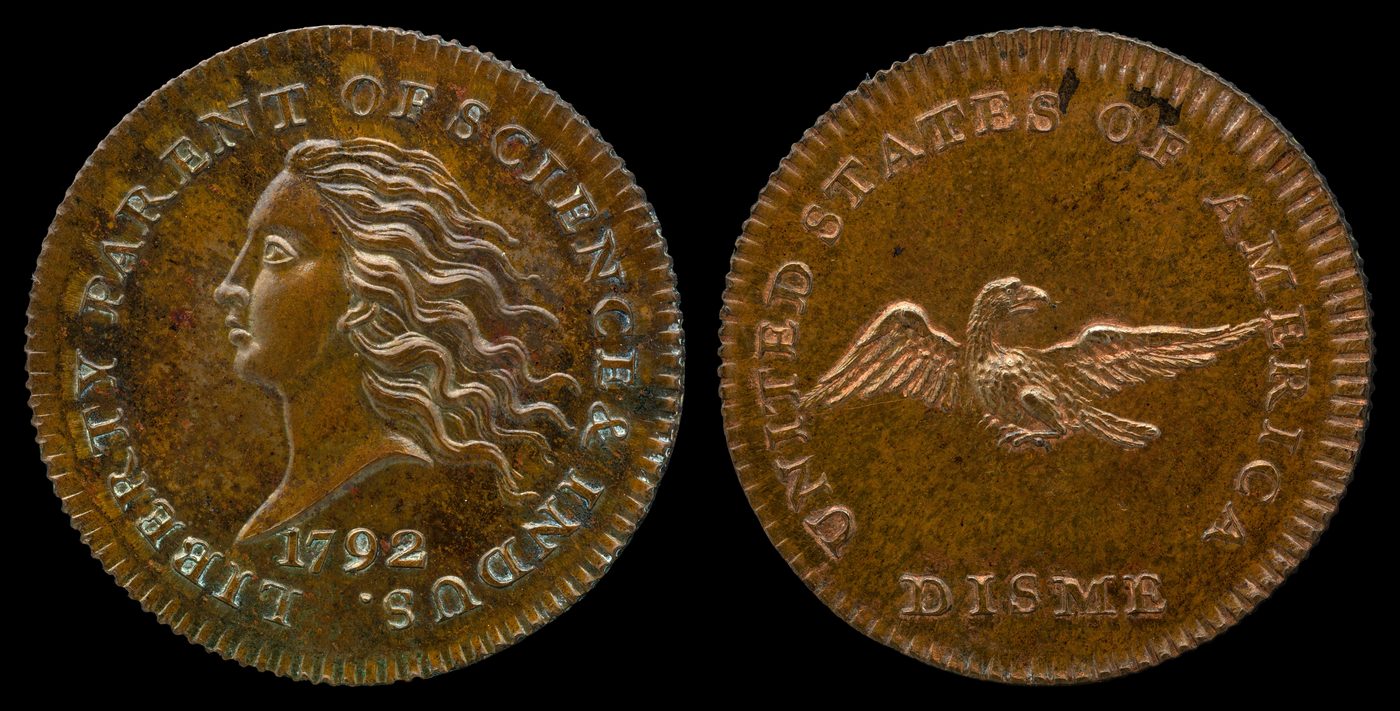
The story behind the coin
In the spring of 1792, the United States had a constitution, a president, and almost no money of its own. Spanish silver dollars, British coppers, and a confusion of state and foreign coins changed hands in the markets. Congress wanted something American — and on April 2, 1792, it passed the Coinage Act, the law that built the Mint and laid out a decimal system of dollars, cents, and tenths.
That "tenth" had a name: the disme. The word is old French for a tithe — a tenth part — and it was probably said something like "deem." Within a few years the spelling relaxed into the word we use now. The dime. So the disme is not a curiosity off to the side of American coinage. It is the dime's birth certificate.
What survives from that first year is not a circulating coin. It is a pattern — a trial piece, struck to test a design and show it to the people who decided whether to approve it. The Mint struck the disme mostly in copper, a cheap metal, instead of the silver a real dime would carry. A few copper pieces could be made fast and handed to officials and influential men without spending precious metal. That is why a ten-cent coin exists in copper at all, and why it was never spent: it was an argument made in metal, not a coin made for a pocket.
A handful of dismes were also struck in silver — the closest thing to "the real thing" the Mint ever made of this design. Those are rarer still.