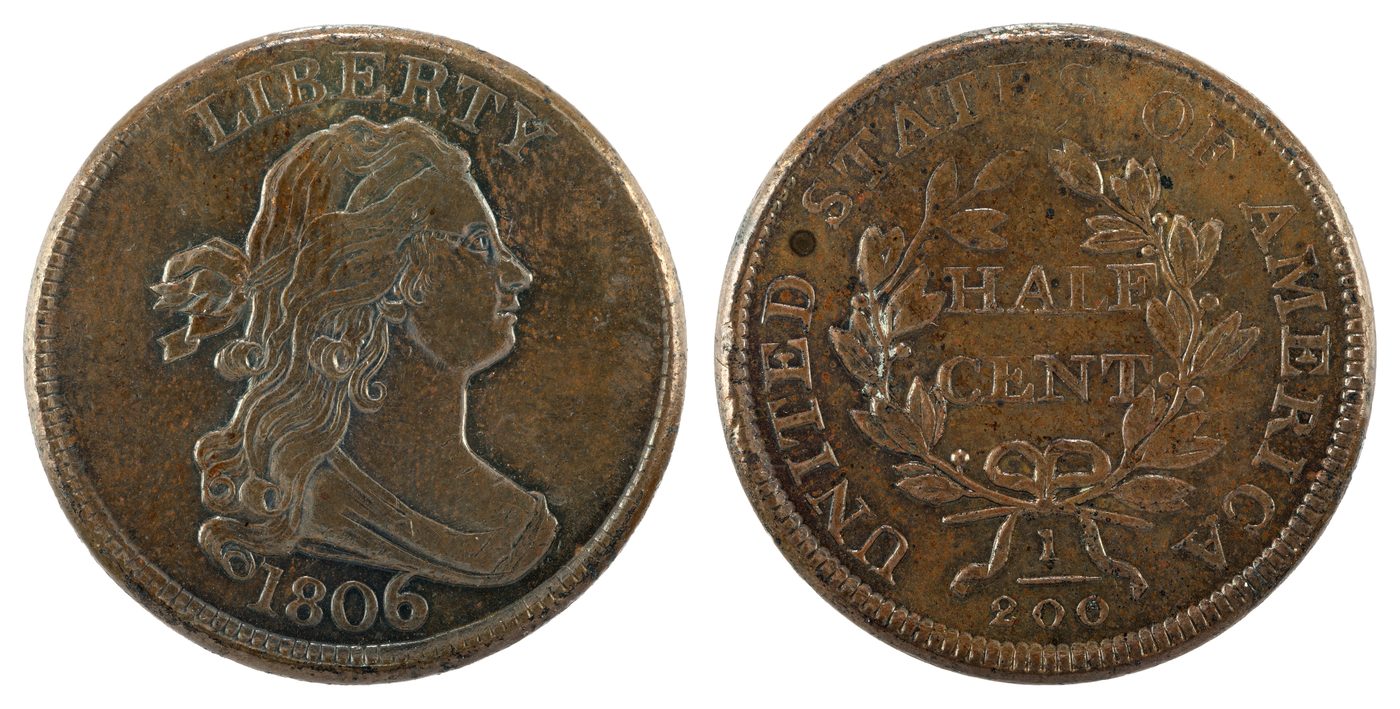
The story behind the coin
Picture the smallest coin you can imagine being useful. Now cut its value in half. That was the half cent — a piece worth one two-hundredth of a dollar, the lowest denomination the United States ever made.
The country needed it more in theory than in practice. In 1792 Congress built a decimal money system from scratch, and a tidy system wants a coin for every small step of value. The half cent filled the bottom rung. But ordinary people found it almost pointless. Shopkeepers disliked making change in it, banks didn't want it, and it never circulated the way a copper coin was supposed to.
So the Mint in Philadelphia treated it as an afterthought — and the records show it. No half cents were struck dated 1798, 1799, or 1801. When Robert Scot's new Draped Bust design finally reached the denomination in 1800, the Mint was so frugal that some 1800 coins, and all the famously rare 1802 coins, were struck on blanks cut from damaged large cents — the new half cent was literally made from the scrap of a bigger one.
By the end of 1807 the Mint had more than 167,000 unwanted half cents sitting in storage. It struck a final batch anyway in 1808, then stopped — the Draped Bust era was over. The coin nobody wanted in its own time is exactly why so few survive in nice shape, and why collectors now chase the survivors.