US coin · series

The Flowing Hair Half Dime (1794–1795)

A sliver of silver from the Mint's first years — America's first regular five-cent piece.

The Flowing Hair Half Dime (1794–1795)
Public domain · source

It is smaller than a modern dime and weighs about as much as a paperclip. Yet the Flowing Hair half dime was real money in a brand-new country — the first five-cent silver coin the United States made for everyday use, struck in the same first months the Mint learned how to make coins at all.

The story behind the coin

In 1792 the United States had a constitution, a flag, and a president — but no coins of its own. People still spent Spanish silver, British copper, and a jumble of foreign change. The Coinage Act of April 1792 set out to fix that. It created the Mint, defined the dollar, and split it into decimal parts: dimes, half dimes, cents. One of those new units was the half dime — a five-cent piece in silver.

The very first of them came that same year. About 1,500 "half dismes" (the old spelling) were struck in 1792, before the Mint building was even finished. They were a trial run more than a coinage. The real, regular issue had to wait — for a building, for presses, and for silver.

That wait ended in 1794. The Philadelphia Mint finally had its equipment and began striking silver. The half dime joined the half dollar and the dollar in the new lineup. These are among the first coins the federal government ever made — small change for a country that had almost none. A half dime bought a loaf of bread or a glass of whiskey. It was not a souvenir of the founding; it was the founding, in your pocket.

There is a quirk worth knowing. Coins dated 1794 and coins dated 1795 were, in fact, mostly struck together during 1795 — the Mint kept using its 1794 dies into the next year before adding fresh ones. So a "1794" half dime and a "1795" half dime often rolled off the same presses in the same months. The date on the coin is the date on the die, not always the year of striking.

The design and who made it

The man behind the design was Robert Scot, a Scottish-born engraver who became the Mint's Chief Engraver in 1793 and held the post until he died in 1823. He cut both sides of the coin.

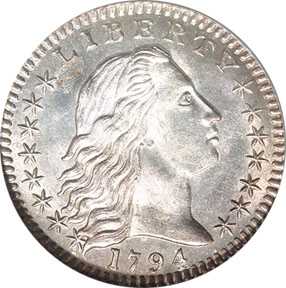
The obverse — the "heads" side — shows Liberty in profile, facing right, her hair loose and streaming behind her. That flowing hair gives the type its name. The word LIBERTY arcs above her, the date sits below, and fifteen stars ring the edge — eight on the left, seven on the right — one for each state that had joined the Union by then.

Turn it over and you meet a small, almost fragile eagle. Collectors call it the "small eagle" or "delicate eagle." It perches inside an open wreath of olive branches, wings spread, with UNITED STATES OF AMERICA wrapped around the rim. There is no shield, no banner, no motto — just a plain, hopeful little bird. It was the same Flowing Hair Liberty and small eagle Scot put on the silver dollar and half dollar of these years, so the half dime is the tiniest member of a matched family.

The design did not last long. Liberty's wild hair drew criticism almost at once, and by 1796 the Mint replaced it with Scot's more composed Draped Bust. That short life is part of why the Flowing Hair half dime stands out: it belongs to one brief, formative moment and nothing after it.

Key facts

Years struck
1794–1795 (both dates mostly struck during 1795)
Designer
Robert Scot — obverse and reverse
Composition
89.24% silver, 10.76% copper
Weight
≈1.34 g
Diameter
≈16.5 mm
Edge
Reeded
Mint
Philadelphia (no mint mark)
Total mintage
86,416 half dimes coined (combined 1794 + 1795 dies)
Obverse
Liberty with flowing hair, 15 stars (8 left, 7 right), LIBERTY above, date below
Reverse
Small eagle within an open wreath, UNITED STATES OF AMERICA
Replaced by
Draped Bust half dime (1796)

Collecting it

For collectors, the whole type comes down to two dates: 1794 and 1795. The Mint's records list a combined 86,416 half dimes for the period — they did not break the count out by date. So the split between the two years is an estimate, worked out from how many of each survive and from the dies that struck them. The standard reference by Russell Logan and John McCloskey puts roughly 7,700 to 1794-dated dies and the rest, the great majority, to 1795. That makes the 1794 the key date — scarcer, more sought after, and the one most people build a type set around if they can afford it. Neither year is common, but 1795 is the one you actually find.

Collectors who go deeper chase die marriages — the specific pairing of one obverse die with one reverse die, each with its own tiny tells. Logan and McCloskey cataloged them with "LM" numbers, the standard shorthand for this series. There are four known marriages for 1794 and ten for 1795. Hunting them turns a two-coin set into a small world of its own.

High grades are genuinely scarce here, and the reasons are baked into the coin. The Mint was new and still learning: dies cracked, strikes came up soft, planchets (the blank silver discs) were uneven. These coins then circulated hard in a cash-poor economy, so most survivors are well worn. A Flowing Hair half dime with sharp detail and original surfaces is a coin that dodged two centuries of pockets and purses — which is exactly why one in high grade commands so much more than a worn example.

One practical warning: this type is faked. Counterfeit detectors point to telltale raised lines near the "BE" of LIBERTY and the "17" of the date on known fakes. For a coin this old and this valuable, a grade from a major certification service — the reason these come in sealed holders — is worth its weight.

Questions collectors ask

What is a half dime?

A half dime is a five-cent coin made of silver — half the value of a dime. The United States used silver half dimes from the 1790s until 1873, when the copper-nickel five-cent piece (the nickel) eventually replaced the denomination. It is not the same as a nickel; it is much smaller and made of silver.

Why was the 1794 half dime actually struck in 1795?

The Philadelphia Mint kept using its 1794-dated dies into 1795 before cutting new ones, so most coins bearing either date were struck during 1795. The date reflects the die, not always the calendar year of striking. The Mint's records report a single combined total for the period rather than a year-by-year count.

Which date is rarer, 1794 or 1795?

The 1794 is the key date — far scarcer than the 1795. The Mint never split its mintage by year, so the estimate that only about 7,700 coins carry the 1794 date comes from the standard die-and-survival study by Logan and McCloskey. The 1795 is the year you are far more likely to find.

Who designed the Flowing Hair half dime?

Robert Scot, the Mint's Chief Engraver from 1793 to 1823. He engraved both sides and used the same Flowing Hair Liberty and small-eagle design on the silver dollar and half dollar of the same years.

How is it different from the 1792 half disme?

The 1792 half disme (about 1,500 struck) was an experimental first issue made before the Mint was fully operational. The Flowing Hair half dime of 1794–1795 was the first regular, circulating half dime — a different design, struck once the Mint had its presses running.

Why are high-grade examples so scarce?

The early Mint struck these coins unevenly — soft strikes, cracked dies, and rough planchets were common — and the coins then circulated heavily in a cash-short economy. Survivors with sharp detail and original surfaces are uncommon, which is why grade matters enormously to value.

Sources