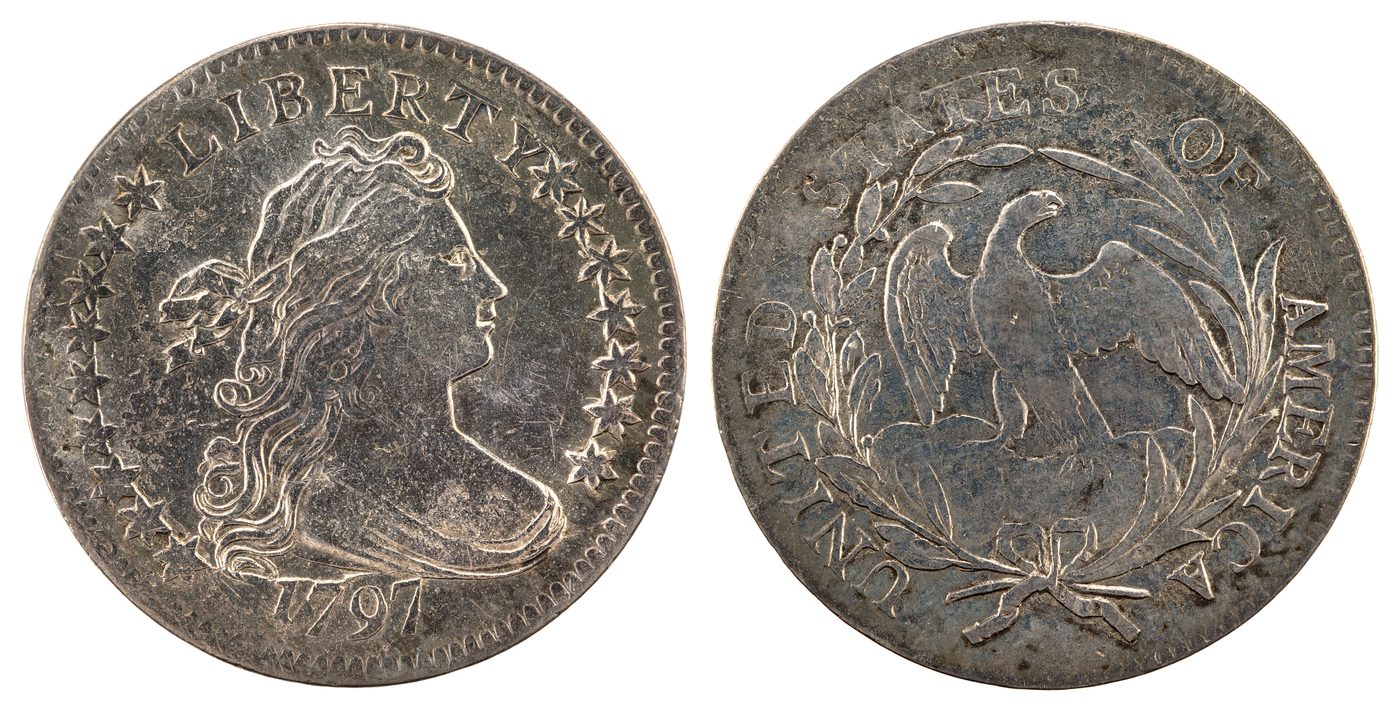
US coin · series

The Draped Bust Dime: America's First Ten-Cent Piece

A coin that never tells you what it's worth — born in a mint barely three years old.

The Draped Bust Dime: America's First Ten-Cent Piece
US Mint (coin); photograph by Jaclyn Nash, National Numismatic Collection, National Museum of American History (Smithsonian Institution) · public domain · source

In 1796 the United States struck its first dime. Look closely and something is missing: nowhere on the coin does it say "ten cents," or "one dime," or anything at all about its value. That blank space is the whole early republic in miniature — a young country still figuring out what its money should even say.

The story behind the coin

In 1796 the United States Mint was three years old and still learning to make coins. It had no steam power, no mechanized presses worth the name — just hand-cut dies and screw presses muscled by men. That year, for the first time, it struck a dime.

The coin came out of a simple need. The Coinage Act of 1792 had laid out a decimal money system — dollars, dimes, cents — to replace the chaos of Spanish, British, and French coins that Americans actually used day to day. A "disme" (the old spelling, from the French for tenth) was meant to be one-tenth of a dollar. But the Mint struggled to produce silver coins at all in its first years, and the dime had to wait until 1796 for its debut.

Here is the strange part. The 1792 law required a mark of value only on the copper coins — the cent and half cent. So the silver dime carried no denomination at all. No "10 C.," no "ONE DIME." A person was simply expected to know that this small silver coin, smaller than a cent, was worth ten of them. It's a window into how new and improvised the whole system still was.

The Draped Bust dime was struck only through 1807, and not even every year — there are no dimes dated 1799 or 1806. The Mint coined silver to order, turning bullion that depositors brought in into whatever denominations were wanted. In some years, nobody wanted dimes.

The design and who made it

The obverse — the "heads" side — shows Liberty as a woman in flowing hair and drapery, facing right, the word LIBERTY above her and the date below. This is the Draped Bust portrait, the design that gives the coin its name. It replaced the earlier, wilder Flowing Hair Liberty and was meant to look more refined — more like a classical bust than a frontier emblem.

The credited designer is Robert Scot, the Mint's first Chief Engraver. Scot was a Scottish-born engraver, trained in Edinburgh, who came to America and was appointed by George Washington in 1793. He held the post until his death in 1823, and his hand shaped the look of nearly all early U.S. coinage. The official record credits him with both sides of this dime.

The portrait itself, though, came from outside the Mint. By long tradition it was based on a drawing by the celebrated painter Gilbert Stuart — the artist behind the Washington portrait on the dollar bill. Collectors have also long said the woman who modeled for it was Ann Willing Bingham, a famous Philadelphia socialite. Both claims are traditional rather than proven: the Stuart sketch has never been found, and the model's identity is unconfirmed. It's a lovely story, repeated for two centuries — treat it as tradition, not documented fact.

The reverse — the "tails" side — changed midway through the series, which is why collectors speak of two distinct types:

  • Small Eagle (1796–1797). A slight, naturalistic bald eagle perched on a cloud, ringed by a wreath, with UNITED STATES OF AMERICA around the rim. Many people of the day thought it looked scrawny — not the proud bird a young nation wanted.
  • Heraldic Eagle (1798–1807). A bold redesign based on the Great Seal of the United States: a broad-winged eagle with a shield on its breast, arrows in one talon, an olive branch in the other, and a banner reading E PLURIBUS UNUM. Far more regal — and the look that would define American silver for decades.

Watch the stars on the front, too. The 1796 dime carries 15 stars, one for each state in the Union at the time. Early 1797 dimes jump to 16, after Tennessee joined in June 1796. Then the Mint gave up chasing statehood — you can't keep adding stars forever — and settled on 13, for the original colonies. That tug-of-war is frozen right there on the coins.

Key facts

Years struck
1796–1807 (none dated 1799 or 1806)
Denomination
Ten cents — but no value is shown on the coin
Designer
Robert Scot (credited, obverse and reverse)
Obverse portrait
Liberty, by tradition after a Gilbert Stuart drawing
Reverse types
Small Eagle (1796–1797); Heraldic Eagle (1798–1807)
Composition
89.24% silver, 10.76% copper
Weight / diameter
≈2.70 g; ≈19 mm; reeded edge
First-year mintage (1796)
22,135
Lowest-mintage year (1804)
≈8,265 — rarest date in the series

Collecting the Draped Bust dime

This is one of the great early-American type coins, and it is scarce by nature. Mintages were tiny — often well under 40,000 for a whole year, sometimes far less — and these coins circulated hard in an economy short on small change. A dime was real money in 1800. Most got worn smooth, clipped, or melted. Survivors in any grade are uncommon; survivors with sharp detail are genuinely rare.

The first thing collectors decide is which type they want. The Small Eagle dimes of 1796 and 1797 are the prizes — a two-year design, the only years that scrawny eagle appears. A 1796 is doubly desirable as the very first U.S. dime ever struck. In high grades, the 1797 issues are actually scarcer than the 1796.

The undisputed key date is the 1804. With a mintage around 8,265, it's the lowest of the entire series, and it comes in two reverse varieties named by the John Reich Collectors Society: JR-1 with 13 stars above the eagle and JR-2 with 14 stars. The 14-star (JR-2) is the rarer of the two — grading services estimate only a few dozen survive across all grades. Either way, an 1804 dime is a five- to six-figure coin.

A few other variety notes reward a careful eye. The 1798 over 7 overdates — where an old 1797 die was repunched with the new date — are popular, and come with either 16 or 13 stars on the reverse. The 1797 splits into a 16-star and a 13-star obverse. These small differences, catalogued in Early United States Dimes, 1796–1837 (the John Reich Collectors Society reference), are what turn type collecting into die-variety collecting.

Why are high grades so scarce? Three reasons stack up. The coins were struck by hand on primitive equipment, so even fresh examples often show weak strikes and adjustment marks. They were spent, not saved — nobody set aside dimes in 1800. And there were never many to begin with. A Draped Bust dime that is both well struck and well preserved is one of the harder things to find in all of U.S. numismatics.

Questions collectors ask

Why doesn't the Draped Bust dime say what it's worth?

The Coinage Act of 1792 required a value mark only on the copper cent and half cent. Silver and gold coins were left without one, so the dime carries no '10 cents' or 'one dime' anywhere — people were simply expected to know it was worth a tenth of a dollar.

Which is the rarest Draped Bust dime?

The 1804, with a mintage of roughly 8,265 — the lowest of the series. It exists in two reverse varieties, JR-1 with 13 stars and the rarer JR-2 with 14 stars above the eagle. Both are major rarities; the 1804 is a five- to six-figure coin.

What's the difference between the Small Eagle and Heraldic Eagle dimes?

It's the reverse design. The Small Eagle (1796–1797) shows a slight, natural bald eagle in a wreath. The Heraldic Eagle (1798–1807) shows a bold eagle with a shield, arrows, and olive branch, based on the Great Seal. They're collected as two separate types.

Why are there no dimes dated 1799 or 1806?

The early Mint coined silver to order from the bullion depositors brought in. In some years no dimes were requested, so none were struck. The gaps reflect demand, not a lost or rare date.

Who designed the Draped Bust dime?

Robert Scot, the Mint's first Chief Engraver, is credited with the design. The Liberty portrait is traditionally said to be based on a Gilbert Stuart drawing, with Philadelphia socialite Ann Willing Bingham as the model — but that attribution is tradition, not documented fact.

Why are nice examples so hard to find?

Mintages were tiny, the coins were struck by hand on crude presses (so strikes are often weak), and dimes were spent rather than saved. Few survived, and even fewer with sharp, original detail.

Sources