US coin · series

The Capped Bust Half Dollar

America's workhorse silver coin — designed by an indentured immigrant, hoarded by banks, and cut from 450 different hand-made dies.

The Capped Bust Half Dollar
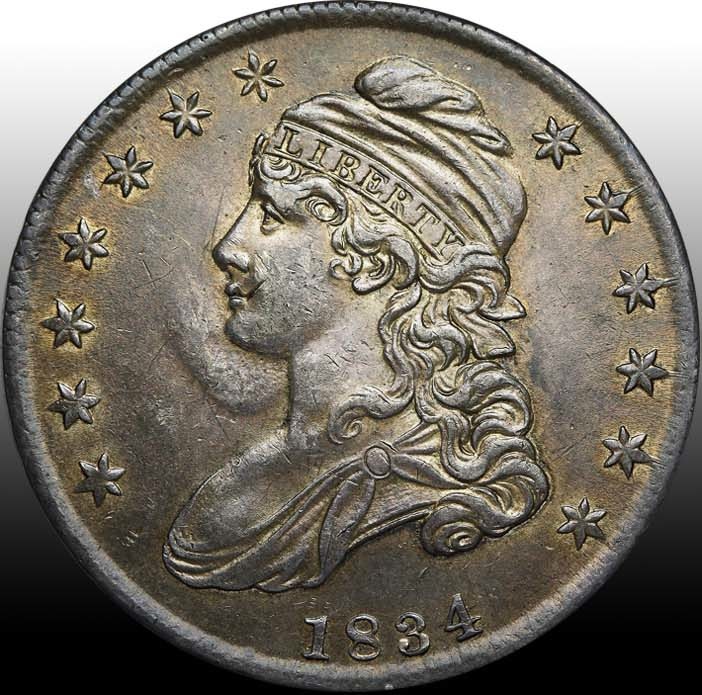
Coin: Robert Scot; Image by Lost Dutchman Rare Coins · public domain · source

For nearly thirty years this was the largest silver coin most Americans ever held — yet many of them barely circulated. Banks treated half dollars like ingots, stacking them in vaults and passing them between each other instead of spending them. That quirk is why a coin struck before the Civil War can still turn up looking almost new.

The story behind the coin

In the early United States, the half dollar did a job no one intended for it: it became the nation's silver vault.

Here is the strange part. From 1804 through the mid-1830s, the U.S. Mint struck no silver dollars for circulation. The dollars it had made were vanishing — merchants shipped them to the Caribbean to swap, one-for-one, for slightly heavier Spanish coins, then pocketed the difference. So the Mint gave up on the dollar and let the half dollar become the biggest silver coin in everyday American money.

But "everyday" is misleading. Banks didn't spend half dollars — they stored them. A bag of half dollars was a convenient, countable unit of silver, so banks held them as reserves and shuffled them from one institution to another to settle accounts. Many coins went from the Mint to a vault and stayed there. That's the accepted explanation numismatists give for a remarkable fact: a surprising number of these coins, struck between Jefferson's second term and the eve of the railroad age, survive today looking far fresher than their age suggests.

So the Capped Bust half dollar is, in a sense, the coin America saved instead of spent — which is exactly why so much of it is still here to collect.

The design — and the immigrant who made it

The man behind the design arrived in Philadelphia in 1800 as an indentured servant.

John Reich was born in 1768 in Fürth, Bavaria, the son of an engraver and medal-maker. Fleeing the upheaval of the Napoleonic wars, he sailed for America and worked off his passage under contract. His talent was obvious early — Mint Director Elias Boudinot wrote to President Jefferson in 1801 that he was "much pleased with his work." Yet Reich waited years for a job. He was finally hired as assistant engraver in 1807, at $50 a month — pay so modest that Jefferson himself reportedly balked at the figure.

His Capped Bust design debuted on the half dollar that same year. The obverse — the heads side — shows Liberty facing left, her hair tied back, wearing a soft cloth cap (a Phrygian cap, an ancient symbol of a freed person) with LIBERTY across the headband. The reverse — the tails side — carries a heraldic eagle, a shield on its breast, an olive branch and arrows in its talons, and a ribbon reading E PLURIBUS UNUM ("out of many, one"). Reich's Liberty was warmer and rounder than the stiff designs before it — a real face, not an emblem. (Collectors have long whispered that he modeled her on his "fat German mistress." It's a good story, traced to 1860s Mint gossip and almost certainly untrue — enjoy the legend, but don't repeat it as fact.)

Reich's design outlived him at the Mint. He left in 1817 — possibly from ill health, possibly because his request for a raise was refused — and spent his last years in Albany, New York. Chief Engraver William Kneass maintained and modified the design through the 1820s and 1830s. Then in 1836 the Mint installed steam-powered presses, and Chief Engraver Christian Gobrecht reworked the coin to suit them: he shrank it slightly, added a close collar (a ring that strikes the edge cleanly), replaced the inscribed edge with simple reeding (the ridged grooves you still feel on a coin's rim today), and dropped E PLURIBUS UNUM from the reverse.

Key facts

Years struck
1807–1839
Obverse designer
John Reich (Capped Bust Liberty)
Later modifications
William Kneass; Christian Gobrecht (1836 reeded-edge restyle)
Lettered edge (1807–1836)
32.5 mm, 13.48 g, edge reads FIFTY CENTS OR HALF A DOLLAR
Reeded edge (1836–1839)
30 mm, 13.36 g, plain reeded rim
Composition (lettered edge)
≈89.2% silver, ≈10.8% copper
Composition (reeded edge)
90% silver, 10% copper
Reverse legend change
'50 C.' → 'HALF DOL.' beginning 1838
Primary key date
1815/2 — 47,150 struck (series' lowest)
Famous rarity
1838-O — about 20 struck (proof, first New Orleans half dollar)

Collecting it: key dates, varieties, and why grade is scarce

This is the series that invented a whole style of collecting.

Because every die was cut and punched by hand, no two are quite identical — a star placed a hair too high, a date repunched, letters of different sizes. A researcher named Al C. Overton catalogued these die pairings (called "die marriages"), and serious collectors now chase coins by Overton number — O-101, O-107, and on through roughly 450 recognized marriages of the lettered-edge years. The people who try to collect them all even have a club, founded in the late 1960s: the Bust Half Nut Club. The name is affectionate, and earned.

A few dates and varieties stand out:

  • 1815/2 — the undisputed key. The Mint struck no half dollars at all in 1816 because a fire shut down silver coinage, and the 1815s were made from a single salvaged 1812 die with a 5 punched over the 2 (an overdate). Every genuine 1815 is an 1815/2, just 47,150 made — the lowest mintage in the series. Top examples have sold for six figures.
  • 1817/4 — an extraordinarily rare overdate, known from only a handful of survivors.
  • 1838-O — the first half dollar from the new New Orleans Mint, struck as a proof (a specially polished presentation coin) in a quantity usually estimated at about 20 pieces. It is one of the great rarities of American silver.
  • 1839-O — the first New Orleans half dollar made for circulation, and a genuinely scarce branch-mint issue.
  • 1836 Reeded Edge — only about 1,200 struck in the first year of the new format; rare in every grade.

Why is high grade so scarce despite millions made? Two reasons. The hand-made dies and softer early striking left many coins weakly detailed even when new. And the silver was the point — coins that did circulate wore fast, and untold numbers were eventually melted when silver prices made the metal worth more than fifty cents. A common date in worn condition is affordable and plentiful; the same date sharp and lustrous is a different animal entirely.

Questions collectors ask

Who designed the Capped Bust half dollar?

John Reich, a Bavarian-born engraver who came to America as an indentured servant, designed the Capped Bust Liberty in 1807. Chief Engraver William Kneass later maintained the design, and Christian Gobrecht reworked it in 1836 for the Mint's new steam presses.

Why is the 1815/2 half dollar so valuable?

It has the lowest mintage in the series — just 47,150 coins, all struck from a single salvaged die that punched a 5 over a 2. A Mint fire then halted production, so no other 1815-dated halves exist. Scarcity plus that dramatic overdate make it the series' key date.

What is an Overton number?

It's a catalog code for a specific 'die marriage' — a unique pairing of an obverse and reverse die. Because early dies were cut by hand, each marriage has tiny identifying quirks. Al C. Overton numbered them (like O-101), and specialists collect the coins one marriage at a time.

What's the difference between the lettered edge and reeded edge versions?

Through 1836 the edge carried the words FIFTY CENTS OR HALF A DOLLAR and the coin was about 32.5 mm wide. In 1836 the Mint adopted steam presses and a close collar, so Gobrecht's restyled coin is slightly smaller (30 mm) with a plain reeded edge — the ridged rim you still feel on coins today.

Why do so many survive in good condition for such an old coin?

Because banks treated half dollars as silver reserves rather than spending money. Many coins moved from the Mint into bank vaults and from bank to bank, never really circulating — so they escaped the wear that aged most other coins of the era.

Sources