US coin · series

The Capped Bust Half Eagle (1807–1812)

An immigrant engraver's new face for America's $5 gold — most of which Europe melted down.

The Capped Bust Half Eagle (1807–1812)
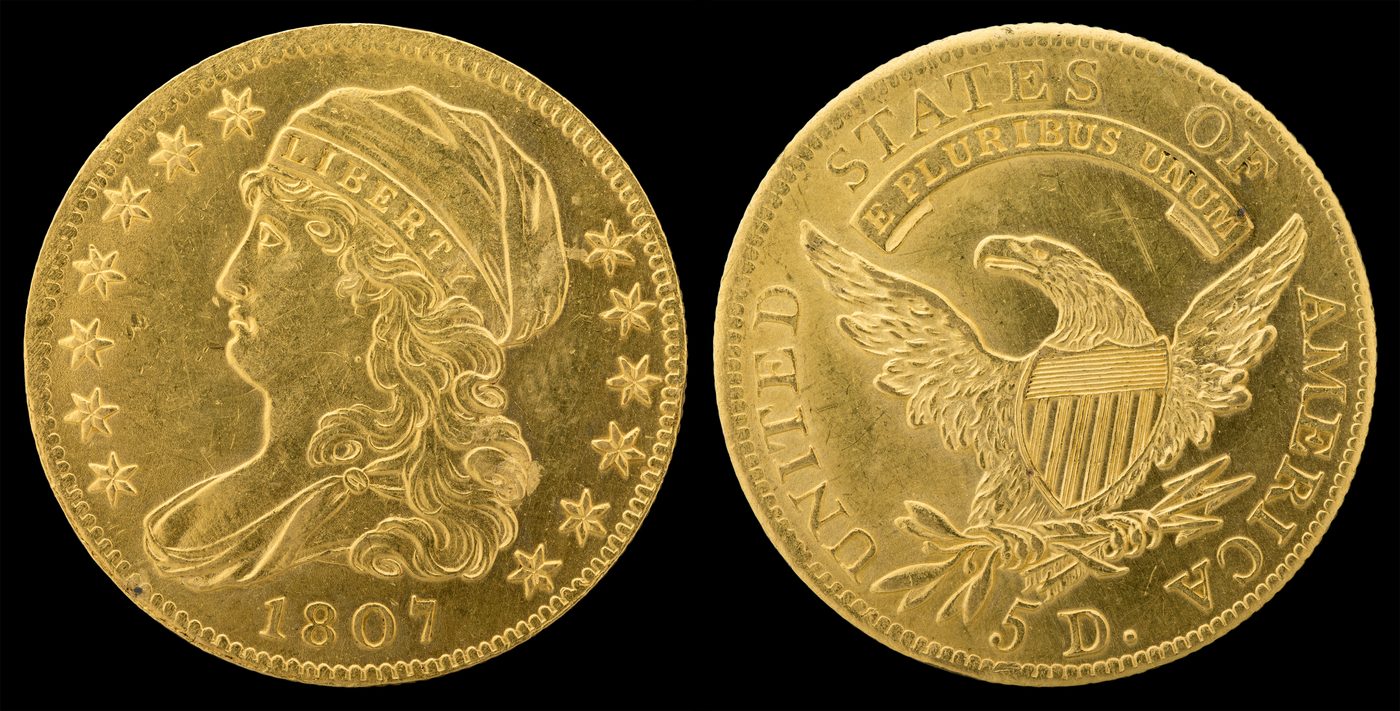
US Mint (coin), National Numismatic Collection, National Museum of American History (photograph by Jaclyn Nash) · public domain · source

The United States struck nearly 400,000 of these $5 gold pieces in just six years. Almost none of them stayed home. Merchants shipped the gold to Europe, where it was worth more melted than spent — which is exactly why a coin made by the hundreds of thousands is hard to find today.

The story behind the coin

In 1807 a German immigrant who had come to America as an indentured servant put his stamp on the country's gold. His name was John Reich, and the half eagle — the $5 gold piece — was one of the first coins he redesigned.

The half eagle mattered out of all proportion to its size. The United States had no paper currency from the federal government yet, and Congress had quietly suspended the silver dollar in 1804. That left gold coins like the half eagle as the country's largest, most serious money — the coin of banks, big merchants, and international trade.

And that was the problem. Gold trades on its metal, not its stamp. Through this whole period, the bullion in a U.S. half eagle was often worth more abroad than $5 at home. So merchants and bankers took the freshly minted coins, shipped them across the Atlantic — mostly to England — and had them melted into bullion. The Mint was, in effect, running a foundry for Europe. Coins poured out the door and never came back.

That single fact shapes everything a collector needs to know. The mintages look healthy — tens of thousands a year. The survivors do not. Hold one of these and you're holding a coin that got lucky: it dodged the melting pot that swallowed most of its brothers.

The design and who made it

Reich's arrival was no accident. In 1806 a new Mint director, Robert Patterson, wanted the coinage refreshed, and he pushed to hire Reich as assistant engraver under the long-serving chief engraver, Robert Scot. Reich started on April 1, 1807, at $600 a year — and immediately set about replacing Scot's older designs.

On the obverse — the heads side — Reich gave America a new Liberty. She faces left, her hair gathered into a soft, loose cap, with a band across it reading LIBERTY and drapery falling at her neck and shoulder. Thirteen stars surround her, seven to the left and six to the right, with the date below. That draped, capped portrait is why the type is often called the Capped Draped Bust — and why it's distinct from the later 1813 redesign, where Reich stripped away the drapery and enlarged the head.

The reverse — the tails side — was just as new. Reich threw out Scot's busy heraldic eagle and gave the coin a single, naturalistic eagle with its wings spread, clutching an olive branch and arrows. Above it floats a ribbon reading E PLURIBUS UNUM — "out of many, one" — wrapped around the legend UNITED STATES OF AMERICA, with the denomination spelled simply as 5 D. at the bottom.

Reich left a quiet signature most people never notice: a small notch in the lowest star on the right. It's his mark, hidden in plain sight on America's money. He served the Mint a decade, then left in 1817 — by some accounts over a refused raise, by others ill health — and died around 1832 or 1833 in relative obscurity, his designs far more famous than his name.

Key facts

Denomination
Half eagle ($5 gold)
Years struck
1807–1812
Designer
John Reich (obverse and reverse)
Composition
91.67% gold, 8.33% copper (.9167 fine)
Weight
8.75 g (135.0 grains)
Diameter
25 mm
Edge
Reeded
Mint
Philadelphia (no mint mark)
Approx. total mintage
~399,000 across six years
Scarcest issue
1808/7 overdate

Collecting it: dates, varieties, and why grades matter

Here's the good news for collectors: as early U.S. gold goes, the 1807–1812 half eagle is one of the more attainable types. The mass melting hit later dates of this series harder, and a surprising number of clearly gradable Capped Bust Left coins survived. There are no impossible "stoppers" if you simply want one example, or even one of each year.

The chase starts with the varieties.

The 1808/7 overdate is the prize. The Mint reused a 1807 die and repunched an 8 over the 7 — and you can still see the ghost of the old digit. It's the scarcest issue of the type, with fewer than about 175 examples thought to survive and only a small handful in Mint State.

The year 1810 is its own puzzle box. Collectors recognize four combinations of date and denomination size, from the common Large Date / Large 5 down to the Large Date / Small 5 — a coin so rare that only an estimated four to six pieces are known. A date-only collector might own a single 1810 and never think twice; a variety specialist could spend years on that one year alone.

Then there's grade. Grade is the measure of how worn or well-preserved a coin is. Because these pieces were money first and collectibles never — they circulated hard, and most were melted — high-grade survivors are genuinely scarce. A coin in MS63 (a solid uncirculated grade) is already considered rare for the type, and true gems in MS65 or finer exist in single digits for most dates. One more catch the specialists warn about: most surviving half eagles of this era have been cleaned or "processed" at some point, which hurts both eye appeal and value. An original, uncleaned coin with honest color and luster is the one worth holding out for.

Questions collectors ask

Why is it called the 'Capped Draped Bust' half eagle?

Because John Reich's Liberty wears a soft cap and has drapery at her neck and shoulder. That detail separates this 1807–1812 type from Reich's 1813 redesign, where he removed the drapery and enlarged the head — the 'Capped Head' type. Collectors also call the 1807–1812 design the 'Capped Bust Left' half eagle.

If hundreds of thousands were made, why are they hard to find?

Gold trades on its metal. Through this period the bullion in a U.S. half eagle was often worth more in Europe than $5 at home, so merchants shipped the coins overseas — mostly to England — to be melted. The mintages were large; the survival rate was not.

What's the rarest date or variety?

The 1808/7 overdate is the scarcest single issue of the type, with fewer than about 175 examples known. Among the 1810 varieties, the Large Date / Small 5 is extraordinarily rare — only an estimated four to six pieces are known.

Who designed it, and did he do both sides?

John Reich — born in Bavaria, who came to America as an indentured servant — designed both the obverse (Liberty in a cap) and the reverse (the naturalistic eagle with the E PLURIBUS UNUM ribbon). He was the Mint's assistant engraver, hired in 1807.

Does it have a mint mark?

No. Every coin of this type was struck at the Philadelphia Mint, which used no mint mark in this era.

Sources