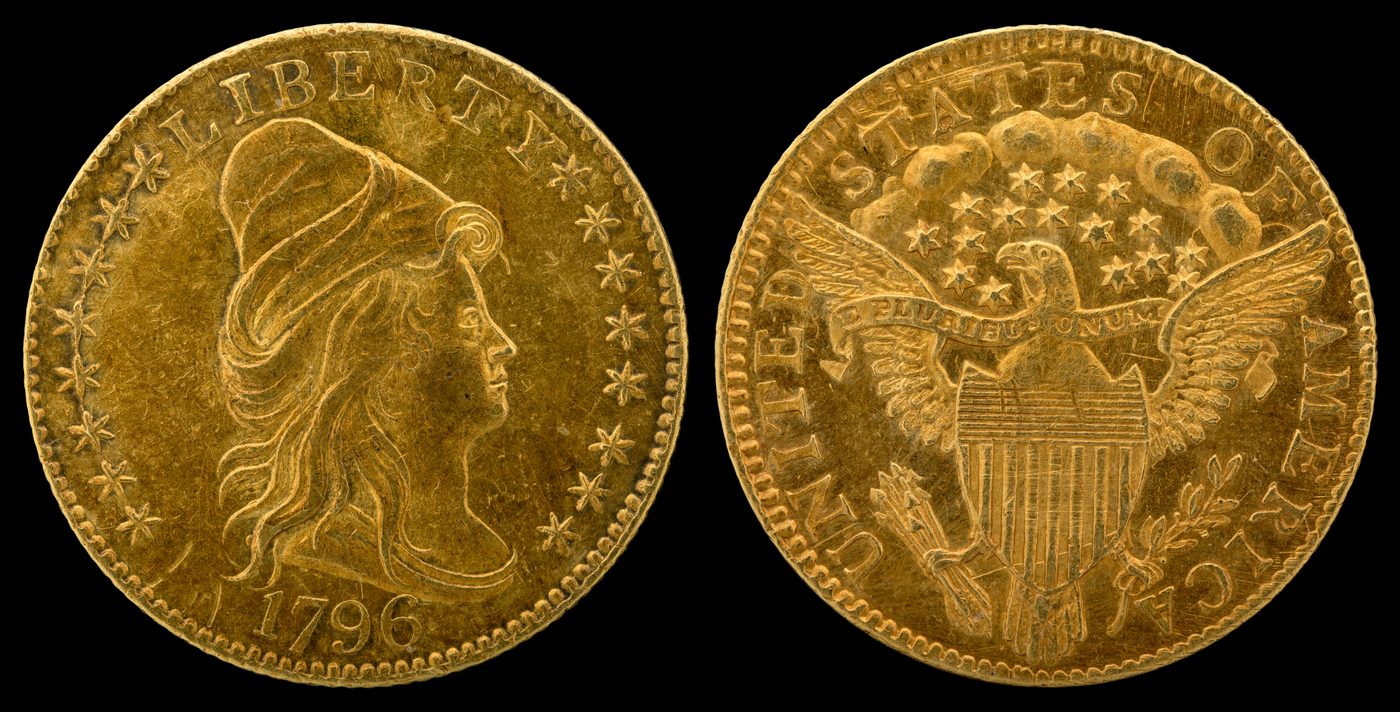
US coin · series

The Capped Bust Right Quarter Eagle: America's First $2.50 Gold Coin

Eight years, fewer than 20,000 coins, and one of the great rarities in U.S. gold.

The Capped Bust Right Quarter Eagle: America's First $2.50 Gold Coin
US Mint (coin); National Numismatic Collection, National Museum of American History (photograph by Jaclyn Nash) · public domain · source

In 1796, a brand-new nation struck its first $2.50 gold piece. The whole first delivery was sixty-six coins. Two centuries later, collectors still hunt the survivors.

The story behind the coin

The United States Mint was barely four years old when it tried gold for the first time at the smallest size: the quarter eagle, worth two dollars and fifty cents.

The first delivery, on September 21, 1796, was sixty-six coins. A second delivery that December added 897 more. That was effectively the entire first year — a few hundred small gold pieces from a mint still finding its feet in a rented building in Philadelphia.

Gold barely circulated in the young republic, and that is the key to the whole series. The Mint did not stockpile metal; it struck coins to order, from gold that banks and merchants brought in. Almost nobody asked for the little $2.50 piece. Worse, the coins were worth slightly more as metal than as money, so they were melted, shipped abroad, or hoarded. That is why the quarter eagle appears in fits and starts — struck in 1796, 1797, and 1798, then nothing for years, then 1802, 1804, 1805, 1806, and 1807. There is no 1799, 1800, 1801, or 1803 quarter eagle. Across the whole eight-year run, the Mint made fewer than 20,000 of them.

So this is not a coin Americans spent. It is a coin the nation proved it could make — the first $2.50 gold piece, struck in tiny numbers by a mint still learning its craft, and survived by a sliver of luck.

The design and who made it

The man behind it was Robert Scot, the Mint's Chief Engraver, who cut both sides — the obverse (the "heads" side) and the reverse (the "tails" side).

On the obverse, Liberty faces right, draped, wearing a soft cap. Collectors nicknamed the type "Turban Head," but that is a happy accident: it is a Phrygian cap — an ancient symbol of freedom worn by freed Roman slaves — and the way Liberty's hair coils around it makes it look like a turban. The word LIBERTY arcs above, the date sits below.

The very first 1796 coins carried no stars on the obverse. Later in 1796 Scot added stars around Liberty, and from then on every quarter eagle of the type wears them. That single change — stars or no stars — splits the first year into two of the most coveted coins in American numismatics.

The reverse is a heraldic eagle, copied from the Great Seal of the United States: a spread-winged bird with a striped shield on its breast, an olive branch in one talon and a bundle of arrows in the other, and a ribbon in its beak reading E PLURIBUS UNUM — "out of many, one." UNITED STATES OF AMERICA runs around the rim. It is stiff and formal, an engraver's faithful copy of an official emblem rather than living art, and contemporaries grumbled that early U.S. eagles looked scrawny. That criticism eventually cost Scot the job: in 1808 the immigrant engraver John Reich replaced the design with a softer, left-facing Liberty and a more natural eagle, ending the Capped Bust Right type for good.

Key facts

Denomination
Quarter eagle ($2.50)
Years struck
1796–1807 (eight years; no 1799–1801 or 1803)
Designer
Robert Scot — obverse and reverse
Obverse
Liberty in a Phrygian cap, facing right (the "Turban Head")
Reverse
Heraldic eagle after the Great Seal, E PLURIBUS UNUM
Composition
.9167 gold (22 karat), balance silver and copper
Weight
≈4.37 g (67.5 grains)
Diameter
≈20 mm
Edge
Reeded
Total mintage (all years)
Fewer than 20,000 coins
First-year rarity
1796 No Stars — 963 struck
Series key
1804 13-star reverse — about 9 believed to exist
Replaced by
John Reich's Capped Bust Left, 1808

Collecting it: key dates and rarities

Every date in this series is rare by ordinary standards — the common years still had mintages most coins would envy as their rarest. The 1805, often called one of the more available dates, had a reported mintage of just 1,781 pieces.

A few stand out:

  • 1796 No Stars — the first quarter eagle ever, and the only one without stars on the obverse. Reported mintage of 963; perhaps 100–125 survive in any condition. One of the most famous and historic of all U.S. gold coins.
  • 1796 With Stars — even scarcer to begin with: only 432 struck after Scot added the stars later that year. Same year, two completely different coins to chase.
  • 1797 — a tiny issue (reported around 427 pieces) with only a couple dozen thought to survive.
  • 1804 13-Star Reverse — the undisputed key to the series. Most 1804 quarter eagles show 14 stars on the reverse; the 13-star variety is believed to exist in only about nine examples across all grades.
  • 1806 overdates — the 1806 comes as an overdate two ways, a 6 punched over a 4 (1806/4) and over a 5 (1806/5), the latter much scarcer. An overdate happens when the Mint reused an old die and re-cut the new year over the old one — you can still see the ghost of the earlier digit.
  • 1807 — the most available date of the whole type, and the one most type collectors target for a single representative example.

High grades are brutally scarce, and the reason is the same one that kept mintages low. These coins barely circulated in commerce; many sat in bank vaults and were melted when gold rose, so survivors tend to be lightly worn pieces that escaped the furnace rather than pristine ones that were carefully saved. A genuine Mint State (uncirculated) Capped Bust Right quarter eagle is a major event. For most collectors, owning any honest example of the type — even well-circulated — is the achievement.

Questions collectors ask

Why is it called the Turban Head quarter eagle?

It's a nickname, not a fact about the design. Liberty wears a Phrygian (liberty) cap — an old symbol of freedom — but her hair coils around it in a way that looks like a turban, so collectors dubbed the type 'Turban Head.' It's the same coin as the Capped Bust Right quarter eagle.

What's the difference between the 1796 No Stars and With Stars quarter eagles?

Both were struck in 1796. The very first coins had no stars on the obverse (963 struck). Later that year Robert Scot added stars around Liberty (only 432 of that variety). They're two separate, highly prized coins from the same first year.

Why are there no 1799, 1800, 1801, or 1803 quarter eagles?

The Mint struck gold to order, from metal that depositors brought in, and almost nobody wanted the small $2.50 piece. In those years no quarter eagles were struck at all. Production resumed with the 1802 and 1804 dates.

What is the rarest date in the series?

The 1804 with a 13-star reverse is the key. Only about nine examples are believed to exist in all grades. The 1796 No Stars is the most historic and famous, but the 1804 13-star is the scarcest.

What is the coin made of?

It's 22-karat gold — .9167 fine — with the remainder a silver-and-copper alloy, the standard set by the Coinage Act of 1792. It weighs about 4.37 grams and is roughly 20 mm across, with a reeded edge.

Who designed it, and what came after?

Robert Scot, the Mint's Chief Engraver, designed both sides. The type ran through 1807. In 1808 John Reich replaced it with a new left-facing Liberty and a more natural eagle — the Capped Bust Left quarter eagle.

Sources