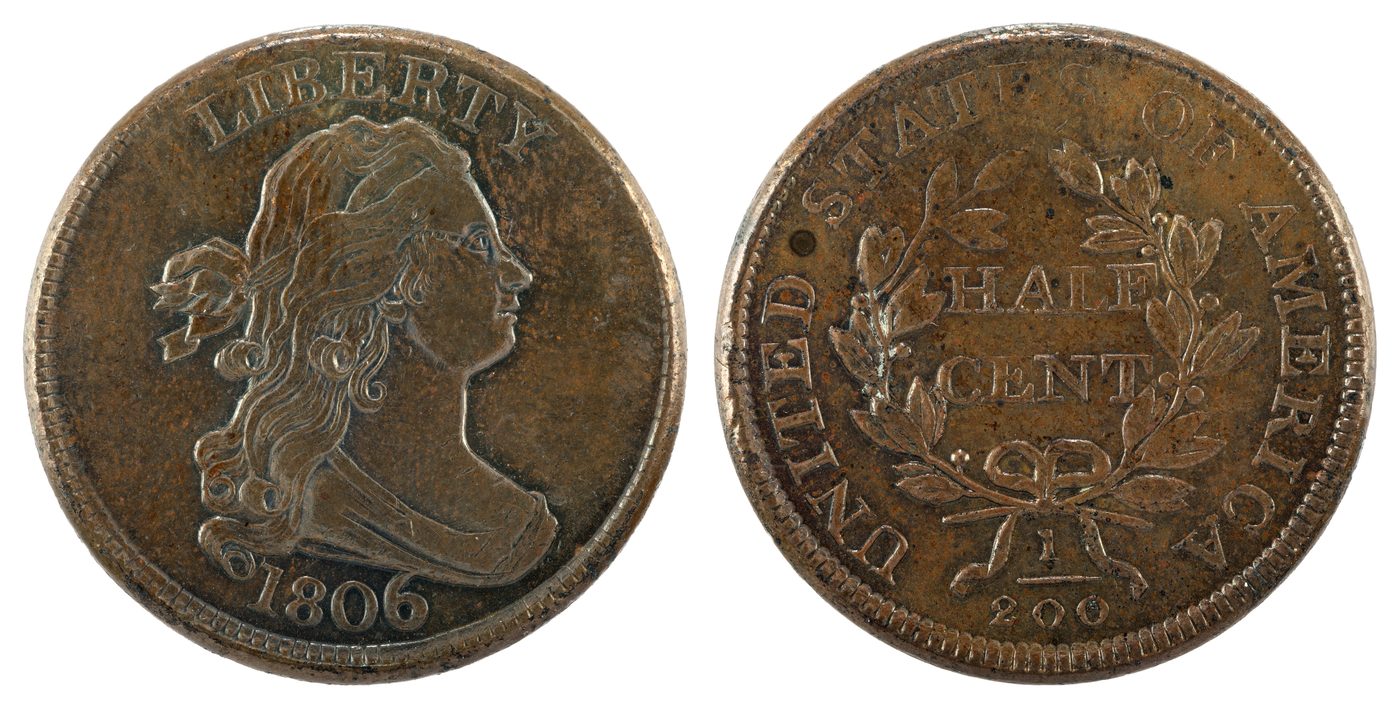
US coin · series

The Half Cent — the smallest coin America ever made

Worth a two-hundredth of a dollar, struck in pure copper, and quietly abolished by Congress in 1857.

The Half Cent — the smallest coin America ever made
US Mint (coin); photograph by Jaclyn Nash, National Numismatic Collection, National Museum of American History (Smithsonian) · public domain · source

In 1793 the brand-new United States Mint struck a coin worth one two-hundredth of a dollar — five mills, half of one cent. No U.S. coin before or since has been worth less. It ran for 64 years, was never much loved, and died by act of Congress.

The smallest money America ever minted

In 1793, in its very first year of striking coins, the United States Mint made a coin worth one two-hundredth of a dollar. That is the half cent — five mills, half of a single penny — and no American coin before or since has ever been worth less.

It sounds absurd today. But in the 1790s, half a cent bought something real. A young country was hungry for small change, foreign coins still circulated everywhere, and prices were often quoted in fractions a modern shopper would never recognize. A coin worth a half cent let a merchant make exact change instead of rounding against a poor customer. That was the whole point.

The catch was that almost nobody wanted to carry it. The half cent was awkward, low in value, and forever in the shadow of the large cent struck beside it. For 64 years the Mint kept making it — sometimes a few hundred thousand at a time, sometimes barely any, sometimes none at all — until Congress finally pulled the plug in 1857. By then a half cent still bought roughly what a dime buys today, but it had become, in the Mint's eyes, simply not worth the bother.

Five faces of Liberty, all in copper

The half cent was always pure copper, and it always showed the head of Liberty on the obverse — the "heads" side — with a wreath circling the words HALF CENT on the reverse, the "tails" side. But across 64 years it wore five completely different faces, each by a different hand at the early Mint.

The first, in 1793 alone, shows Liberty facing left with a soft cap on a pole behind her — a Liberty Cap, the ancient symbol of a freed slave that the young republic adopted as a badge of liberty itself. The design is usually credited to Henry Voigt, the Mint's first chief coiner. In 1794 the chief engraver Robert Scot reworked it so Liberty faced right, and that version ran through 1797.

Then came the Draped Bust (1800–1808), based on a Gilbert Stuart drawing and engraved by Scot — a more refined, classical Liberty. John Reich's Classic Head followed (1809–1836), giving Liberty a band reading LIBERTY across her hair. Finally Christian Gobrecht — the same artist behind the elegant Seated Liberty silver coins — designed the Braided Hair half cent (1840–1857), with Liberty's hair gathered in a tight braided coronet. Five designers, five Libertys, one tiny copper coin.

Key facts

Years struck
1793–1857 (with gaps)
Denomination
Half cent — 1/200 of a dollar (five mills)
Composition
100% copper, throughout the entire run
Diameter
About 23.5 mm for most of the series
Authorized by
Coinage Act of April 2, 1792
Designs
Liberty Cap, Draped Bust, Classic Head, Braided Hair
Designers
Henry Voigt, Robert Scot, John Reich, Christian Gobrecht
Rarest date
1796 — no more than roughly 200 believed to survive
Discontinued by
Coinage Act of February 21, 1857

Collecting it: the gaps are the story

What makes the half cent fascinating to collectors is how erratic its production was. This was never a coin the Mint cranked out steadily. In some years it struck hundreds of thousands; in others it skipped the denomination entirely.

The most famous prize is the 1796 half cent. No more than about 200 are believed to survive in all conditions, which puts it among the great rarities of early American copper — top examples have sold into six figures. The first year, 1793, is also scarce and prized as the coin that started the denomination, with a recorded mintage of 35,334.

The late series is where it gets strange. The Mint made no half cents for circulation from 1837 through 1839, and again through most of the 1840s. Yet coins dated in those gaps still exist — because the Mint struck small numbers of proofs (specially made, mirror-finish coins) for collectors and dignitaries, and later struck restrikes of earlier dates to satisfy collector demand. Telling an original proof from a later restrike is a genuine specialist's puzzle, and it is half the fun of collecting Braided Hair half cents. Because so little of this copper survives in high grade — it was spending money, not treasure — a sharp, well-preserved half cent of almost any date rewards a careful eye.

Questions collectors ask

What is a half cent worth?

As money, it was worth one two-hundredth of a dollar — half of one cent — when it circulated. As a collectible today, value depends entirely on date and condition. Common worn dates are affordable; the rare 1796 has sold for well into six figures in top grade.

Why did the U.S. make a half-cent coin?

In the 1790s half a cent bought real goods, and the young country badly needed small change to make exact transactions. The half cent let merchants give precise change instead of rounding against the customer.

Why was the half cent discontinued?

The Coinage Act of February 21, 1857 ended it. By then it was unpopular and never widely used, and stopping it saved copper. The same act killed the large cent and introduced the small cent we know today.

What is the rarest half cent?

The 1796 is the rarest date in the whole series, with no more than roughly 200 believed to survive across all conditions.

Who designed the half cent?

Five designs by four engravers: Henry Voigt (1793 Liberty Cap), Robert Scot (later Liberty Cap and the Draped Bust), John Reich (Classic Head), and Christian Gobrecht (Braided Hair).

Is the half cent made of silver?

No. The half cent was always struck in 100% copper, for its entire run from 1793 to 1857.

Sources