US coin · series

The Draped Bust Cent (1796–1807)

A young republic's biggest coin in daily use — and the copper that early Americans actually carried.

The Draped Bust Cent (1796–1807)
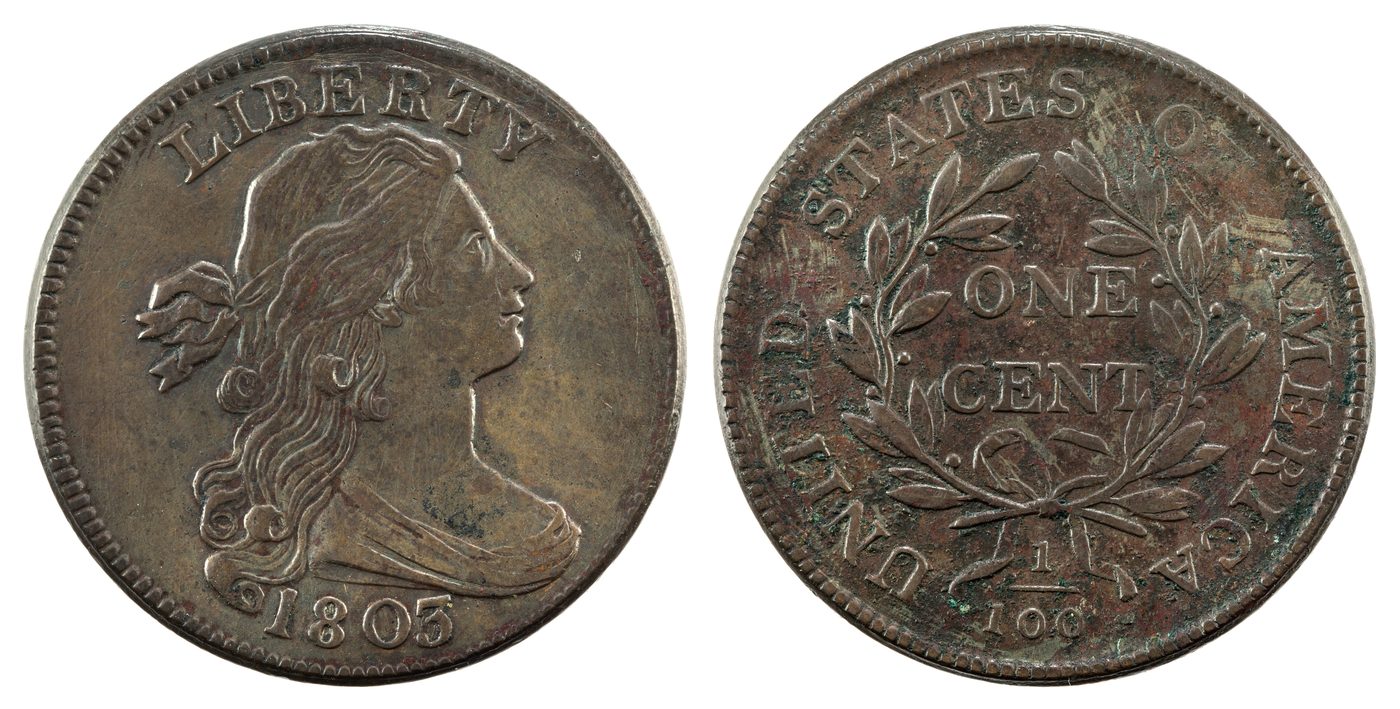
National Numismatic Collection, National Museum of American History (Smithsonian); photograph by Jaclyn Nash. Coin designed by Robert Scot, U.S. Mint · public domain · source

In 1796 the United States Mint gave its lowest coin a new face: a softer, more graceful Liberty draped at the shoulder. Over the next eleven years it struck more than sixteen million of these large copper cents. Two dates — 1799 and 1804 — became some of the most famous rarities in all of American coinage.

The story behind the coin

In 1796 a copper cent was real money. It was the coin a young republic handed across a counter for a newspaper, a candle, a glass of cider. And it was big — about the size of a modern half dollar, struck on a fat copper disc nearly 29 millimeters across. There were no nickels, no dimes most people ever saw in change; the cent did the everyday work.

That year the brand-new United States Mint in Philadelphia gave the cent a fresh portrait. Out went the wild-haired, slightly severe Liberty of the earlier Liberty Cap design. In came a softer, more refined Liberty with flowing hair, a ribbon, and drapery gathered at the shoulder — the "Draped Bust." The Mint rolled the same new portrait across nearly the whole coinage that year: the dollar had received it in 1795, and in 1796 it appeared on the half dime, dime, quarter, and half dollar too. The cent was the workhorse of the set.

The timing matters. This was the founding era of American money itself. The Mint was only a few years old, its dies were cut by hand, its presses were cranked by muscle, and copper was scarce and expensive. Cents were struck in fits and starts as planchets — the blank copper discs — arrived. When you hold a Draped Bust cent, you're holding one of the first coins a sovereign United States ever made for its own people to spend.

The design and who made it

The obverse — the "heads" side — shows Liberty facing right, hair loose down her back, a draped cloth across her shoulder, the word LIBERTY above and the date below, ringed by stars. The reverse — the "tails" side — carries ONE CENT inside a wreath of laurel, with UNITED STATES OF AMERICA around the rim and the fraction 1/100 beneath, a plain reminder that a hundred of these made a dollar. The edge is plain.

The documented designer is Robert Scot, the Mint's first Chief Engraver, who cut the dies and is credited with both sides. He didn't work alone: Assistant Engraver John Smith Gardner and Assistant Coiner Adam Eckfeldt are recorded helping bring the design into production.

Now the famous story — and it is a story. For generations, collectors have repeated that the celebrated portrait painter Gilbert Stuart sketched this Liberty, using as his model Ann Willing Bingham, a Philadelphia society figure said to be the great beauty of her day. It's a wonderful tale, and you'll see it told as fact almost everywhere. But modern researchers treat it with real skepticism: the supposed Stuart sketch has never been found, and the embellished Bingham version traces largely to a 1966 book, long after the coins were struck. Enjoy the legend for what it is — Scot is the engraver the records actually name.

One small detail rewards a close look. The first 1796 cents reused leftover reverse dies from the earlier design (collectors sort them as the "Reverse of 1794," "Reverse of 1795," and the new "Reverse of 1797" by counting the leaves in the wreath). A frugal young Mint wasted nothing.

Key facts

Years struck
1796–1807
Designer
Robert Scot (obverse and reverse)
Composition
Pure copper
Weight
10.89 g (168 grains)
Diameter
~29 mm
Edge
Plain
Mint
Philadelphia
Total struck
Over 16 million across the series
Key date
1799 — the series' great rarity
Low-mintage date
1804 — 96,500 struck (originals)
Replaced by
Classic Head cent (John Reich), 1808

Collecting it: key dates, varieties, and why grade is everything

This is a series collectors fall into and never leave, because almost every coin tells on itself. Each die was engraved by hand, so the cents come in hundreds of distinguishable die marriages — pairings of one obverse die with one reverse die. The standard map is the Sheldon system, from Dr. William H. Sheldon's Early American Cents and its 1958 revision Penny Whimsy. Some "Sheldon numbers" survive in only a handful of pieces, which turns date collecting into a lifelong hunt.

The 1799 is the crown. It is scarce to rare in every grade and has been a legendary key date since the 1800s. There are two die varieties — the normal date (Sheldon-189) and the dramatic 1799/8 overdate (Sheldon-188), where an old "8" peeks out under the final "9." A caution on numbers: an old "42,540" mintage figure circulated for years, but it was discredited and dropped from the Red Book in 1999, so treat any precise 1799 mintage as unknown. Surviving examples are almost always heavily worn; for decades a true Mint State 1799 was thought not to exist, and the finest known has changed hands for hundreds of thousands of dollars.

The 1804 is the other prize, with an original mintage of just 96,500 — the lowest of the series. Beware a famous trap: an unofficial "1804" cent was concocted around 1860 from a discarded 1803 obverse die altered to read 1804 and an unrelated reverse die from 1820, struck from cracked, rusted dies. These "restrikes" (variously attributed to Joseph Mickley or John Haseltine) are easy to spot once you know them — but they catch beginners, and they are not the real thing.

The series is also a playground of charming errors and oddities: the 1796 "LIHERTY", where a bungled die left an "H" in place of the "B"; the 1801 "Three Errors" reverse, which manages a fraction reading 1/000, a wreath with a stem missing, and a "U" in UNITED built from two I's; and several stemless wreath reverses in 1802 and 1803.

Why is high grade so scarce? These were spending coins, struck on soft copper and used hard; most surviving examples are dark and worn smooth. The bright exception is the Nichols Hoard — a bag of about a thousand cents, mostly dated 1796 and 1797, said to have been set aside by Senator Benjamin Goodhue and kept in the family for generations before David Nichols of near Salem, Massachusetts released them around 1863. That single hoard is the reason a few dozen lustrous, near-original early Draped Bust cents exist at all. Outside it, sharp high-grade survivors of any date are genuinely rare, which is exactly why grade drives value so steeply here.

Questions collectors ask

What is the Draped Bust cent made of?

Pure copper. It's a large cent — about 29 mm across and roughly 10.9 grams — far bigger than a modern penny, because in the 1790s a cent's worth of copper had to actually be in the coin.

Who designed the Draped Bust cent?

Robert Scot, the U.S. Mint's first Chief Engraver, who is credited with both the obverse and reverse. There's a long-told legend that painter Gilbert Stuart designed the Liberty bust using Ann Willing Bingham as a model, but the supposed sketch has never been found and modern scholarship doubts it — Scot is the designer the records name.

Why is the 1799 cent so valuable?

It's the rarest date of the series in every grade and has been a famous key date since the 1800s. Two varieties exist, including the 1799/8 overdate. A genuine Mint State 1799 was long thought impossible to find, and top examples have sold for several hundred thousand dollars.

How many 1804 Draped Bust cents were made?

The original 1804 mintage was 96,500 — the lowest in the series. Watch out for the unofficial 'restrike' made around 1860 from a doctored 1803 die and a leftover 1820 reverse die; it's a later concoction, not an original 1804.

What are Sheldon varieties?

A numbering system from Dr. William Sheldon's books that catalogs the hundreds of individual die pairings used to strike these cents. Because each die was cut by hand, collectors chase specific 'Sheldon numbers,' some known from only a few coins.

Why are nice high-grade examples so hard to find?

These were everyday spending coins struck on soft copper, so most survivors are dark and worn. The main source of bright, high-grade early dates is the Nichols Hoard, a bag of about a thousand cents (mostly 1796–1797) preserved into the 1860s.

Sources