US coin · series

The 1792 Half Disme — America's First Coin

Struck in a cellar, ordered by a president, and gone before the Mint had a roof.

The 1792 Half Disme — America's First Coin
Professional Coin Grading Service (PCGS CoinFacts) · public domain · source

In July 1792, before the United States Mint had walls, the new nation struck its first coin in a sawmaker's basement. It was a five-cent piece of silver called the half disme — and George Washington told Congress it was "a small beginning."

The first coin of a new country

In the summer of 1792, the United States had a constitution, a flag, and a brand-new law authorizing money — but no place to make it. The Mint building in Philadelphia was still under construction. So the country's first coin was struck somewhere else entirely: the cellar of a sawmaker named John Harper, near Sixth and Cherry Streets.

The coin was the half disme — a five-cent piece, worth a twentieth of a dollar. (Disme, from the French for "tenth," is the ancestor of our word dime; the half disme was half of one.) Congress had passed the Coinage Act on April 2, 1792, creating the Mint and a decimal money system built on the dollar. Within months, President George Washington wanted something to show for it.

Around 1,500 silver half dismes were struck that July and handed to Secretary of State Thomas Jefferson on July 13, 1792. Jefferson's own memorandum book records a $75 deposit of silver behind them. He carried the little coins off and spread them as a kind of calling card for the young republic — proof that the United States could now coin its own money.

That fall, Washington reported the result to Congress himself. In his annual address on November 6, 1792, he said: "There has been a small beginning in the coinage of half dimes, the want of small coins in circulation calling the first attention to them." It is, as far as a head of state ever gets, a coin's birth announcement.

The design — and the argument over who made it

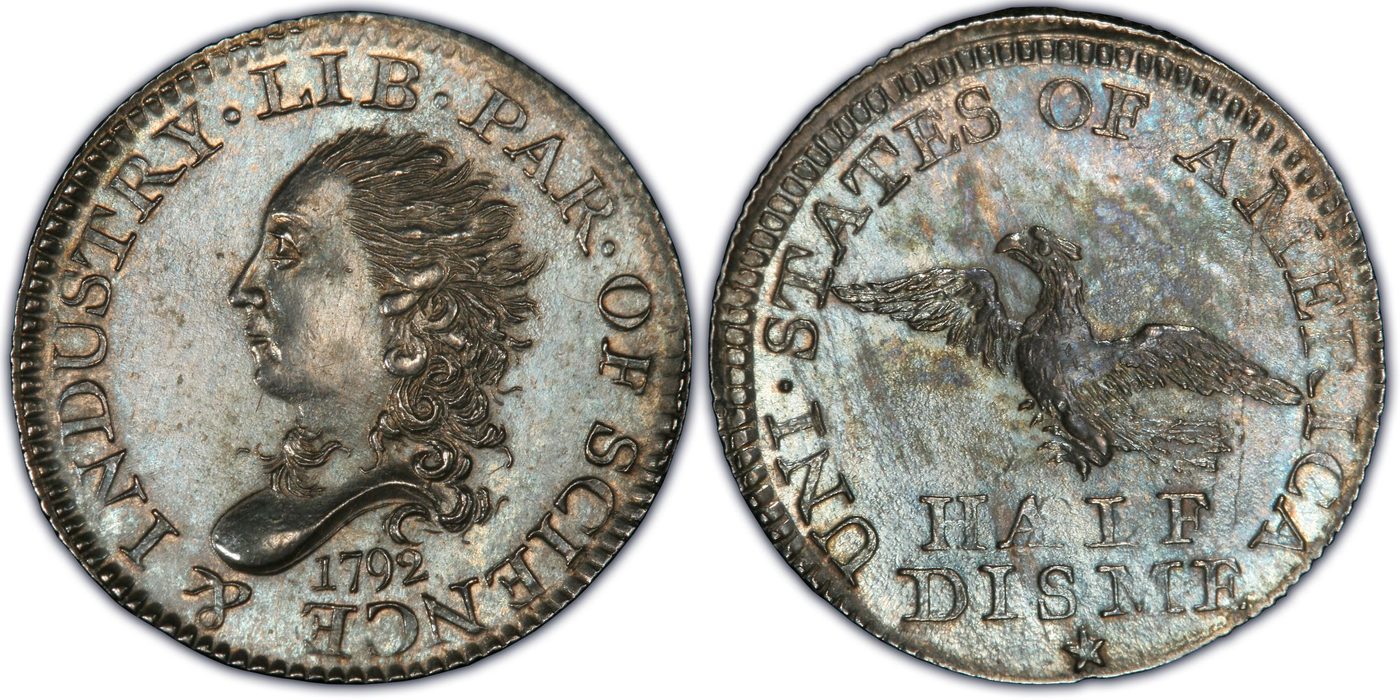
The half disme is tiny — about the size of a fingernail — but every detail was a statement. The obverse (the heads side) shows the head of Liberty facing left, with the date 1792 below and a remarkable motto wrapped around the rim: LIB. PAR. OF SCIENCE & INDUSTRY — "Liberty, Parent of Science and Industry." That line is widely attributed to Benjamin Franklin, and it reads like a thesis statement for the whole American experiment: freedom as the thing that gives birth to knowledge and work.

The reverse (tails) shows an eagle in flight, the words HALF DISME beneath it, a small star, and the legend UNI. STATES OF AMERICA around the edge. An eagle on the wing, not perched — a young country in motion.

Who actually cut these designs is one of the great unsettled questions in American numismatics, and honesty requires saying so. The names most often credited are Robert Birch, an engraver tied to the early Mint, and Joseph Wright, a portrait painter who would soon become the Mint's first draughtsman and die-sinker. The traditional account gives the Liberty obverse to Birch and the eagle reverse to Wright. But newer research has argued the single pair of dies may instead be the work of a British medalist, William Russell Birch — a different man entirely. And the striking itself is usually credited to Henry Voigt, the Mint's acting chief coiner, working Harper's press. The record is thin, and the experts still disagree. We name the leading candidates; we don't pretend the case is closed.

One famous "fact" about the coin is pure legend. A story holds that the Liberty portrait is really Martha Washington. It is charming and persistent — and unsupported. The tale appears to have been popularized decades later by a Mint director, and contemporary evidence does not back it. The face on the coin is Liberty, an idea, not a first lady.

Key facts

Year struck
1792
Denomination
Half disme (5 cents / 1/20 dollar)
Designers (disputed)
Robert Birch and/or Joseph Wright; newer research suggests William Russell Birch
Struck by
Henry Voigt, in John Harper's cellar, Philadelphia
Composition
~89.2% silver, ~10.8% copper (0.892 fine)
Weight
~1.35 g
Diameter
~16.5–17.5 mm (sources vary)
Mintage
~1,500 received by Jefferson, July 13, 1792 (some sources estimate more struck)
Estimated survivors
~250–400
Obverse motto
LIB. PAR. OF SCIENCE & INDUSTRY (attributed to Benjamin Franklin)
Significance
First coin struck by the United States Mint

Collecting the 1792 half disme

There is only one date and one design — 1792 — so the half disme is not a coin you "complete a set" of. You chase the single coin itself, and the chase is steep. Of the roughly 1,500-plus struck, scholars estimate only about 250 to 400 survive. Many of those circulated hard: Jefferson's coins went into pockets and stayed there, so most survivors are worn, sometimes heavily, with the obverse motto faded to a whisper. That circulation is itself the evidence that this was real money, not a trial piece.

A handful escaped wear. The finest known is the Rittenhouse–Hendelson specimen, graded PCGS MS68 — a coin tied to first Mint Director David Rittenhouse himself. It sold in 2018 for a reported $1,985,000, the highest price ever paid for any U.S. half dime (a denomination struck from 1792 to 1873). Even well-circulated examples regularly reach five and six figures, because there is simply no substitute: this is the first U.S. coin, and demand always outruns the tiny supply.

A note on terminology collectors should know. For years the half disme was debated as a pattern — a trial or experimental piece — because it was struck privately, before the Mint opened, alongside genuine 1792 patterns like the Birch cent and the silver-center cent. But the modern consensus, reflected in the Red Book (the standard U.S. coin guide), treats it as a true regular issue: it was struck in quantity, it circulated, and the president himself called it coinage. A unique companion piece struck in copper also exists, and is treated as a separate rarity. Grading, then, matters enormously here — and so does the holder. Because so few exist and the stakes are so high, slabbed and certified examples are the norm at this level; provenance (whose collection a coin passed through) can add real value on its own.

Questions collectors ask

Is the 1792 half disme really the first U.S. coin?

Yes, by the standard reading. It was the first coin struck under the authority of the 1792 Coinage Act and the new federal Mint — struck in July 1792, before the Mint building was finished, in a Philadelphia cellar. Earlier 1792 pieces like the Birch cent and silver-center cent are treated as patterns; the half disme circulated as money.

Is the portrait Martha Washington?

No — that's a legend, not a fact. The figure is Liberty, an allegory. The Martha Washington story appears to have spread decades after 1792 and has no solid contemporary support. We label it as the myth it is.

Who designed the 1792 half disme?

It's genuinely disputed. The names traditionally credited are Robert Birch and Joseph Wright (often obverse and reverse, respectively); newer research argues for British medalist William Russell Birch. The striking is usually credited to Henry Voigt. Reputable sources disagree, so be wary of any single confident attribution.

How much is a 1792 half disme worth?

A lot — even worn ones reach five and six figures, because only an estimated 250 to 400 survive. The finest known, a PCGS MS68 tied to David Rittenhouse, sold in 2018 for a reported $1,985,000. Condition and provenance drive the price.

Why was it struck in a basement?

Because the U.S. Mint building wasn't finished yet. To get coinage going, the first half dismes were struck on a press set up in sawmaker John Harper's cellar near Sixth and Cherry Streets in Philadelphia.

What does 'half disme' mean?

'Disme' is an old spelling from the French word for 'tenth' — the ancestor of 'dime.' A disme was a tenth of a dollar (ten cents); a half disme was half of that, or five cents.

Sources