US coin · series

The Draped Bust Quarter: America's First 25-Cent Piece

A coin the young Mint struck once, abandoned for seven years, then quietly brought back.

The Draped Bust Quarter: America's First 25-Cent Piece
None required (Artist: "Unknown author"; AttributionRequired = false) · public domain · source

In 1796 the United States struck a quarter dollar for the very first time — 6,146 of them — and then didn't make another for seven years. That single year is one of the great prizes of early American coinage, and the whole short series is a window into a Mint still learning how to make money at all.

The story behind the coin

In 1796 the United States Mint did something it had never done before: it struck a quarter dollar. Then it stopped — and didn't strike another one for seven years.

The Mint was barely four years old and overwhelmed. Founded by the Coinage Act of 1792, it had brought its denominations online one at a time: copper cents in 1793, the first silver in 1794, gold in 1795. The quarter came late, in 1796, alongside the first dime and the first quarter eagle. Everything was made by hand. Workers fed blank discs of metal — planchets — one at a time between a pair of engraved steel dies, then turned a heavy screw press by muscle to stamp the design. Output was tiny by any modern measure.

The 1796 quarters trickled out in a handful of deliveries: 1,800 pieces on April 9, then more in May and June, with a last small batch of 252 in early 1797. The grand total was just 6,146 coins. After that, the quarter simply went dark. The Mint had a backlog of more useful denominations — dollars, half dollars, cents — and a quarter was a low priority. Not until 1804 did a single new quarter leave the building.

So the series breaks cleanly in two. There is the lonely 1796 issue. Then, after a seven-year gap, the quarter returns for 1804 through 1807 — and this time it stays, the start of an unbroken American quarter that runs to this day.

The design and who made it

The face of the coin is the "Draped Bust" Liberty — and it came to the Mint through an unusually artistic chain of hands.

Mint officials wanted a softer, more elegant Liberty than the wild-haired figure on the earliest silver. The story long told is that the celebrated portrait painter Gilbert Stuart — the man who painted the Washington on the dollar bill — supplied a drawing of Liberty, possibly modeled on a Philadelphia society figure named Ann Willing Bingham. That drawing was worked into plaster models by an artist named John Eckstein, and finally cut into working coinage dies by the Mint's Chief Engraver, Robert Scot. Scot is the designer of record for the coin as struck. (Treat the Stuart-and-Bingham origin as the traditional account — no sketch survives, and parts of the tale are disputed by historians.)

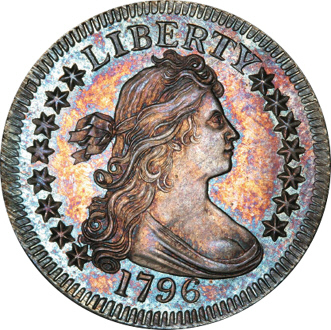
The obverse — the heads side — shows Liberty facing right, hair loose behind a ribbon, with drapery across her shoulders. LIBERTY arches above, the date sits below, and stars run down each side. The 1796 coin carries fifteen stars, one for each state then in the Union.

The reverse — the tails side — is where the two halves of the series part ways. The 1796 quarter wears the Small Eagle: a slender, almost delicate bird perched inside an open wreath. It is the only quarter ever made with this reverse, and the only quarter struck in the 1700s. When the denomination returned in 1804, it wore the Heraldic Eagle instead — a bold, spread-winged eagle borrowed from the Great Seal of the United States, clutching arrows and an olive branch behind a shield. That heraldic bird is what most early American silver of the era looks like.

Key facts

Years struck
1796, then 1804–1807
Designer
Robert Scot (Chief Engraver), after a Gilbert Stuart portrait worked up by John Eckstein
Composition
89.24% silver, 10.76% copper
Weight
approx. 6.74 g
Diameter
approx. 27.5 mm
Edge
Reeded
Reverse types
Small Eagle (1796 only) · Heraldic Eagle (1804–1807)
First-year mintage (1796)
6,146 — the only 18th-century quarter
Key date
1804 — 6,738 struck, the lowest mintage of the Heraldic Eagle years
Best-known variety
1806/5 overdate

Collecting it: key dates, varieties, and why high grades are scarce

This is a short series — only five dates — but it is one of the toughest type sets in American numismatics to complete, and two coins do most of the work.

The 1796 is the headline. As a one-year design, the only quarter of the 1700s, and the only quarter with the Small Eagle reverse, it is on the want list of nearly every serious type collector — which means a tiny surviving population chases enormous demand. Estimates put survivors at roughly 10% of the original 6,146 struck, with only a few dozen known in Mint State (uncirculated, never spent). The finest examples sell for sums well into the high six and even seven figures.

The 1804 is the key date of the later run. Its mintage of just 6,738 — barely more than the famous 1796 — makes it the rarest of the Heraldic Eagle quarters, scarce in every grade and genuinely rare nice. After that the numbers climb: the 1805 (121,394), 1806 (206,124), and 1807 (220,643) are the obtainable dates, the ones a collector reaches for to fill the type.

The marquee variety is the 1806/5 overdate — a coin where the engraver punched a fresh "6" over an old "5" in the date, leaving the earlier digit faintly visible underneath. It's a popular, collectible variety rather than a true rarity. Specialists chase the whole series by Browning numbers (the "B-" reference that catalogs each die pairing).

A word on grade. These quarters are notoriously weakly struck — the screw presses of the day often couldn't drive metal fully into the deepest parts of the design, so detail at the eagle's head and the centers can look soft even on a coin that never circulated. Add two centuries of wear, and high-grade survivors are genuinely scarce. That softness is why a sharp, well-struck Draped Bust quarter commands a steep premium over a worn one — and why grading these coins is as much about strike as about preservation.

Questions collectors ask

Was the Draped Bust quarter really the first U.S. quarter?

Yes. The first quarter dollars ever struck by the United States Mint were the 1796 Draped Bust quarters — 6,146 of them. No quarter had been made before, and none would be made again until 1804.

Why is the 1796 quarter so valuable?

Three things stack up: it's the only quarter struck in the 1700s, the only one with the Small Eagle reverse, and a one-year design — all on a tiny mintage of 6,146. Roughly 10% are thought to survive, so a great deal of demand chases very few coins.

Why are there no quarters dated 1797 through 1803?

The young Mint was small and overwhelmed, and the quarter was a low priority next to dollars, halves, and cents. After the 1796 issue it simply stopped making quarters and didn't resume until 1804.

What's the difference between the Small Eagle and Heraldic Eagle reverses?

The 1796 quarter has the Small Eagle — a slender bird in an open wreath. When the quarter returned in 1804 it wore the Heraldic Eagle, a bold spread-winged eagle with a shield, arrows, and olive branch, taken from the Great Seal. The 1796 is the only quarter with the Small Eagle.

What is the 1806/5 overdate?

It's an 1806 quarter struck from a die where the last digit was punched over an older 1805 die — a faint '5' shows beneath the '6.' It's the best-known variety of the series and very collectible, though not especially rare.

Who designed the Draped Bust quarter?

Robert Scot, the Mint's Chief Engraver, is the designer of record. The Liberty portrait is traditionally credited to a Gilbert Stuart drawing, modeled in plaster by John Eckstein, then engraved into dies by Scot.

Sources