Era
Seated Liberty & Westward Expansion
1836–1865 — when California gold remade American money and a quiet civil war was already in the coins.
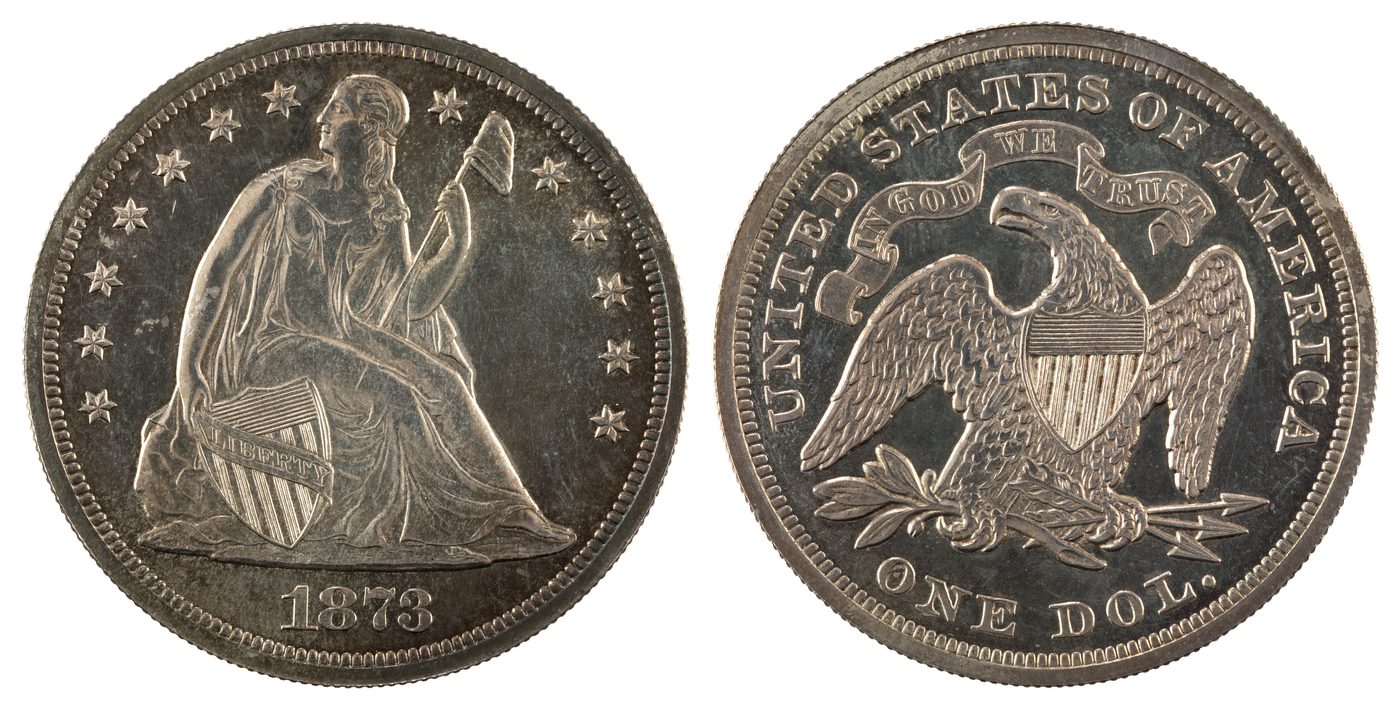
In 1849, so much gold poured out of California that the U.S. government had to invent new coins to hold it all — including the largest gold piece the nation had ever struck. And on almost every coin in a pocket sat the same calm, seated woman, watching the country race west toward a war that would tear it apart.
The world then
In January 1848, a carpenter named James Marshall spotted something glinting in a millrace near Sacramento. Within a year, the secret was out and the world came running. Tens of thousands of "forty-niners" crossed oceans and deserts to dig California gold, and the United States suddenly had a money problem most countries would envy: too much precious metal.
This was the age Americans called Manifest Destiny — the belief, equal parts faith and conquest, that the country was meant to stretch from the Atlantic to the Pacific. The Mexican-American War (1846–1848) made it real. The Treaty of Guadalupe Hidalgo handed the U.S. more than 500,000 square miles, and gold-rich California came with it.
But every new territory raised the same poisoned question: would slavery be allowed there? The Compromise of 1850 patched the argument over for a decade. It did not settle it. The coins of this era were minted by a nation expanding at full sprint — and quietly coming apart at the seams.
The money
So much California gold flooded east that it upset the delicate balance between gold and silver. Suddenly the silver in a half dollar was worth more melted down than spent. Coins vanished — exported abroad or sold for bullion. The government had to act on two fronts at once: find ways to use the new gold, and stop the old silver from disappearing.
The Coinage Act of March 3, 1849 — pushed by Congressman James McKay of North Carolina — authorized two brand-new gold coins. One was tiny: the gold dollar, just 13 millimeters across, the smallest coin the United States has ever struck. The other was a giant: the double eagle, a twenty-dollar gold piece, the highest face value the nation had ever put on a coin. Both were designed by Mint Chief Engraver James B. Longacre. The double eagle let banks and merchants move a fortune in a single coin.
The silver problem got its own fix. The Coinage Act of February 21, 1853 shaved a little weight off the dime, quarter, and half dollar — just enough to make them worth more as money than as metal. The Mint marked the lighter coins with small arrows beside the date and, for one year only, rays bursting around the eagle on the reverse (the "tails" side). That 1853 "Arrows and Rays" quarter and half are one-year designs collectors still chase.
And the metal needed somewhere closer to be coined. Hauling raw gold from California to the Philadelphia Mint was slow, costly, and dangerous, so the San Francisco Mint opened its doors on April 3, 1854 — turning roughly four million dollars of bullion into coin in its first year alone.
The face on every coin
Through all of it sat one woman. The Seated Liberty design shows Liberty on a rock, a shield at her right hand spelling LIBERTY, a liberty cap raised on a pole in her left. It was the work of Christian Gobrecht (1785–1844), who became the Mint's Chief Engraver on December 21, 1840 — engraved from sketches by the painters Thomas Sully and Titian Peale.
Gobrecht first brought her to life on the experimental Gobrecht dollar of 1836–1839, a small, beautiful run of silver dollars. The seated figure proved so good that the Mint spread her across the whole silver lineup — half dime, dime, quarter, half dollar, and the Seated Liberty dollar struck for circulation from 1840. She would reign for over half a century, long after Gobrecht's death in 1844.
One small thing to watch for: the words "In God We Trust" did not yet appear. The motto debuted only at the very end of this era, on the two-cent piece of 1864 — born of Civil War religious feeling — and spread to silver and gold coins afterward. A Seated Liberty coin without the motto is the rule for these years, not a rarity.
Turning points
- 1836Gobrecht dollar
Christian Gobrecht's Seated Liberty debuts on an experimental silver dollar (struck 1836–1839).
- 1838–1839Coronet gold takes shape
Gobrecht's Coronet Liberty Head arrives on the $10 eagle (1838) and is adapted to the $5 half eagle in 1839 — the look that would rule U.S. gold for nearly 70 years.
- 1840Seated Liberty for circulation
The Seated Liberty dollar enters regular production; the design spreads across the silver coinage.
- 1848Gold at Sutter's Mill
Gold found in California; the rush begins in earnest in 1849.
- 1849Two new gold coins
The Coinage Act of March 3 authorizes the gold dollar and the $20 double eagle, both designed by James B. Longacre.
- 1850Compromise of 1850 & circulating double eagle
Congress patches the slavery-expansion crisis; the double eagle begins regular production.
- 1851The three-cent silver
The featherweight 'trime' arrives the same year Congress cuts the postage rate to three cents.
- 1853Arrows and Rays
The Act of Feb 21 lightens subsidiary silver to stop melting; coins get arrows by the date and one-year rays on the reverse.
- 1854San Francisco Mint opens
A branch mint opens April 3 to coin California gold close to its source. The same year brings the $3 gold piece.
- 1857SS Central America sinks
A steamer carrying California gold, including 1857-S double eagles, goes down off the Carolinas in September.
- 1857The penny shrinks
The Coinage Act of 1857 retires the half cent and big copper cent; the small Flying Eagle cent takes over.
- 1864'In God We Trust' debuts
The motto first appears on a U.S. coin — the two-cent piece — amid the Civil War.
- 1865War's end
The Civil War closes; the expansion era's coinage gives way to the postwar nation.
Key facts
- Region
- United States
- Span
- 1836–1865 (Seated Liberty ran to 1891)
- Currency
- U.S. dollar — gold and silver coinage
- Signature designer
- Christian Gobrecht (Seated Liberty & Coronet gold); James B. Longacre (gold dollar & double eagle)
- Signature coins
- Seated Liberty silver, 1849 gold dollar, $20 double eagle, 1853 Arrows & Rays quarter and half
- Smallest U.S. coin
- Type 1 gold dollar — 13 mm, 1.672 g
- First $20 coin
- 1849 double eagle (single pattern survives, in the Smithsonian); regular issue from 1850
Why it fascinates collectors
This is one of the richest hunting grounds in all of American coins, because the history is stamped right into the metal. Pick up a Seated Liberty half dollar and you can read the Gold Rush in it — does it have arrows by the date? Then it's a post-1853 coin, made lighter so it wouldn't get melted. Tiny clues like that turn a single coin into a story.
It is also a field of true rarities. The 1849 double eagle exists as a single known specimen, locked in the Smithsonian — a coin no collector will ever own. At the other extreme, gleaming 1857-S double eagles recovered from the wreck of the SS Central America in the 1980s let collectors hold California gold that spent more than a century on the ocean floor.
And because the Seated Liberty design ran across six denominations and several mints for decades, it rewards depth. A newcomer can start with one affordable dime. A specialist can spend a lifetime chasing dates, mint marks, and the arrows-and-rays varieties — the same calm seated figure, telling a slightly different story every year.
The coins of this era
Lay these coins out in a row and you can watch a country change its mind about itself. They begin with the Capped Bust silver — the dime, half dime, quarter, and half dollar with Liberty in a cloth cap, a look John Reich drew back in 1807 and Chief Engraver William Kneass kept alive into the 1830s. They are the coins Seated Liberty was about to replace. When Kneass suffered a stroke in 1835 that paralyzed his right side, the Mint needed a new hand — and that hand belonged to Christian Gobrecht.
What Gobrecht did was rare in coinage: he made one idea work everywhere. His seated figure, sketched first by the painters Thomas Sully and Titian Peale, debuted on the experimental Gobrecht dollar and then marched across the entire silver lineup — half dime, dime, quarter, and half dollar. For the first time, the small change in an American pocket spoke with a single voice. And Gobrecht did the same trick in gold: his Coronet Head Liberty, first cut for the $10 eagle in 1838, was adapted to the Coronet Head half eagle ($5) in 1839 and would carry every Liberty-head gold coin for nearly seventy years. That unity — one face on the silver, one head on the gold — is why this era reads as a whole and not a pile of unrelated coins.
The Gold Rush then gave the Mint's next great engraver his life's work. James B. Longacre — Chief Engraver from 1844 — designed nearly everything new this era is remembered for: the tiny gold dollar (its first Liberty Head Type 1, then the Type 2 small Indian Head), the Liberty Head double eagle, the three-dollar gold with its Indian-princess Liberty, and the small coins of the 1850s and '60s — the Flying Eagle and Indian Head cents, the three-cent silver, and the two-cent piece. Gobrecht owned the look; Longacre filled in the denominations the racing economy kept demanding.
And it kept demanding them for a reason. Gold made silver scarce, so coins were melted and hoarded — which is why the featherweight three-cent silver of 1851 arrived the very day Congress cut postage to three cents, and why the 1853 silver wears its arrows. The Coinage Act of 1857 then swept away the era's smallest survivors — the half cent and the heavy copper cent, both retired that year — clearing the way for the little Flying Eagle penny. The Civil War drained even copper from circulation: people hoarded anything with metal in it. The Treasurer of the United States, Francis Elias Spinner, answered with Postage Currency — little paper "coins" standing in for the change that had vanished — and the same crisis put four words on the two-cent piece in 1864: In God We Trust. The era's loose ends carry the story past the war: the three-cent nickel of 1865 was struck to redeem all that wartime paper, and the twenty-cent piece (1875–1878), modeled in part by the Philadelphia sculptor Joseph A. Bailly, failed almost at once because Americans kept mistaking it for a quarter. William Barber's heavy trade dollar (1873–1885), built to fight the Mexican peso for the China trade — with several reverse dies also carved by Bailly — is the coda: the Gold Rush argument over silver, carried clear across the Pacific.
A few of these coins were never meant to spend. The era also threw off patterns and oddities that map its arguments in metal: the 1836 two-cent billon pattern, the 1874 twenty-cent pattern (the trial run for the coin nobody wanted), and the strange 1818 cent private restrike "mule" struck from mismatched dies. They are footnotes — but footnotes that tell you exactly what the Mint was wrestling with.
So the thread is one thread. A country racing west struck more gold than it knew what to do with, watched its silver flee, fought a war that hoarded its coppers — and through all of it kept the same seated woman on its silver and the same crowned head on its gold, calm above the chaos.
Questions collectors ask
Who designed the Seated Liberty coinage?
Christian Gobrecht, Chief Engraver of the U.S. Mint, engraved the design from sketches by the painters Thomas Sully and Titian Peale. It first appeared on the experimental Gobrecht dollar of 1836–1839, then spread across the silver coinage and ran (with later tweaks) into the 1890s.
Why did the United States create the gold dollar and double eagle in 1849?
The California Gold Rush flooded the country with gold. Congress passed the Coinage Act of March 3, 1849 to turn that bullion into useful money — a tiny gold dollar and a large $20 double eagle, the highest-value U.S. coin to that point. Both were designed by James B. Longacre.
What do the arrows and rays on some 1853 coins mean?
Gold Rush gold made silver relatively more valuable, so people melted silver coins for profit. The Act of February 21, 1853 lightened the dime, quarter, and half dollar to stop that. The Mint marked the new, lighter coins with arrows beside the date and — for one year only — rays around the eagle on the reverse.
Why doesn't 'In God We Trust' appear on these coins?
It hadn't been added yet. The motto first appeared on a U.S. coin in 1864, on the two-cent piece, near the end of this era. For most Seated Liberty and early Gold Rush coins, no motto is exactly what you should expect.
Is the 1849 double eagle something I could buy?
No. Only a single 1849 double eagle is known to exist, and it is held in the Smithsonian's National Numismatic Collection. Regular double eagles for collectors begin with the 1850 issue.
Why did the twenty-cent piece fail so fast?
It was too easily confused with the quarter — almost the same size, with the same Seated Liberty obverse. Struck for circulation only in 1875 and 1876, it was abolished in 1878 after barely two years. That short, awkward life is exactly why collectors prize it today.
Sources
- Christian Gobrecht — Wikipedia
- Seated Liberty dollar — Wikipedia
- Coinage Act of 1849 — Wikipedia
- Liberty Head double eagle — Wikipedia
- Coronet Head $5 Half Eagle — Coin World
- Gold dollar — Wikipedia
- Gold Dollar (1849–1889) Value Guide — Stack's Bowers Galleries
- 1853 Liberty Seated Quarter, Arrows and Rays — CoinWeek
- Twenty-cent piece (United States coin) — Wikipedia
- Joseph A. Bailly — Wikipedia
- History and Information About The San Francisco Mint — Coin Appraiser
- 'In God We Trust' — The Story of the Two Cent Piece — PCGS
- 20 Dollars, Pattern, United States, 1849 — National Museum of American History (Smithsonian)
- Manifest Destiny — The American Yawp
- James B. Longacre — Wikipedia
- William Kneass — Wikipedia
- Capped Bust (John Reich design) — Wikipedia
- Three-cent silver — Wikipedia
- Coinage Act of 1857 — Wikipedia
- Numismatic Oddities: How Postage Became Currency in the Civil War — Numismatic News
- Trade dollar (United States coin) — Wikipedia