US coin · series

The Capped Bust Half Dime: The Coin They Sealed in a Wall

America's smallest silver coin, reborn in 1829 and gone in eight years.

The Capped Bust Half Dime: The Coin They Sealed in a Wall
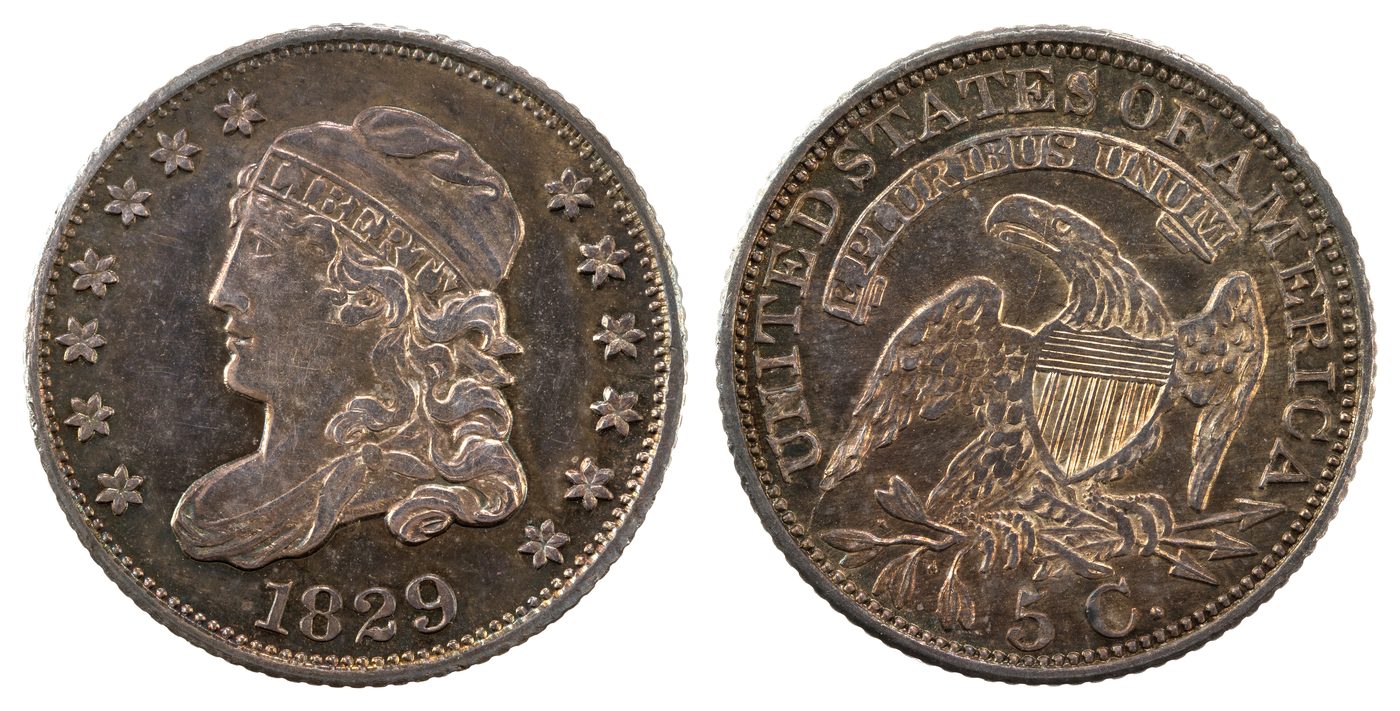
US Mint (coin), National Numismatic Collection, National Museum of American History (photograph by Jaclyn Nash) · public domain · source

On July 4, 1829, the U.S. Mint struck a coin and then bricked it into the foundation of its own new building. It was a half dime — five cents of silver smaller than your fingernail — and it had not been made in 24 years.

The coin sealed in a wall

On the Fourth of July, 1829, a crowd gathered in Philadelphia to lay the cornerstone of the second United States Mint. Into that cornerstone went the founding documents of the country — copies of the Declaration of Independence, the Constitution, and George Washington's Farewell Address. Beside them went two coins: a 1792 half disme, the very first silver coin the young Mint ever struck, and a brand-new 1829 half dime, struck that same morning for the occasion.

The pairing was deliberate. The half dime — five cents in silver — had launched American coinage in 1792, then quietly disappeared. The Mint had not made one since 1805. For 24 years there was no half dime at all. Bringing it back, on Independence Day, and sealing it next to its 1792 ancestor was the Mint telling a story about itself: we started here, and we are still here.

Why revive a coin nobody had missed for a generation? The honest answer is that the records don't fully say. The likeliest reason is plain commerce — a country running short of small change needed a piece worth more than a copper cent but less than a dime. Whatever the cause, the half dime came roaring back: across just nine years the Mint struck more than thirteen million of them. The tiny coin that opened the cornerstone ceremony went on to fill pockets and tills across the early republic.

The design, and the three men behind it

The face of the coin — the obverse, or "heads" side — shows Liberty in left profile, her hair gathered under a soft cloth cap. A band across the cap reads LIBERTY. Thirteen stars ring her, seven to the left and six to the right, one for each original state, with the date below. Flip it over to the reverse and you find an eagle with a shield on its breast, an olive branch and arrows in its talons — peace and war held in balance — under the motto E PLURIBUS UNUM ("out of many, one"). The denomination, 5 C., sits at the bottom.

The design has a tangled paternity, and it's worth getting right. The original "Capped Bust" Liberty was the work of John Reich, a German-born engraver who introduced it on the half dollar back in 1807. When the Mint finally brought the half dime back in 1829, Chief Engraver William Kneass adapted Reich's well-loved design down to half-dime scale — shrinking a half-dollar motif onto a coin barely over half an inch across. Later still, as Kneass's health failed, Christian Gobrecht reworked the dies and would soon design the Seated Liberty type that replaced this one. So the half dime carries the fingerprints of all three: Reich's concept, Kneass's hand on this denomination, Gobrecht's later touch.

Hold one and the achievement is obvious. This is the smallest silver coin the United States ever made — roughly 15.5 millimeters wide and weighing about 1.35 grams. To press a full eagle, shield, motto, and thirteen stars into that space, with a reeded (grooved) edge to deter clipping, was real craft on a punishing canvas.

Key facts

Years struck
1829–1837
Denomination
Half dime (5 cents)
Designers
John Reich (original Capped Bust); William Kneass (adapted to the half dime); Christian Gobrecht (later die work)
Composition
89.24% silver, 10.76% copper
Weight
≈1.35 g
Diameter
≈15.5 mm — the smallest U.S. silver coin
Edge
Reeded
Mint
Philadelphia (no mint mark)
Total business strikes
More than 13 million across the series
Highest-mintage year
1835 — 2,760,000
Lowest-mintage year
1837 — 871,000
Replaced by
Seated Liberty half dime (introduced 1837)

Collecting it: no rare dates, but plenty to chase

Here is the friendly truth about this series: it has no rare dates. Every year from 1829 to 1837 was struck in real numbers, so a collector can assemble a full date run without ever hunting a single elusive issue. That makes the Capped Bust half dime one of the most approachable early-American types — a genuine piece of 1830s silver, often available in honest circulated grades (Very Good to Very Fine, in collector shorthand) at modest cost.

The chase is in the details. The series is a die-variety hunter's paradise. Because each working die was engraved partly by hand, tiny differences multiply: the standard reference, Federal Half Dimes: 1792–1837 by Russell J. Logan and John W. McCloskey, catalogs them with "LM" numbers that specialists trade by heart. The famous ones turn on the size of the date and the size of the "5 C." denomination — the 1835 alone comes in Large Date and Small Date, Large 5C and Small 5C combinations, and 1837 splits into a Large 5C and a sought-after Small 5C. There are over-date oddities too, where a die was repunched, like the 1834 and 1836 "3 over inverted 3." None of these are household names, but to someone who collects the series they are the whole game.

Where the coin gets genuinely scarce is in condition. These were workhorses — small, soft, and spent hard. A half dime that escaped circulation and survives in Gem Mint State (a top, near-flawless grade) is uncommon, and prices climb steeply at the high end even though the same date is cheap worn. The proofs — special presentation strikings, made only a few dozen at a time, if that — are rare in every grade and command serious premiums. The 1829 proof, struck for that cornerstone year, is the trophy.

Questions collectors ask

Why is it called a Capped Bust half dime?

After the design: Liberty's bust shown in profile wearing a soft cloth cap inscribed LIBERTY. The same 'Capped Bust' look appears on the half dollar, quarter, and dime of the era. 'Liberty Cap' is a common nickname for the same type.

Who actually designed it?

Three hands. John Reich created the original Capped Bust Liberty in 1807. William Kneass, the Mint's Chief Engraver, adapted it for the half dime when the denomination returned in 1829. Christian Gobrecht reworked the dies later as Kneass's health declined.

Why was there a 24-year gap in half dimes?

The Mint struck no half dimes between 1805 and 1829. The exact reason isn't fully documented, but the denomination simply fell out of production until demand for small silver change brought it back in 1829.

Are there any rare dates I need to watch for?

No — there are no rare dates in the series. Every year was struck in quantity. The scarcity is in die varieties (the 1837 Small 5C, the 1835 date-and-denomination combinations), in high Mint State grades, and in the proofs.

What's the 1837 Small 5C about?

1837 was the final year, and it exists with a large and a small '5 C.' denomination. The Small 5C is the more sought-after of the two among variety collectors. 1837 also overlapped the new Seated Liberty half dime that replaced this type.

Is the silver worth anything on its own?

Barely — each coin holds only about 1.2 grams of fine silver. These are collected as history and as type coins, not as bullion. The value is in the design, the date variety, and the grade.

Sources