US coin · series

The Capped Bust Quarter: America's Scarcest Quarter

A mint fire, a vanishing date, and the moment machines took over the money.

The Capped Bust Quarter: America's Scarcest Quarter
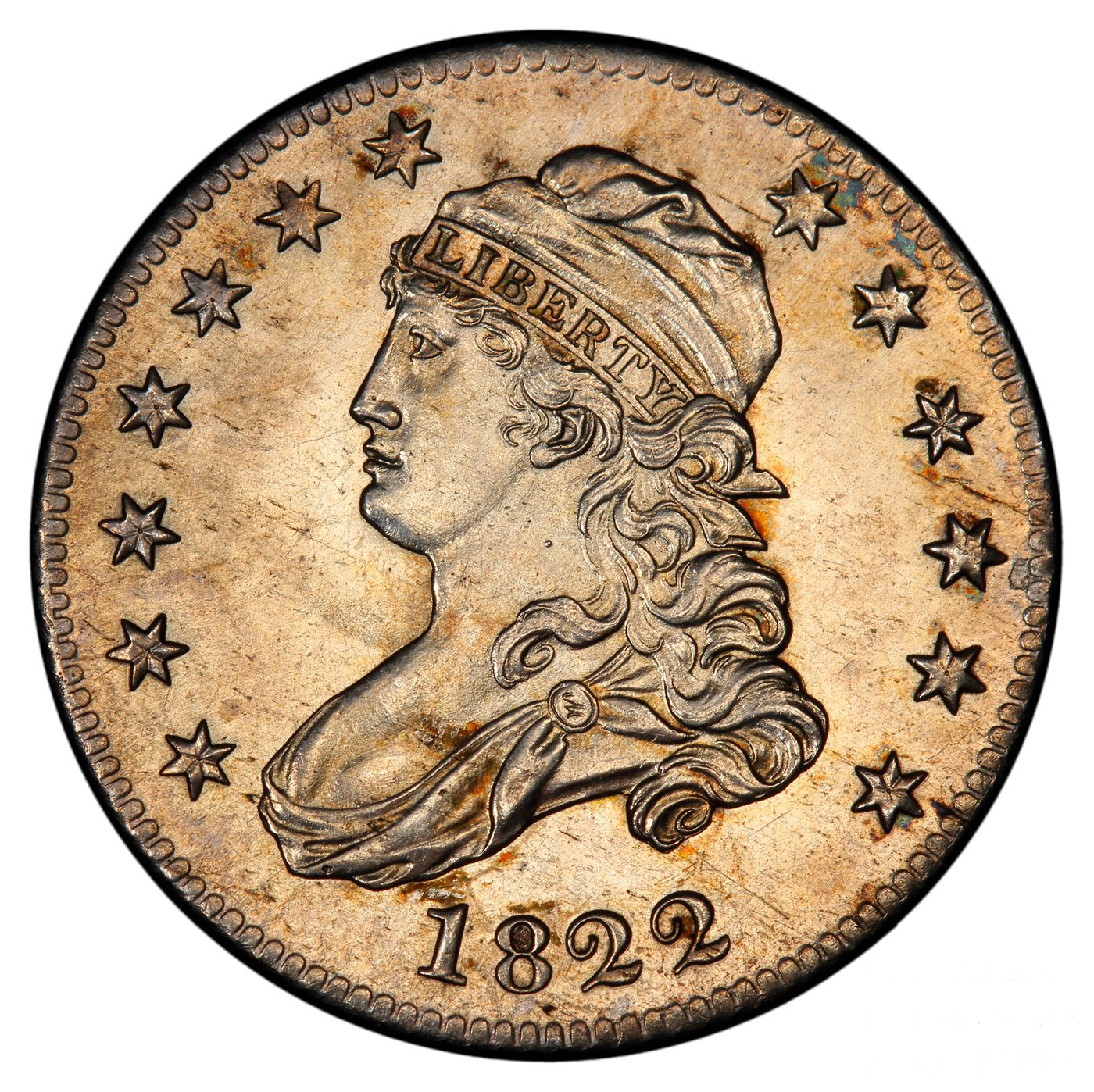
National Numismatic Collection, National Museum of American History (Smithsonian Institution) · public domain · source

In 1815 the U.S. Mint finally struck a quarter again after seven empty years — then a fire nearly ended it before it began. What survived is the rarest circulating quarter series America ever made.

The story behind the coin

For seven years, America made no quarters at all. Between 1808 and 1814 the Philadelphia Mint poured its small silver supply into half dollars — the workhorse coin of the early republic — and the quarter simply waited its turn. When it returned in 1815, the new coin wore John Reich's "Capped Bust" design, already familiar from the dime and half dollar.

Then disaster. In January 1816 a fire tore through the Mint's machinery building and destroyed the rolling equipment that flattened silver into coinage strip. Quarter production stopped cold. None were struck in 1816 or 1817, and the press did not turn again for quarters until 1818.

That stop-and-start rhythm runs through the whole series. No quarters were struck in 1826, 1829, or 1830 either. The result is a coin that was never made in great numbers and was spent hard when it was — which is exactly why, two centuries later, the Capped Bust quarter is the rarest U.S. quarter series ever made for everyday circulation.

The design — and who made it

The obverse — the heads side — shows Liberty facing left in a soft cloth cap, the word LIBERTY banded across it, seven stars to the left and six to the right, with the date below. The reverse — the tails side — carries a heraldic eagle, a shield on its breast, an olive branch and arrows in its talons, ringed by UNITED STATES OF AMERICA and the value 25 C.

The design was the work of John Reich, a German-born engraver who came to America as an indentured immigrant and rose to assistant engraver at the Mint. His "Capped Bust" Liberty first appeared on the half dollar in 1807; it reached the quarter in 1815. Reich gets credit for both sides of this coin.

In 1831 the coin was reworked. Mint Director Samuel Moore wanted to modernize: a new steam-powered press and a "close collar" that struck each coin to a uniform diameter, giving cleaner, more consistent pieces. Chief Engraver William Kneass redrew Reich's Liberty — slightly smaller, more youthful — and shrank the planchet from 27 mm to 24.3 mm. Moore also ordered the motto E PLURIBUS UNUM removed from the reverse scroll, reasoning that "one out of many" simply repeated what UNITED STATES already said. That split the series into two clear types: the Large Size (1815–1828) and the Small Size (1831–1838).

Key facts

Years struck
1815–1838 (none in 1816–1817, 1826, 1829–1830)
Designer
John Reich (original); William Kneass (1831 redesign)
Composition
89.24% silver, 10.76% copper (1815–1836); 90% silver from 1837
Weight
6.74 g / 104 grains (1815–1836); 6.68 g from 1837
Diameter
27 mm Large Size (1815–1828); 24.3 mm Small Size (1831–1838)
Edge
Reeded
Mint
Philadelphia only (no mint mark)
Rarest circulation date
1823/2 overdate — 17,800 struck, ~33 believed to survive (PCGS estimate)

Collecting it: key dates, varieties, and grade

This is a series defined by its scarcities, and a few names dominate.

The 1823/2 is the prize. It was struck from a leftover 1822 die re-engraved to read 1823 — you can still see the old 2 beneath the new 3. Only 17,800 business strikes were delivered, the lowest figure in the series, and PCGS estimates roughly 33 survive in any condition. It is the rarest U.S. quarter ever intended to circulate.

The 1827 original is nearly as legendary. Only a tiny number of true 1827 quarters exist; the Mint later produced restrikes from old dies. Collectors tell them apart by a small detail in the date — originals show a "curl base 2," the restrikes a "square base 2" — because each was struck from a different leftover reverse die.

Then there are the blunders. On the 1822 25/50 C. and 1828 25/50 C. varieties, a Mint workman first punched "50" into the denomination — a half-dollar value — then corrected it to "25," leaving the wrong number faintly showing beneath. A genuine factory mistake, frozen in metal, and prized for exactly that. And in the great unsolved puzzle of the series, a handful of 1815 and 1825 quarters carry a single counterstamped "E" or "L" above Liberty's head. No one has ever proven who did it or why — theories range from school prizes to a private merchant's mark. The legend is part of the appeal; the answer is genuinely lost.

Why are high grades so scarce? These coins worked for a living. A quarter was real money in the 1820s — a day's wage for many — so it changed hands until it wore smooth. Few were saved new, the Mint kept no proof program for sale to collectors then, and the steel dies of the era cracked and clashed under hand-press pressure. A Capped Bust quarter with full original detail and surfaces survived two centuries against long odds, which is why even common dates command real premiums in the highest grades.

Questions collectors ask

Why is the 1823/2 Capped Bust quarter so rare?

Only 17,800 were struck — the lowest figure in the series — from a re-dated 1822 die, and they circulated hard. PCGS estimates only about 33 survive in any grade, making it the rarest U.S. quarter ever made for circulation.

What is the difference between Large Size and Small Size Capped Bust quarters?

Large Size coins (1815–1828) are 27 mm across and carry E PLURIBUS UNUM on the reverse. In 1831 the Mint adopted a steam press and close collar; William Kneass reworked the design, shrank the coin to 24.3 mm, and the motto was removed. Those Small Size coins run 1831–1838.

Who designed the Capped Bust quarter?

John Reich created the original Capped Bust design, used on both the obverse and reverse. William Kneass modified it for the smaller 1831 version.

What is the 1822 25/50 C. variety?

A Mint engraver mistakenly punched a half-dollar '50' into the quarter's denomination, then corrected it to '25.' The earlier '50' still shows beneath the '25.' A similar error reappears on the 1828 25/50 C. — both are sought after as genuine die blunders.

Why are no Capped Bust quarters dated 1816, 1817, 1826, 1829, or 1830?

An 1816 fire destroyed the Mint's rolling machinery and halted quarter production into 1818. Production gaps in 1826, 1829, and 1830 reflect the Mint's small silver supply and its priority on other denominations.

Sources