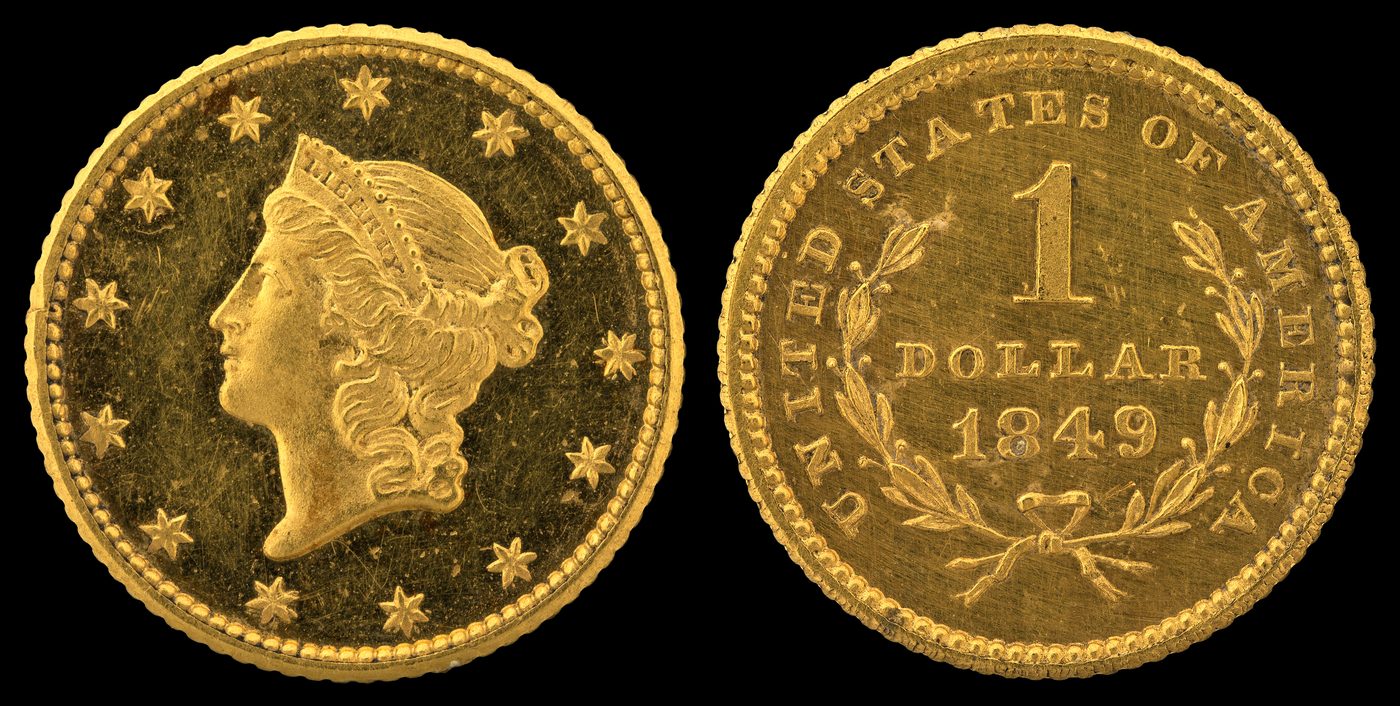
The story behind the coin
In 1848 a carpenter found flecks of gold in a California millrace, and within a year the country's money supply was upside down. Gold flooded east from the diggings faster than the Mint had any use for it. Congress's answer, in the Act of March 3, 1849, was to turn that raw metal into coin — authorizing both the giant $20 double eagle and, at the opposite extreme, a one-dollar gold piece.
The idea of a gold dollar wasn't new. It had been pitched and rejected through the 1830s and 1840s as a gimmick. What changed was the gold itself. With so much bullion arriving, a tiny gold coin suddenly made economic sense — and there was proof it could work. A North Carolina goldsmith named Christopher Bechtler had been privately striking gold dollars since 1831, and people used them. The federal government finally followed.
The job of designing it fell to the Mint's Chief Engraver, James Barton Longacre — and almost nobody at the Philadelphia Mint wanted him to succeed. He had powerful enemies inside the building (more on that below), men who argued a coin this small was a foolish, impractical thing. Longacre did it anyway, alone, in a matter of weeks. The coin that came out the other side is the smallest the United States has ever made: 13 millimeters across — narrower than a dime — and weighing under two grams.