US coin · series

The Capped Bust Dime: Liberty in a Cap, 1809–1837

An immigrant engraver redrew America's silver — and his dime outlived him by a generation.

The Capped Bust Dime: Liberty in a Cap, 1809–1837
US Mint (coin); National Numismatic Collection, National Museum of American History — photograph by Jaclyn Nash · public domain · source

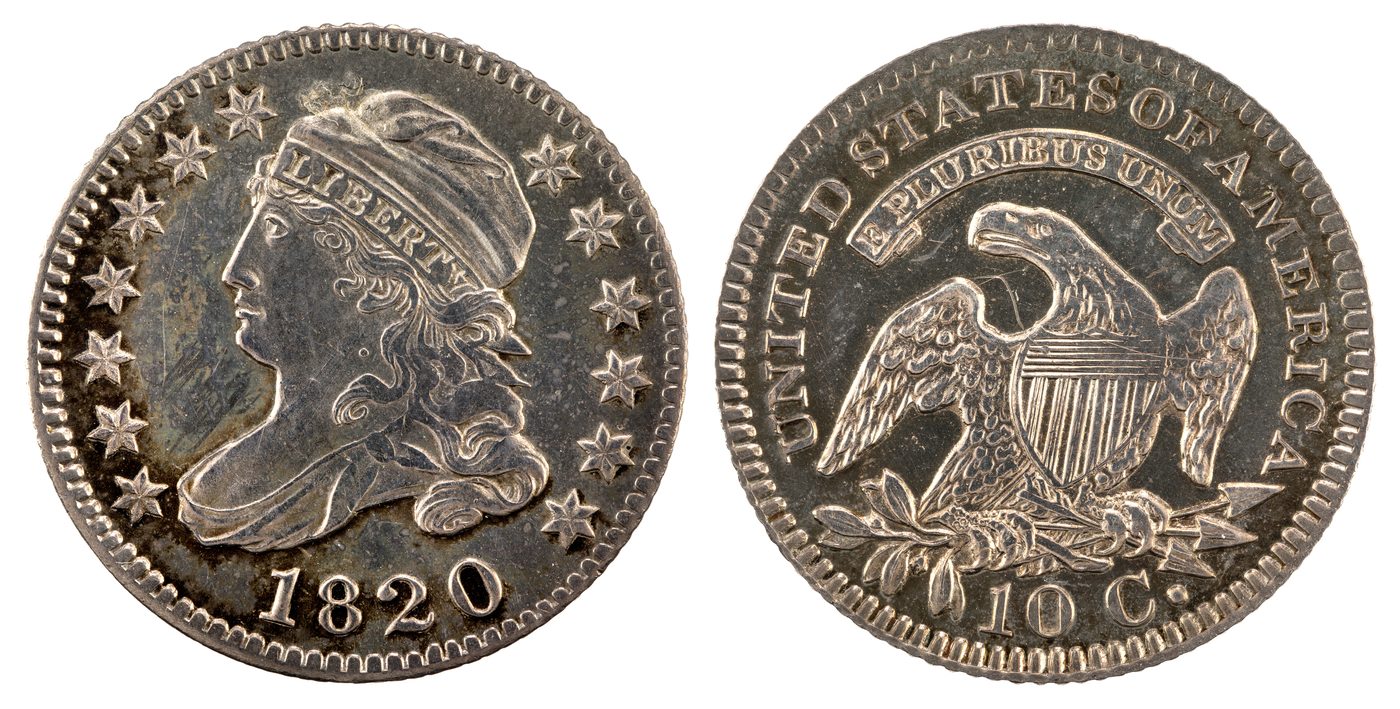
In 1807 the U.S. Mint handed its entire silver coinage to a German immigrant who had arrived as an indentured servant. His Liberty — chin up, hair loose, a soft cap pinned with a ribbon reading LIBERTY — reached the dime in 1809 and stayed there for almost thirty years. A few of those dates are now among the hardest coins in American numismatics to find.

The story behind the coin

In 1807 the Mint did something unusual. It handed the look of every silver and gold coin in the country to a man who had come to America as an indentured servant.

His name was John Reich — born Johann Matthias Reich in Fürth, Bavaria, in 1768, the son of an engraver. He fled the Napoleonic wars and arrived in Philadelphia around 1800, bound to work off a debt of about twenty guineas. His skill got noticed fast. As early as 1801, Mint Director Elias Boudinot wrote to President Jefferson that he "was much pleased with his work." In April 1807 the Mint hired Reich as assistant engraver to the aging Chief Engraver, Robert Scot, at $600 a year — a sum Jefferson himself thought high.

Reich's job was nothing less than to redraw American money. His new Liberty — wearing a soft cloth cap, the kind freed Roman slaves once wore — debuted on the half dollar in 1807. The dime was next. In 1809 the first Capped Bust dimes left the press, replacing the older Draped Bust design. The same Liberty would eventually appear on the half dollar, quarter, dime, and half dime — one designer's face on a whole drawer of American silver.

The early dimes show their age in the best way: struck by hand-set presses, on planchets (blank coin discs) that often came out a touch off-center or weak. A 1809 dime that is sharp and well centered is a small miracle of early industrial America.

The design and who made it

The obverse — the heads side — is Liberty facing left, her hair spilling from under a cap held by a ribbon lettered LIBERTY. Thirteen stars ring her for the original states; the date sits below. The reverse — the tails side — carries an eagle with a shield on its breast, an olive branch and arrows in its talons, ringed by UNITED STATES OF AMERICA, with the value spelled out as 10 C. below.

That little "10 C." matters more than it looks. Reich was the first Mint designer to put the denomination right on the coin as a matter of course — an obvious idea in hindsight, and his.

Reich engraved both sides. Collectors credit him with a quiet signature too: a small notch cut into the 13th star, a maker's mark hidden in plain sight.

The series splits into two looks. The large type (1809–1828) is the older style, with wide rims and big tooth-like denticles around the edge. Then in 1828 the Mint's new Chief Engraver, William Kneass, adapted Reich's design for a new tool: the close collar. A collar is a steel ring that surrounds the blank as it's struck. A close collar holds the metal in tight, so every coin comes out the same diameter with a clean reeded (grooved) edge — early mass-production precision. The result is the small type (1828–1837): a slightly smaller, neater dime. Kneass changed the machinery, not really the art — the Liberty is still Reich's.

Reich never saw the small type. Worn down by low pay and little recognition, he left the Mint in 1817 and died around 1832–1833. His Liberty kept circulating in American pockets for another twenty years.

Key facts

Years struck
1809–1837
Designer
John Reich (obverse and reverse); modified by William Kneass in 1828
Mint
Philadelphia only — no mint mark
Composition
~89.24% silver, ~10.76% copper (the 1837 issue moved toward 90% silver)
Weight
~2.70 grams
Diameter
~18.8 mm (large type, 1809–1828); ~18.5 mm (small type, 1828–1837)
Edge
Reeded
Two types
Large/Wide Border (1809–1828); Small/close-collar (1828–1837)
Key date
1822 — about 50,000 struck, the scarcest date in the series
Other tough date
1809 — roughly 51,000 struck (first year)
Rarest variety
1829 Curl Base 2
Replaced by
The Seated Liberty dime, beginning 1837

Collecting it: key dates, varieties, and scarce grades

The Capped Bust dime is one of the great early-type series for collectors who like a puzzle. There is one mint and no mint marks, so the chase is about dates and die varieties, not branches.

The key date is 1822. Roughly 50,000 were struck, and few survived; estimates of known survivors run into the low hundreds. In any grade it is the date that decides whether a collector finishes a full set. The 1809 first-year dime is close behind — about 51,000 struck, often weakly made, and genuinely scarce in sharp condition.

Then there are the varieties, the part specialists live for. They use the JR numbers — a die-marriage attribution system named for John Reich — to tell apart coins struck from different die pairs in the same year. A few have become famous:

  • 1814 STATESOFAMERICA — a reverse die where UNITED was punched too high, squeezing STATES OF AMERICA together with no space, so it reads as one run-on word.
  • 1823/2 overdate — the entire year 1823 was struck over 1822 dies, so a faint underlying 2 shows beneath the 3. Sub-varieties exist with large and small letter E's.
  • 1828 Large Date vs. Small Date — the transition year. The Large Date keeps the old wide denticles; the Small Date shows the close-collar look that defines everything after.
  • 1829 Curl Base 2 — a tiny difference in the shape of the digit 2 that makes this the most coveted variety in the whole series, scarcer even than the 1822.

Why are high grades so hard? These coins were workhorses. They paid for bread and ferry rides and circulated until the silver was nearly smooth. Mint State (uncirculated) survivors exist mostly because a few people set coins aside — there was no organized coin-collecting hobby yet to save them in numbers. So a fully struck, lustrous Capped Bust dime, especially an early date, is rare on top of being old. Grade scarcity and date scarcity stack.

Questions collectors ask

Is the Capped Bust dime the same as the Liberty Cap dime?

Yes — they're two names for the same coin. 'Capped Bust' is the standard hobby name, after Liberty's soft cap and the bust portrait. 'Liberty Cap' describes the same cap, a symbol of freedom borrowed from ancient Rome. Both refer to John Reich's dime struck from 1809 to 1837.

Why is the 1822 dime so valuable?

Two reasons. Very few were made — only about 50,000 — and very few survived; most circulated until they wore out. It's the scarcest date in the series, so completing a full set hinges on finding one, which keeps demand high in every grade.

Who designed the Capped Bust dime?

John Reich (born Johann Matthias Reich in Bavaria) designed both sides. In 1828, Chief Engraver William Kneass adapted the design for a new close-collar striking process, creating the slightly smaller 'small type' — but the Liberty remained Reich's.

Does the Capped Bust dime have a mint mark?

No. Every Capped Bust dime was struck at the Philadelphia Mint, which used no mint mark in this period. If a Capped Bust dime shows a mint mark, treat it with suspicion.

What is the 1829 Curl Base 2 dime?

It's a die variety defined by the shape of the base of the digit 2 in the date — curved rather than flat. It's the rarest and most expensive variety in the whole Capped Bust dime series, sought even harder than the 1822 date.

What does the '10 C.' on the reverse mean?

It's the denomination — ten cents. John Reich was the first U.S. Mint designer to routinely put the value right on the coin, an idea we now take for granted.

Sources