Era
The Early Republic: A Young Country Argues About Money
From the first 1792 patterns to Capped Bust silver and Classic Head gold — a forty-year fight over what a dollar should even be.
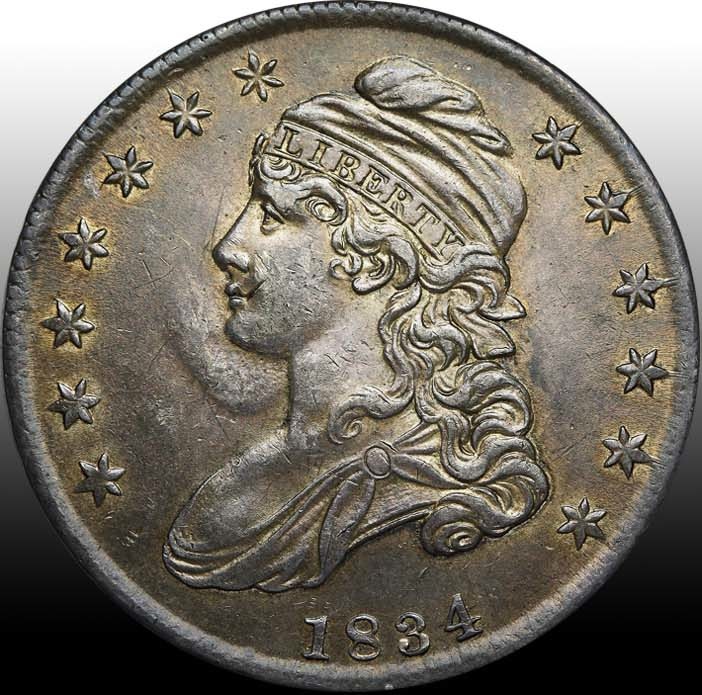
In 1792 the United States struck its very first coins as experiments — a few silver "dismes" and a quarter dollar that never reached a single American pocket. Over the next four decades the young nation could not agree on the most basic question a country faces: what is money? The coins of the Early Republic — many designed by a German immigrant who arrived as an indentured servant — are the surviving witnesses to that argument.
The world then
In 1792 the United States was sixteen years old and had no coins of its own. Congress passed the Coinage Act that year, founded the Mint in Philadelphia, and struck a handful of trial pieces — but real coinage took years to follow. By 1808, when this era hits full stride, there was still no income tax, no Federal Reserve, no paper money issued by the government. There was Congress, a small Mint, and a population that mostly farmed.
Money itself was a patchwork. Spanish silver dollars — minted in Mexico and Peru — circulated more widely than American coins. People cut them into "bits" to make change, which is why a quarter is still "two bits." Foreign coins were legal tender in the United States until 1857. The young Mint struggled to fill the gap, and small change was chronically scarce.
Then came the fights. The War of 1812 burned the Capitol and nearly bankrupted the Treasury. A boom in western land turned to bust in the Panic of 1819. And running underneath everything was a question that would define the era: should the country's money be gold and silver you can bite — "hard money" — or paper notes issued by banks? The coins of the Early Republic were struck right in the middle of that quarrel.
The money
It begins with experiments. In 1792 the brand-new Mint struck a tiny run of pattern coins — test pieces to prove the new nation could make its own money. The 1792 disme (an old spelling of "dime") and a matching 1792 quarter dollar pattern with an eagle on a globe were among them. Almost none survive, and none truly circulated; they are the first heartbeat of American coinage. The men who cut these earliest dies — Henry Voigt and Adam Eckfeldt among the Mint's first craftsmen, with portrait work attributed to artists like Joseph Wright — were building a coinage from nothing.
The era's defining hand arrived in 1807. The Mint hired John Reich, born in Fürth, Bavaria, in 1768, who had reportedly come to America around 1800 as an indentured servant — fleeing the Napoleonic wars by selling years of his labor for passage. He was taken on as assistant engraver at fifty dollars a month, under the aging chief engraver Robert Scot, and handed an enormous job: redesign every U.S. coin, from the copper half cent to the gold half eagle.
His answer was the Capped Bust design — Liberty in a soft cloth cap, a fresh, fuller portrait that replaced the thin earlier styles. (The obverse is the heads side, the reverse the tails.) It first appeared on the half dollar and the gold half eagle in 1807, then spread across the silver: the dime from 1809, the quarter from 1815, the half dime from 1829. His second portrait, the Classic Head — Liberty with curly hair bound by a band reading LIBERTY — went onto the large cent and the half cent.
There's a charming legend that Reich modeled Liberty on "his fat mistress." Mint records from the 1860s repeat it, but it is almost certainly invented — a good story, not a fact. What is documented is that Reich felt underpaid and overworked, and he left the Mint in 1817 after a decade. The exact reason is uncertain; sources point to ill health, a denied raise, or both.
The coins themselves tell the era's deeper story — the hard-money fight. Gold quietly vanished from American pockets, because by law it was worth less as a U.S. coin than as raw metal abroad. People melted gold coins and shipped them overseas for profit. Congress fixed it with the Coinage Act of 1834, which cut the gold in the ten-dollar eagle from 247.4 grains to 232 and shifted the silver-to-gold ratio toward 16-to-1. Gold coins finally stayed home — and a new Classic Head gold design (by chief engraver William Kneass) marked the lighter standard.
Meanwhile the politics turned violent in spirit. President Andrew Jackson hated the Second Bank of the United States, the closest thing the country had to a central bank, run by the Philadelphia aristocrat Nicholas Biddle. Jackson saw it as a tool of the rich. In 1832 he vetoed its recharter; by 1836 the Bank was dead. To force "hard money" on the country, Jackson issued the Specie Circular in 1836, demanding gold or silver for public land. Banks had printed far more paper than they could redeem in coin, and when buyers came for their gold, the vaults were empty. The result was the brutal Panic of 1837.
The Mint modernized right as the storm hit. In March 1836 it ran its first steam-powered coining press, designed by Franklin Peale after studying the mints of Europe — a toggle-joint machine that could strike about a hundred coins a minute, ending decades of hand labor. The half dollar lost its lettered edge for a reeded one (the ridged edge you still feel today), and shrank in size. A new law in January 1837 standardized silver at .900 fine. By 1838 Reich's portraits were giving way to Christian Gobrecht's Seated Liberty — and the Early Republic's coinage was over.
The coins of this era
Walk down the denominations and you can read the whole argument in metal. They span more than forty years, from the first trial strikes to the start of the long Seated Liberty silver. They were not designed all at once, or by one hand, but together they form a single thread — patterns to prove a country could coin, copper for the poor, silver for daily trade, gold for the rich and for the Treasury's pride.
It opens with experiments. The 1792-disme-pattern and the 1792-quarter-dollar-pattern (an eagle perched on a globe) were the Mint's first attempts at a national coinage — proof-of-concept pieces, struck in tiny numbers, that barely touched circulation. They are where American money begins.
Then copper, the money of ordinary people. The half cent and the large cent carried Liberty's likeness through several faces. The draped-bust-half-cent and the broader half-cent-copper type cover the smallest coin the country ever made; John Reich's Classic Head (the classic-head-half-cent and classic-head-large-cent) wore a band reading LIBERTY. Critics complained the face looked too young, so in 1816 chief engraver Robert Scot gave the cent an older, crowned Liberty — the Matron Head (matron-head-large-cent) that ran for two decades. These were the coins that actually jingled in a farmer's pocket.
The silver is where Reich's Capped Bust portrait spread across a whole family of coins struck from the same idea: the capped-bust-half-dime, capped-bust-dime, capped-bust-quarter, and capped-bust-half-dollar. The half dollar did the heavy lifting — banks moved reserves in bags of them — which is why it survives in such numbers, and in so many hand-cut die varieties, today. The earlier draped-bust-dollar-1804 belongs here too, though its story is stranger than its date: the famous 1804-dated silver dollars were actually struck around 1834 as diplomatic gifts for the King of Siam and the Sultan of Muscat — the "King of American Coins," born of a courtesy mission, not of the year stamped on it.
The gold tells the hard-money fight most plainly, because gold was the thing that kept disappearing. The early eagles set the stage: the liberty-cap-eagle-ten-dollar (1795–1804) was America's first ten-dollar gold coin, and the capped-bust-right-half-eagle (1795–1807) its first five. Reich's redesign followed — the capped-bust-half-eagle, then the capped-head-half-eagle and capped-head-quarter-eagle ($2.50), coins so often melted that survivors are genuinely scarce. When the Coinage Act of 1834 shrank the coins to stop the melting, William Kneass's lighter Classic Head gold answered — the classic-head-quarter-eagle and classic-head-half-eagle. The ten-dollar eagle-1804-plain-4 shares the 1804 dollar's secret: it, too, was a backdated diplomatic strike, not a coin of its stated year. And the era's gold closes with the liberty-head-eagle — Gobrecht's Coronet Head, begun in 1838, which would go on to define American gold coinage for nearly seventy years.
The era ends the way it began — with one engraver reinventing everything. Christian Gobrecht drew Seated Liberty from a painted sketch by Thomas Sully, paired in 1836 with Titian Peale's soaring eagle on the silver dollar — the first struck for circulation since 1806. Within two years the seated figure had spread to the seated-liberty-half-dime, seated-liberty-dime, seated-liberty-quarter, and the seated-liberty-dollar coinage. So the Early Republic closes not with a full stop but with a handoff: the coins that argued over what money should be giving way to the long, settled silver and gold of the decades that followed.
Timeline
- 1792The Coinage Act founds the Mint; the first pattern coins — the 1792 disme and quarter dollar — are struck as experiments.
- 1807John Reich's Capped Bust design debuts on the half dollar and gold half eagle.
- 1808The Classic Head large cent begins; Capped Bust appears on the gold quarter eagle.
- 1812War with Britain strains the Treasury; half cent production halts for over a decade.
- 1816Robert Scot redesigns the cent into the Matron Head — an older, crowned Liberty.
- 1817Reich resigns from the Mint after ten years, underpaid and in failing health.
- 1819The Panic of 1819 — the young nation's first major financial crisis.
- 1832Jackson vetoes the recharter of the Second Bank of the United States, opening the Bank War.
- 1834The Coinage Act cuts the gold content of U.S. coins to stop them being melted and exported; 1804-dated dollars and eagles are struck as diplomatic gifts.
- 1836First steam-powered coining press runs; the Gobrecht dollar revives the silver dollar; Specie Circular demands gold or silver for public land; the Second Bank's federal charter ends.
- 1837The Panic of 1837 grips the country; Seated Liberty reaches the dime and half dime; a new law standardizes silver at .900 fineness.
- 1838Gobrecht's Seated Liberty reaches the quarter and his Coronet Head defines U.S. gold; Reich's portraits give way, closing the era.
Key facts
- Region
- United States
- Span covered here
- 1792 patterns; main coinage 1808–1838
- First coins
- 1792 disme and quarter dollar patterns — experiments, not circulating money
- Signature silver
- Capped Bust (half dollar 1807–1839, dime 1809–1837, quarter 1815–1838, half dime 1829–1837)
- Signature copper
- Classic Head large cent (1808–1814) and half cent (1809–1836)
- Lead designer
- John Reich (1768–after 1817), Bavaria-born assistant engraver
- Silver standard
- 89.2% silver before 1837; standardized to .900 fine in January 1837
- Monetary fight
- Hard money (gold/silver) vs. bank-issued paper; the Bank War and Panic of 1837
- Turning-point technology
- First steam-powered coining press, March 1836
- Closing design
- Gobrecht's Seated Liberty silver and Coronet Head gold, from 1836–1838
Why it fascinates collectors
These coins are old enough to feel like artifacts and common enough that you can actually own one. A circulated Capped Bust half dollar is a real, two-century-old piece of American silver you can hold for the price of a nice dinner — and collectors love it precisely because each one is a little different.
That's because they were made by hand, one die at a time. Mint workers cut each die — the steel stamp that strikes the coin — by punching in the date and letters individually, so the spacing wanders. Collectors catalog these tiny differences as die varieties, and the Capped Bust half dollar series has hundreds of them, mapped in obsessive detail. Two coins of the same date can be entirely different prizes.
Then there are the witnesses to the chaos: Hard Times tokens. From roughly 1832 to 1844, with the Mint unable to supply enough small change, merchants and political cranks struck their own copper pieces the size of a cent. Some advertised a store; some were blunt satire — a jackass labeled with Jackson's slogans, a sinking ship of state. They are not official coins at all, but they may be the most honest money of the era: the public literally minting its own opinion of the Bank War. For a collector, holding a Capped Bust half in one hand and a Hard Times token in the other is holding both sides of the argument.
Questions collectors ask
What were the first coins the United States ever made?
The Mint's earliest strikes were pattern coins in 1792 — trial pieces meant to prove the new nation could produce its own money. Among them were the 1792 disme (an old spelling of 'dime') and a quarter dollar pattern showing an eagle on a globe. Almost none survive, and they were never released into general circulation, which makes them among the most coveted pieces in all of American numismatics.
Who designed the Capped Bust and Classic Head coins?
John Reich, a Bavarian-born engraver hired by the U.S. Mint in 1807. He created the Capped Bust portrait used across the silver coinage and the Classic Head used on the copper cent and half cent. His original concept was later modified by chief engraver William Kneass, who also designed the Classic Head gold coins of 1834.
What was the 'hard money' fight all about?
It was an argument over what money should be. 'Hard money' meant gold and silver coin you could weigh and trust. 'Soft money' meant paper notes issued by banks — convenient, but only worth something if the bank could pay out coin on demand. President Andrew Jackson distrusted paper and the Second Bank of the United States that backed it, and his push for hard money helped trigger the Panic of 1837.
Why did the U.S. change the weight of its gold coins in 1834?
Because gold coins were disappearing. By law a U.S. gold coin held more metal than it was worth as money, so people melted them down and shipped the gold abroad for profit. The Coinage Act of 1834 reduced the gold content — the ten-dollar eagle dropped from 247.4 grains of gold to 232 — which kept gold coins circulating at home.
Why is an 1804-dated dollar from this era, when the date says 1804?
Because the famous 1804 silver dollars were not actually struck in 1804. The best-supported account is that they were made around 1834 as part of presentation sets given to foreign rulers — the King of Siam and the Sultan of Muscat. The Mint backdated them to 1804, the last year listed in its records for the denomination. A matching backdated 1804 ten-dollar gold eagle was struck for the same gift sets, which is why both belong to the Early Republic, not to 1804.
Are Capped Bust coins rare and expensive?
Most are surprisingly attainable. Tens of millions of Capped Bust half dollars were struck, and well-worn examples are among the most affordable genuine early American silver coins. Value climbs sharply for scarce dates, rare die varieties, and coins in high grade — but the series is a classic entry point precisely because the common dates are not out of reach.
What are Hard Times tokens?
Privately made copper pieces, struck from about 1832 to 1844, that circulated as substitutes for the cent during a shortage of official small change. Some advertised merchants; many were political satire aimed at Andrew Jackson and the Bank War. They are collected today as vivid, unofficial commentary on the financial chaos of the era.
Sources
- Wikipedia — 1792 half disme / disme
- Wikipedia — 1792 quarter (pattern)
- CoinWeek — John Reich, Coin Designer at the United States Mint
- Wikipedia — Capped Bust
- Wikipedia — Classic Head
- Wikipedia — Coronet large cent (Matron Head)
- Wikipedia — Coinage Act of 1834
- Wikipedia — Bank War
- Federal Reserve History — The Second Bank of the United States
- Wikipedia — Specie Circular
- Wikipedia — Hard times token
- Franklin Institute — Steam-Powered Coin Press (1836)
- NGC — USA Coin Album: The Coinage of 1837
- Wikipedia — Gobrecht dollar
- Wikipedia — Christian Gobrecht
- PCGS — A King Is Born: The History of the 1804 Draped Bust Dollar
- CoinWeek — The King Among Rarities: A Brief History of the United States 1804 Dollar
- Stack's Bowers — Liberty Head Eagle, Type 1, No Motto (1838–1866)