US coin · series

The Matron Head Large Cent (1816–1835)

A stern, grown-up Liberty — minted after the only year America made no cent at all.

The Matron Head Large Cent (1816–1835)
US Mint (coin); photograph by Jaclyn Nash, National Numismatic Collection, National Museum of American History (Smithsonian Institution) · public domain · source

In 1815, the United States made no one-cent piece at all — the only year in the nation's history that happened. The reason was a war, and the cure was a new coin: a heavier, sterner Liberty that collectors would one day nickname the Matron Head.

The story behind the coin

In 1815, the United States Mint made no cents. Not because nobody wanted them — because it had run out of metal to make them from.

The cent was struck from nearly pure copper, and the Mint did not refine its own. It bought ready-made copper discs — planchets (the blank rounds a coin is struck onto) — shipped from Britain. The War of 1812 cut that supply line. The wartime embargo on British goods choked off the planchet shipments, and by 1814 the Mint's stockpile was gone. So 1815 stands alone as the single year in American history with no cent of any date.

When the war ended and copper started crossing the Atlantic again, the Mint needed a fresh face for the restarted coin. The design it had been using — the Classic Head — had drawn complaints, so Chief Engraver Robert Scot cut a new one. Cents flowed again in 1816 wearing it, and they kept that look, with only small tweaks, for nearly two decades.

Collectors gave it the name it carries today more than a century later. In the early 1970s, members of the Early American Coppers club started calling Scot's grown-up, no-nonsense Liberty the "Matron Head" — and the nickname stuck.

The design and who made it

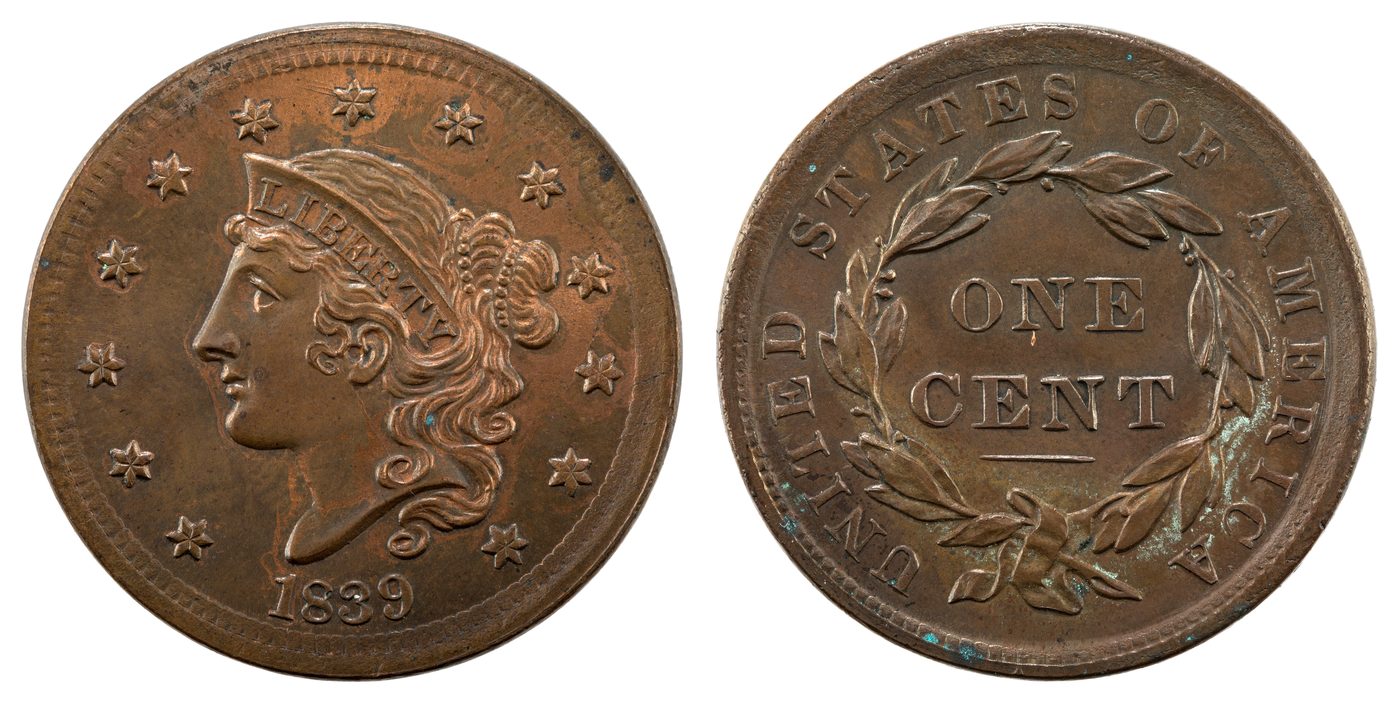
The obverse — the heads side — shows Liberty facing left, older and more severe than the youthful heads that came before. Her hair sweeps back into a bun tied with plain cords, a few locks falling past her ear and down her neck. Above her forehead sits a coronet, a small headband, with the word LIBERTY across it. That coronet is why the type's formal catalogue name is the Coronet cent; the stern face is why hobbyists call it the Matron Head. Thirteen stars and the date ring the rest of the field.

The reverse — the tails side — is a closed wreath of laurel, tied at the bottom with a ribbon, with ONE CENT stacked inside it and UNITED STATES OF AMERICA arcing around the rim.

Both sides are the work of Robert Scot, the Mint's first Chief Engraver, who had cut dies for the U.S. coinage since the 1790s. Scot designed and engraved the Matron Head obverse and reverse alike. He did not see the type through to the end: Scot died in November 1823, and William Kneass succeeded him as Chief Engraver in early 1824 and maintained the dies. Late in the run — around 1835 into 1836 — engraver Christian Gobrecht softened Liberty's features into a younger look, the change that closes out the Matron Head and leads toward the Braided Hair cents that followed. The classic, stern Matron Head is the 1816–1835 design.

Key facts

Years struck
1816–1835 (Coronet/Matron Head type runs to 1839)
Designer
Robert Scot — obverse and reverse
Later engravers
William Kneass (from 1824); Christian Gobrecht modified the head c. 1835–1836
Composition
Nearly pure copper
Weight
About 10.89 g
Diameter
About 28–29 mm
Edge
Plain
Denomination
One cent (a 'large cent' — far bigger than today's penny)
Key date
1823 — no cents were struck in 1823; 1823-dated coins were struck in 1824
Lowest mintage
1821 — 389,000 struck

Collecting it

The Matron Head is one of the friendlier early coppers to start with — most dates exist in enough quantity that a worn, honest example is affordable. The interest lives at the two ends: the genuinely rare dates, and the hoard that makes the early ones strangely easy.

The 1823 is the key. Here the calendar plays a trick. No cents were actually struck in 1823; the coins that bear that date were struck in 1824, alongside the 1824s. They come two ways — a normal date and an 1823/2 overdate, where an old "2" punch still shows under the "3" because the Mint reused a die. Both are scarce, and the 1823 is widely held to be the hardest regular cent to find of its whole era. There are also private restrikes — pieces made decades later, around the 1860s, by someone outside the Mint (the dealer Joseph Mickley is the name most often floated, though it has never been proven) using an 1823 die mated to an old reverse. The restrikes are collectible in their own right; they are not Mint products, and a serious cabinet wants the distinction labeled.

The 1821 is the genuine low-mintage date. Just 389,000 were struck — the smallest output of the type — and it is tough in high grade.

Varieties reward a sharp eye. The most famous is the 1817 "15 Stars," where the obverse carries fifteen stars instead of the usual thirteen — a design slip that collectors prize. Overdates run through the series: besides the 1823/2, there are 1819/8, 1820/19, 1824/2, and 1826/5, each the fingerprint of a reused or repunched die.

Why high grade is scarce — and why some early dates aren't. Copper is unforgiving. It darkens, spots, and corrodes, so a cent that kept its original bright "red" color (the just-struck copper shine, as opposed to the brown a coin turns with age) is genuinely hard to find and commands a premium. With one big exception. Sometime after the Civil War — the story says inside a small keg, possibly under a railroad platform in Georgia — a cache of uncirculated cents dated 1816 through 1820 surfaced. It is remembered as the Randall Hoard, after John Swan Randall, who handled the coins as they reached the market in the 1860s and '70s. A good estimate puts it near 5,000 pieces. That single find is the reason mint-state cents of 1816–1820 are far more available than the date and age would suggest. Most Randall coins show a telltale look — bright red mottled with brown or black flecks; a fully pristine, untouched red survivor is the rare prize within the rare prize.
Questions collectors ask

Why is the 1823 large cent so valuable?

Two reasons. First, scarcity: it is widely regarded as the hardest regular cent to find of its era. Second, a calendar quirk — no cents were actually struck during 1823. The coins dated 1823 were struck the following year, in 1824, and they come as a normal date and a scarcer 1823/2 overdate. Beware: privately made restrikes from decades later also carry the 1823 date and are not Mint products.

Why are 1816 to 1820 cents common in mint condition but later dates aren't?

Because of the Randall Hoard — a cache of uncirculated cents dated 1816 through 1820, estimated near 5,000 pieces, that surfaced after the Civil War and entered the market in the 1860s and '70s. That single find flooded the hobby with high-grade early-date examples. Cents from after 1820 had no such hoard, so mint-state survivors of those years are far scarcer.

What is the 1817 '15 Stars' cent?

A famous variety. The obverse normally carries thirteen stars, one for each original state. On some 1817 cents an engraver cut fifteen instead. It's a clear, eye-catching error that collectors specifically seek out.

Who designed the Matron Head cent?

Robert Scot, the Mint's first Chief Engraver, designed and engraved both the obverse and the reverse. He died in late 1823; William Kneass succeeded him and kept the design going, and Christian Gobrecht later modified Liberty's head around 1835–1836.

Why is it called a 'large cent' — and a 'Matron Head'?

'Large cent' is literal: these early one-cent pieces are about 28–29 mm across, much bigger and heavier than the modern penny. 'Matron Head' is a collector nickname coined in the early 1970s for Scot's older, sterner Liberty. The same coin is also called the Coronet cent, after the LIBERTY headband she wears.

Sources