US coin · series

The Capped Head Quarter Eagle: Gold That Was Born to Be Melted

A little $2.50 gold coin worth more melted than spent — so the world melted it.

The Capped Head Quarter Eagle: Gold That Was Born to Be Melted
US Mint (coin), National Numismatic Collection (photograph by Jaclyn Nash); credit: National Numismatic Collection, National Museum of American His… · public domain · source

Between 1808 and 1834, the United States struck tens of thousands of small gold quarter eagles. Almost none survive. The coins were worth more as metal than as money the day they left the press — so they were melted and shipped abroad almost as fast as the Mint could make them.

The coin that disappeared

Picture a gold coin the size of a modern dime, worth two and a half dollars in a year when that bought a week's groceries. The U.S. Mint struck a run of them across a quarter-century — and then the world quietly destroyed almost all of them.

The Capped Head quarter eagle ($2.50 in gold) was doomed by arithmetic. The Coinage Act of 1792 fixed the official value of gold to silver at 15 to 1. But by the 1820s, gold was worth closer to 15.5 or 15.6 to 1 in Europe. That gap sounds tiny. It wasn't. It meant the gold inside an American quarter eagle was worth more than its face value — so anyone holding one could melt it, sell the metal abroad, and pocket the difference.

That is exactly what happened, at industrial scale. A bullion broker in 1831 reportedly melted some 40,000 U.S. half eagles in Paris in a single transaction. American gold coins, never common to begin with, all but vanished from the country's pockets. The quarter eagle was the smallest, scarcest victim of that flow.

So the Mint made these coins, and the market unmade them. That is the whole story of why a coin struck by the thousands is now counted in the dozens — and why collectors a century and a half later treat finding one as a genuine event.

The design and who made it

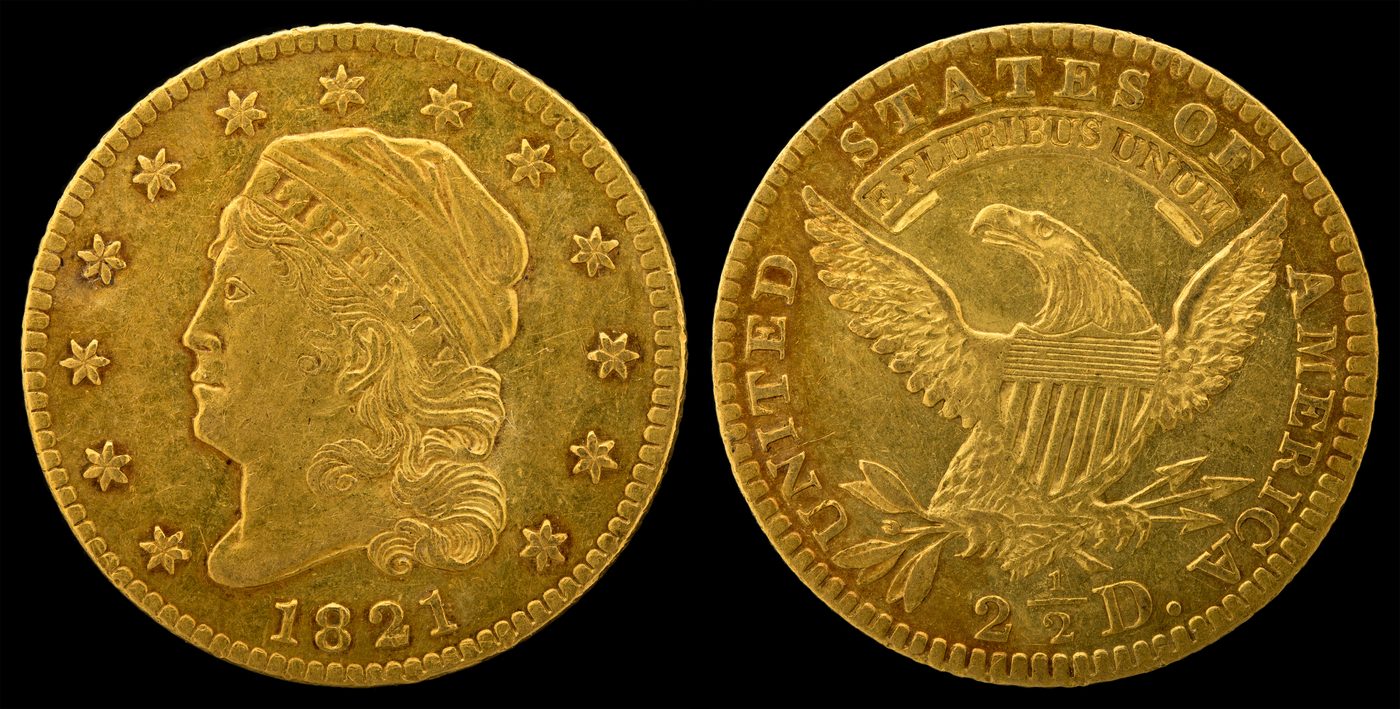
The obverse — the heads side — shows Liberty facing left in a soft cloth cap, the word LIBERTY stitched across the band, ringed by thirteen stars for the original states. The reverse carries an eagle with wings spread, a shield on its breast, an olive branch and arrows in its talons — peace and war, held together.

That design was the work of three hands across the type's life.

John Reich drew it first. Born Johann Matthias Reich in Bavaria, he came to America in 1800 as an indentured servant — a worker bound to repay the cost of his passage through years of labor. The Mint's chief coiner bought out the rest of his indenture, and in 1807 Reich was hired to modernize every U.S. coin. His Capped Bust Liberty replaced the stiff, borrowed designs that came before. On the 1808 quarter eagle — the only year of its kind — both sides are pure Reich.

Robert Scot, the Mint's aging chief engraver, reworked the design when the quarter eagle returned in 1821, trimming Liberty's portrait to fit a smaller field. William Kneass, who took the chief engraver's chair after Scot died in 1823, revised it again in 1829 — smaller stars, smaller letters, and a key technical leap: the close collar. A collar is a steel ring that surrounds the blank as it's struck. The new "close" collar held the metal in place, giving every coin a uniform diameter and a crisp, raised rim instead of the slightly ragged edges of earlier strikes.

So the Capped Head quarter eagle is really three closely related coins under one name: Reich's one-year 1808 issue, Scot's larger 1821–1827 version, and Kneass's tighter, reduced-diameter 1829–1834 version.

Key facts

Denomination
Quarter eagle ($2.50), gold
Years struck
1808; 1821–1834 (none dated 1809–1820)
Designers
John Reich (1808); Robert Scot (1821–1827); William Kneass (1829–1834)
Composition
0.9167 fine gold (22-karat 'crown gold'), balance silver and copper
Weight
About 4.37 g
Diameter
About 20 mm (1808–1827); about 18.2 mm (1829–1834, reduced)
Edge
Reeded
Mint
Philadelphia (no mint mark)
One-year type
1808 — 2,710 struck, all in a single day
Lowest mintage
1826 — 760 struck
Type ended by
Coinage Act of 1834 (gold content reduced)

Collecting it: why so few survive

Every date in this series is rare. That isn't collector hyperbole — it's a direct consequence of the melting. Across 1821–1834, the Mint struck only about 42,000 of these quarter eagles in total (plus a tiny number of proofs — specially made presentation strikes with mirror-like fields). Most went straight to the crucible.

A few issues stand out even within a rare type:

1808 — the one-year wonder. The entire mintage of 2,710 coins was struck on a single day in February 1808, and the design was never used again. Surviving estimates vary by source — many specialists put it at roughly three to four dozen known, while others count up to perhaps 125–150 in all grades — but every account agrees it is one of the great prizes of U.S. gold. Most survivors show wear, and a long die crack from the top of Liberty's cap is seen on known examples.

1826 — the lowest number. Just 760 struck, and the survivors are scarce in any grade.

1834 (reduced diameter) — the melted date. Roughly 4,000 were struck early in 1834 to the old, heavier standard. Then the Coinage Act of 1834 lowered the gold content, and the older coins were suddenly worth more melted than spent. Most of the 1834 mintage is believed to have stayed at the Mint and gone into the melting pot. Mint records don't confirm whether ordinary 1834 business strikes were ever released, and some specialists believe the few survivors may all be proofs.

Two overdates add a hunt for variety collectors: the 1824/1 and the 1826/5, where an old date punch shows beneath the new one — the Mint reusing a die and saving steel. On the 1824, every known coin is an overdate.

High grades are scarce for a simple reason: these were valuable coins that mostly circulated hard before being melted, so an example with original mint luster survived against long odds. Across both grading services, only a few dozen Mint State grading events exist for the entire 1808 issue.

Questions collectors ask

Why are Capped Head quarter eagles so rare?

The gold inside them was worth more than $2.50 because U.S. law undervalued gold relative to silver. Holders melted the coins and sold the metal — especially in Europe — so most were destroyed within a few years of being struck. A type made by the tens of thousands now survives in the dozens to low thousands by date.

Is the 'Capped Head' quarter eagle the same as the 'Capped Bust' quarter eagle?

They describe one closely related family. The 1808 issue is often called Capped Bust to Left (John Reich's one-year design). The 1821–1834 coins are usually called Capped Head Left, in a larger size (1821–1827) and a reduced size (1829–1834). Catalogs group them together as the same general type.

Who designed the Capped Head quarter eagle?

John Reich created the original design used in 1808. Robert Scot reworked it for the 1821–1827 coins, and William Kneass revised it again for the reduced-diameter 1829–1834 coins, adding the close-collar striking that gave the coins uniform diameters and sharper rims.

Why was the type discontinued in 1834?

The Coinage Act of 1834 reduced the gold content of U.S. coins so their bullion value would once again sit below face value, ending the incentive to melt them. The redesigned, lighter quarter eagle that followed is the Classic Head — and it finally circulated in real numbers.

Why are there no quarter eagles dated 1809 through 1820?

The Mint simply struck none in those years. The 1808 mintage was tiny and the denomination didn't return until 1821, which is part of why the 1808 stands so alone.

Sources