US coin · series

The Classic Head Half Cent: the coin a war nearly erased

America's smallest denomination, struck in fits and starts across 27 years — and missing entirely for thirteen of them.

The Classic Head Half Cent: the coin a war nearly erased
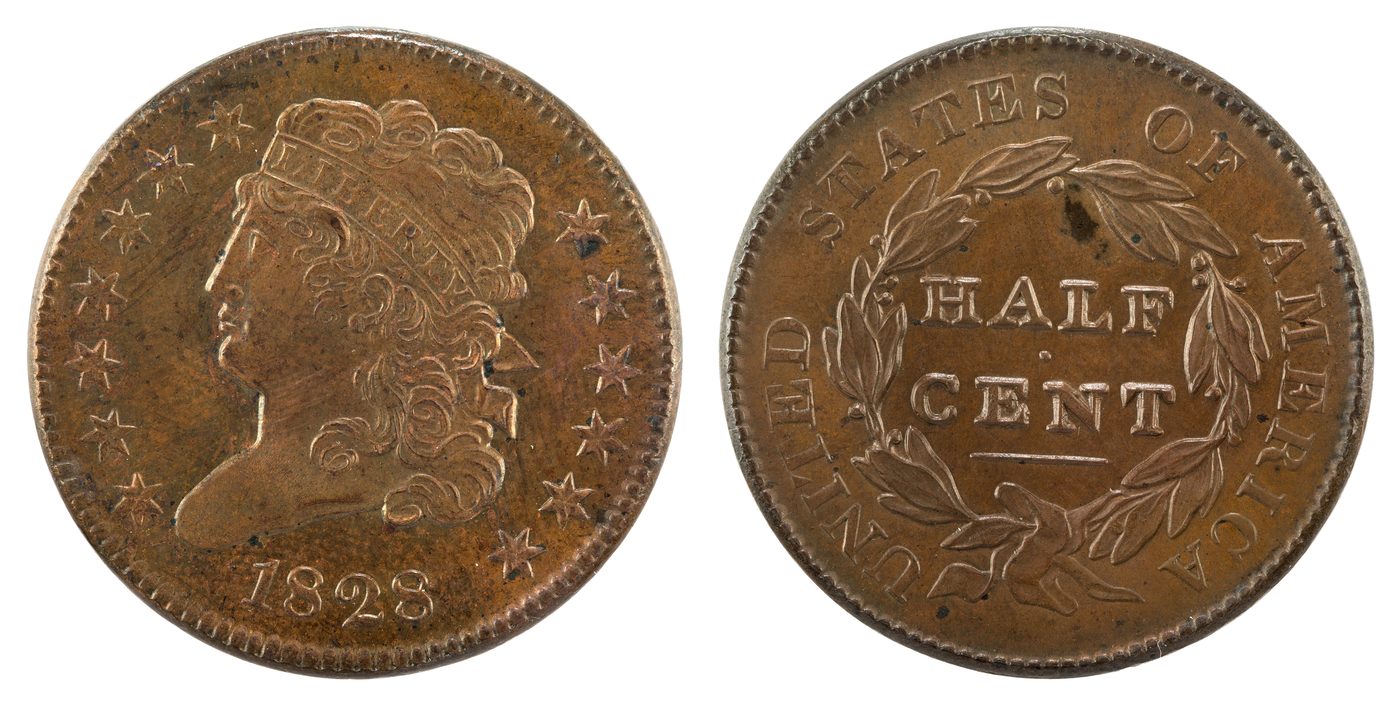
US Mint (coin), National Numismatic Collection (photograph by Jaclyn Nash); Credit: National Numismatic Collection, National Museum of American His… · public domain · source

Between 1812 and 1824, the United States Mint made no half cents at all. A war had cut off its copper. When the little coin came back, it returned as one of the most start-stop series in American money — and left behind a handful of dates collectors have chased for over a century.

The story behind the coin

Imagine a coin worth half of one cent. Even in 1809, that was barely enough to matter — and Americans treated the half cent accordingly. It was the runt of the Mint's lineup, minted only when someone actually asked for it.

So the half cent has a strange, stuttering history, and the Classic Head version (1809–1836) is the most stop-and-start chapter of all. The Mint struck it hard at first, then watched the world get in the way.

That world was the War of 1812. The Mint did not roll its own copper blanks in this era — it bought them ready-made (called planchets, the blank discs a coin is struck from) from the English firm of Boulton & Watt in Birmingham. War with Britain choked that supply off. With no blanks to strike, the Mint simply stopped making half cents after 1811.

The gap lasted thirteen years. No half cents were struck from 1812 through 1824. When production finally resumed in 1825 — said to be in response to an order from a Baltimore merchant — the coin came back to a country that had changed around it. Across the whole 1809–1836 run, the Mint struck roughly 3.6 million Classic Head half cents, and skipped entire years again and again: nothing in 1827, nothing in 1830, and by the 1830s the coin survived mostly as a curiosity for collectors rather than a thing people spent.

The design and who made it

The man behind the design was John Reich — born Johann Matthias Reich in 1768 in Fürth, Bavaria. He learned engraving from his father, then fled the Napoleonic Wars and arrived in America around 1800 as an indentured servant, working off the cost of his passage. He was, by all accounts, one of the most gifted die-cutters the young country had access to.

The Mint hired him on April 1, 1807, as assistant to Chief Engraver Robert Scot, at fifty dollars a month. Reich got the title of assistant and the salary of one — and he kept both, without a raise, for exactly ten years before resigning in 1817, worn down by low pay and poor health.

His work was everywhere on American coinage. Reich reworked nearly every denomination, and a softened, more mature Liberty he cut became known as the "Classic Head." It is worth pausing on that name: it is a nickname, applied long after the fact — the cataloguer Ebenezer Mason is credited with attaching it around 1868. To collectors of the day it was simply the current cent and half cent.

Reich's design appeared first on the large cent in 1808, then on the half cent in 1809. Here is what it shows:

  • The obverse — the "heads" side — is Liberty facing left, her curls tied back under a headband reading LIBERTY, ringed by thirteen six-pointed stars for the original states, with the date below.
  • The reverse — the "tails" side — wraps UNITED STATES OF AMERICA around a laurel wreath, with HALF CENT spelled out at the center.

Reich designed both sides. In the later years of the run, after Reich had left and Robert Scot had died, Chief Engraver William Kneass modified the working dies — so the coin you hold from, say, the 1830s is Reich's vision touched by other hands.

Key facts

Years struck
1809–1836 (struck 1809–1811, 1825–1826, 1828–1829, 1831–1836)
Designer
John Reich — obverse and reverse
Later modified by
Robert Scot, then William Kneass
Composition
100% copper
Weight
5.44 g
Diameter
23.5 mm
Edge
Plain
Highest-mintage date
1809 — 1,154,572 struck
Series total
≈3,637,912 across all years
No half cents struck
1812–1824, 1827, 1830
Famous rarities
1811, 1831, 1836

Collecting it: key dates, varieties, and why high grades are scarce

A complete set of Classic Head half cents is a reachable goal — but a few dates stand between a collector and the finish line, and they are where the money and the romance live.

1811 is the scarce date of the early run. It was struck right before the war shut the series down, in modest numbers, and worn-but-honest examples are genuinely hard to find. Two versions exist — a Wide Date and a Close Date — plus a later unofficial restrike (a coin struck after the fact, sometimes from mismatched dies) that pairs an 1811 obverse with an old reverse from an earlier type.

1831 and 1836 are the trophies. By the 1830s the half cent barely circulated, and these dates were made in tiny numbers — largely as proofs (specially struck presentation coins, made from polished dies for sharp, mirror-like surfaces) rather than as money for the till. The 1831 carries a stated mintage of just 2,200, and experts still debate whether any were truly meant for circulation. The 1836 is a proof-only year. To complicate matters, the Mint later produced restrikes of both dates for collectors, so the same year can exist as an original or a later strike — a distinction that separates a good coin from a great one.

The most famous variety is the 1828 with 12 stars. Most 1828 half cents carry the usual thirteen stars; on one die the engraver simply punched in twelve — seven left, five right. That mistake makes the 12-star coin the prize of an otherwise common year. Reported 1828 mintage was 606,000, second only to the first-year 1809, yet the 12-star die accounts for only about a fifth of survivors.

Why are high grades so scarce across the board? Copper is unforgiving. It spots, it tones, it corrodes, and a soft little coin worth half a cent was not something anyone set aside with care. Most survivors are worn and brown. A Classic Head half cent with sharp detail and original surfaces — what graders call mint state — is genuinely uncommon, and that is exactly what drives the prices at the top of the series.

Questions collectors ask

Who designed the Classic Head Half Cent?

John Reich (born Johann Matthias Reich, 1768, in Fürth, Bavaria), the U.S. Mint's assistant engraver. He designed both the obverse Liberty and the reverse wreath. The 'Classic Head' name was applied by collectors decades later. In the coin's final years, after Reich had resigned, Chief Engraver William Kneass modified the dies.

Why were no half cents made between 1812 and 1824?

The War of 1812 cut off the Mint's supply of ready-made copper blanks (planchets) from the English firm Boulton & Watt. With no blanks to strike, half cent production simply stopped after 1811 and did not resume until 1825.

What are the rarest dates in the series?

The 1811 is the scarce early date. The 1831 and 1836 are the trophies — both were made in tiny numbers, largely as proofs, and both exist as later restrikes as well. Telling an original from a restrike is a key skill for collectors of these dates.

What is the 1828 '12 stars' half cent?

A die variety. Most 1828 half cents show the usual thirteen stars; one die was punched with only twelve. That error makes the 12-star coin a prized variety in an otherwise common year.

What is the Classic Head Half Cent made of?

Pure copper — 100%. It weighs 5.44 grams, measures 23.5 mm across, and has a plain (smooth) edge.

Sources