US coin · series

The Classic Head Large Cent (1808–1814)

An immigrant engraver's Liberty, struck on English copper that ran out during a war.

The Classic Head Large Cent (1808–1814)
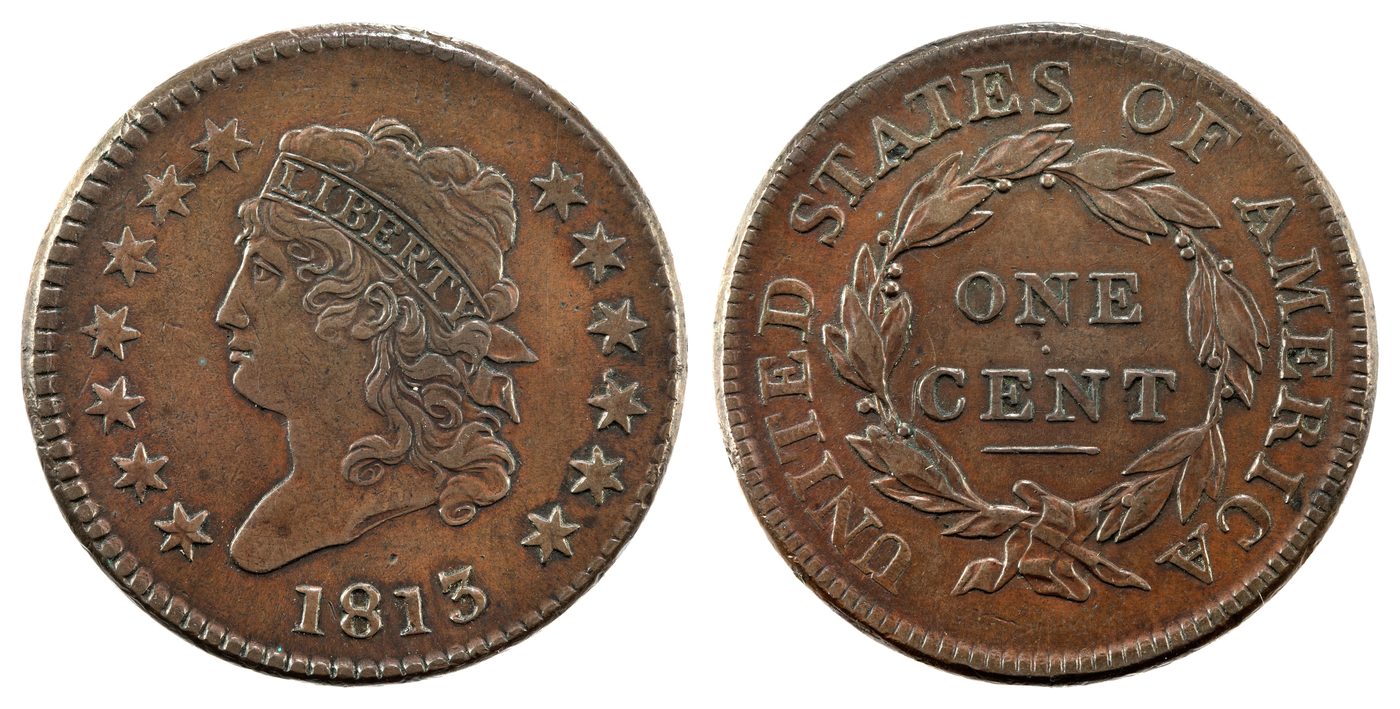
US Mint (coin); National Numismatic Collection, National Museum of American History (photograph by Jaclyn Nash) · public domain · source

In December 1814, the Mint scraped together its last copper and struck cents to pay its own workers. Then the supply ran dry. That is why, in the whole run of American one-cent pieces, there is no coin dated 1815 — and why this short, scarce series sits at the seam between the early Mint and the country that came after the war.

The story behind the coin

The United States Mint did not make its own copper. It bought ready-made blank discs — planchets — from one supplier across an ocean: the firm of Boulton & Watt in Birmingham, England. For years that arrangement worked. Then the two countries went to war.

The War of 1812 cut the lifeline. The last big shipment of English planchets — about 20 tons — reached the Mint in 1812. After that, nothing. The Mint coined cents in 1812 and 1813 out of the stock it already had on the shelf, watching the pile shrink.

By late 1814 the Treasury had ordered the Mint to stop striking cents, and Mint workers had gone without their wages for the better part of a year. So in December 1814, Mint Director Robert Patterson told his chief coiner, Adam Eckfeldt, to strike the last copper into cents — and hand those coins to the staff as pay. The men spent them immediately.

Then the copper was gone. No cents were struck in 1815 at all — the only year, going back to 1793, with no U.S. cent. Private merchants and foreign coppers filled the gap in people's pockets until fresh planchets arrived from England in 1816. The Classic Head cent is the coin caught on the wrong side of that famine: a design that lasted just seven years and went out not because anyone disliked it, but because the raw material stopped coming.

The design & who made it

The man behind it was John Reich — and his story is half the appeal. Born in 1768 in Fürth, Bavaria, the son of a medal-engraver, Reich fled the chaos of the Napoleonic Wars and reached Philadelphia in 1800 as an indentured servant: he had effectively sold years of his labor to pay for the passage. He worked off the debt, and in 1807 the Mint hired him as assistant to its aging Chief Engraver, Robert Scot.

Reich's job was enormous — redraw nearly every U.S. coin. His new Liberty first appeared on cents in 1808, and he designed both sides. The obverse (the heads side) shows Liberty facing left, her curls bound by a ribbon-like headband reading LIBERTY, with thirteen stars and the date around her. The reverse (tails) is a wreath tied with a bow, circling the words ONE CENT, with UNITED STATES OF AMERICA around the rim.

Collectors call this the "Classic Head" — but that name came much later, first appearing in print in 1868. Reich never used it. The look earned the name because the headband recalls the fillet worn by athletes on ancient Greek and Roman coins; for decades earlier, dealers had instead called it the "Turban Head."

Reich was never paid well. His salary was $50 a month — a sum President Jefferson reportedly thought too high — and after a decade of squinting at tiny dies, he resigned on March 31, 1817, citing pay and failing eyesight. He left a quiet signature on his work: a tiny notch in the 13th star, his private mark.

Key facts

Years struck
1808–1814 (Philadelphia only; no mint mark)
Designer
John Reich — obverse and reverse
Composition
Copper
Weight / diameter
≈ 10.89 g / 29 mm, plain edge
Total business strikes
≈ 4,757,722 across all seven years
Scarcest date
1811 — 218,025 struck
Famous varieties
1810 10/09, 1811 1/0, 1812 Small/Large Date, 1814 Plain & Crosslet 4
Why it ended
War of 1812 cut off English copper planchets

Collecting it

This is a series collectors prize for its difficulty, not its rarity on paper. No single date is a great rarity — but every date is genuinely scarce in high grade, and that is the whole game.

The reason is the metal itself. The copper of these years was soft and often impure, and most of these cents went straight into hard daily use during a cash-short wartime economy. Worn, corroded, and dark-brown survivors are the norm. A sharply struck coin that kept its original red-brown color is the exception, and prices reflect it: values stay modest through the middle circulated grades, then climb steeply above Extremely Fine and become expensive in Mint State.

A few signposts for the series. The 1811 is the key date — the lowest mintage of the run at 218,025 — and the toughest to find nice. Among varieties, watch for overdates, where an old die was repunched with a new year and the earlier digits still show: the 1810 10/09 and the 1811 1 over 0. The 1814 comes with two styles of the numeral 4 — a "Plain 4" and a "Crosslet 4" (with a small bar across the top of the digit). There's even a well-supported theory that many of the 1814 Plain 4 cents were actually struck in 1816, after copper returned, using leftover dies — a quiet footnote to that famine year.

A clean, problem-free Classic Head cent — good color, no corrosion, a readable date and stars — is harder to land than the price guides suggest. That gap between "common date" and "common condition" is exactly why type collectors single this series out.

Questions collectors ask

Why is there no 1815 large cent?

The Mint bought its copper blanks from Boulton & Watt in England, and the War of 1812 cut off the supply. The last cents from the remaining stock were struck in December 1814 to pay Mint workers. With no copper left, none were made in 1815 — the only year, going back to 1793, with no U.S. cent. Fresh planchets arrived from England in 1816 and production resumed.

Who designed the Classic Head cent?

John Reich, a Bavarian-born engraver who came to America as an indentured servant in 1800 and joined the Mint in 1807. He designed both the obverse and the reverse. The design first appeared on cents in 1808.

Why is it called the 'Classic Head'?

Because Liberty's headband recalls the fillet worn by athletes on ancient Greek and Roman coins. The name is a later collector term, first printed in 1868 — Reich never used it, and earlier dealers called the design the 'Turban Head.'

Which is the rarest date in the series?

The 1811, with a mintage of 218,025 — the lowest of the run and the hardest to find in attractive condition. That said, every date in the series is scarce in high grade because the soft copper of the period wore and corroded easily.

What are the 'Plain 4' and 'Crosslet 4' of 1814?

Two styles of the numeral 4 in the date. The Crosslet 4 has a small horizontal bar across the top of the digit; the Plain 4 does not. Both are collected as distinct varieties — and many Plain 4 coins may actually have been struck in 1816 from leftover dies.

Sources