Era
The Civil War & Reconstruction: When America Ran Out of Coins
A nation at war hoarded every cent it had — and the money that filled the gap still rattles in collectors' trays today.
In the winter of 1862, you could not get change in America. Coins had vanished — hoarded into mattresses and melting pots — and a country fighting for its life had to invent new money on the fly. What it invented, from the first "In God We Trust" to a silver dollar built for China, is one of the strangest chapters in American coinage.
The world then
In the spring of 1861, the United States split in two and went to war with itself. The conflict that followed — four years of it — was the deadliest in the nation's history, and paying for it nearly broke the Treasury. Then came Reconstruction: a tense, dozen-year struggle to rebuild the South and decide what the reunited country would be.
Money sat at the center of all of it. Before the war, U.S. coins were specie — gold and silver and copper worth, in metal, roughly what they were stamped to be worth. A silver dime held about a dime's worth of silver. That worked beautifully right up until people stopped trusting the future.
In late 1861, with battlefield news grim and the government's finances shaky, Americans did the rational thing: they stopped spending their coins. A gold or silver coin was wealth you could bury. Paper promises from a government that might lose the war were not. So the coins disappeared into hoards — and a nation that ran on small change suddenly had none.
The money
The government's first answer was paper. In late 1861 it suspended specie payments — it stopped redeeming its paper for gold and silver on demand — and on February 25, 1862, Congress passed the First Legal Tender Act. It created United States Notes, printed with green ink on the back and instantly nicknamed greenbacks. By the war's end roughly $431 million of them were in circulation. For the first time, paper money was legal tender across the whole country, backed not by metal but by faith in the Union.
But greenbacks came in dollars, and the crisis was about pennies — the small change that buys a loaf of bread. With coins hoarded, people paid each other in postage stamps, in privately printed merchant tokens, in scraps of paper. From August 1862 the government issued tiny "postage currency," later called fractional currency — paper notes worth as little as three cents. A country was making change out of postage stamps.
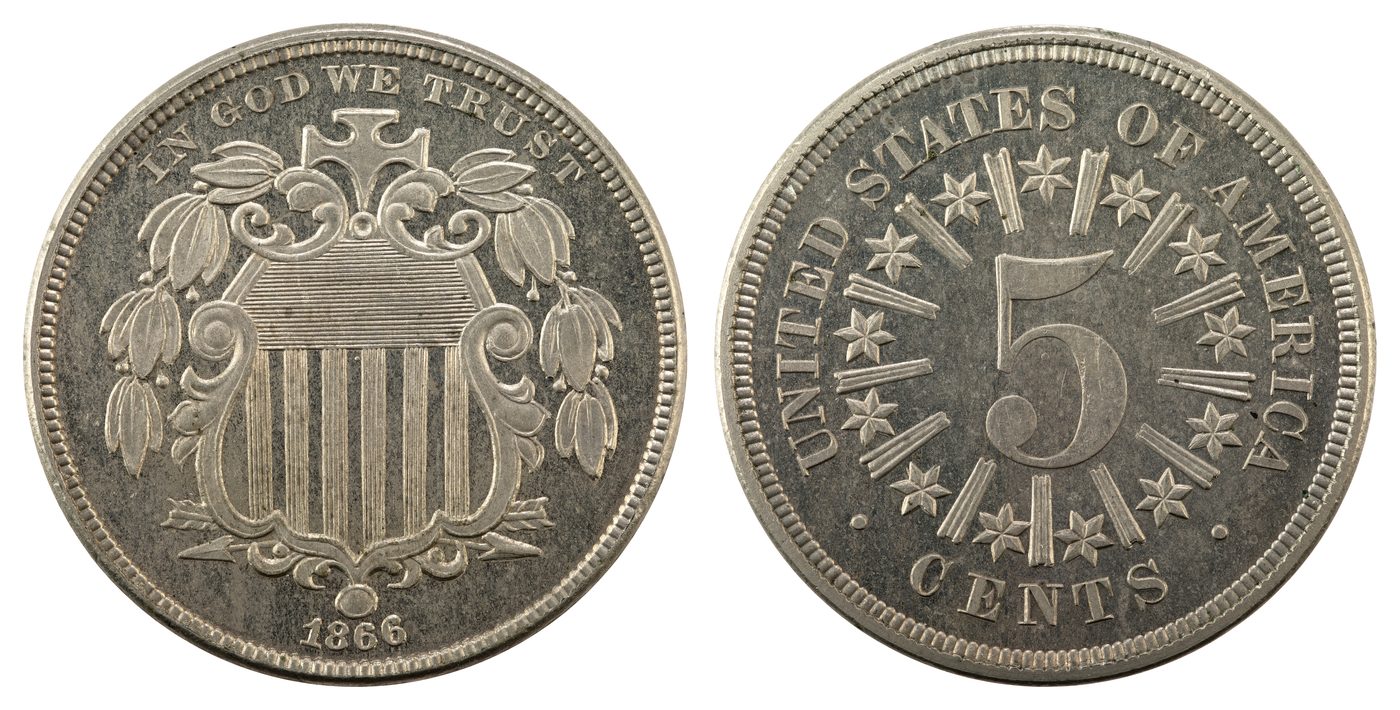
The Mint's answer was to make coins out of cheaper metal, so people would actually spend them. That single idea — strip the precious metal out, keep the coin in your pocket — drove a burst of new denominations. The two-cent piece arrived in 1864 in bronze. The same year, the little Indian Head cent quietly switched from a pale copper-nickel alloy to that same cheap bronze. The three-cent nickel followed in 1865. The Shield nickel — the first five-cent coin made of copper and nickel rather than silver — came in 1866. None of them held much metal value, which was exactly the point: there was no reason to hoard them.
The two-cent piece carried something extra. Stamped across the shield on its front was a phrase no U.S. coin had ever worn: IN GOD WE TRUST. The idea came from a letter. In November 1861, a Pennsylvania minister named M. R. Watkinson wrote to Treasury Secretary Salmon P. Chase, urging that the nation put God on its coins during the crisis. Chase agreed. On November 20, 1861, he told Mint Director James Pollock to find "the fewest and tersest words possible" for the idea. Pollock tried several — "GOD OUR TRUST," "GOD AND COUNTRY" — before the now-famous wording was struck onto the new two-cent piece in 1864. (Watkinson's own suggestion had actually been "GOD, LIBERTY, LAW.")
Behind nearly every one of these coins stood one man: James Barton Longacre, the Mint's fourth Chief Engraver. He designed the two-cent piece, the three-cent nickel, the Shield nickel, and the Indian Head cent. He had held the engraver's post since 1844 and would die on New Year's Day 1869, still in office. His successor, William Barber, would design the era's most ambitious coin of all.
That coin was the Trade Dollar. By the early 1870s the West was flooding with silver, and the U.S. wanted a way to spend it — specifically, to compete with the Mexican silver peso in trade with China and Asia. Authorized by the Coinage Act of 1873, Barber's Trade Dollar shows Liberty seated on bales of merchandise, facing west across the Pacific. It was a coin meant to leave the country. Most of the first ones did, shipped straight to China. But the same 1873 act quietly ended the old silver dollar — a move Western silver interests would forever call "the Crime of '73" — and as silver prices crashed, the Trade Dollar became an awkward orphan. In 1876 the government stripped it of its legal-tender status at home. A dollar that was no longer quite a dollar.
The coins of this era
The famous new denominations — the two-cent piece, the nickels, the Trade Dollar — grab the headlines. But they are only part of the story. The coins of the Civil War and Reconstruction hang together because two great events touched almost every one of them.
The first was the motto. Once "In God We Trust" landed on the 1864 two-cent piece, Congress went further. The Act of March 3, 1865 ordered the words onto every coin large enough to hold them. So in 1866 the motto fanned out across the whole money: onto the silver Seated Liberty quarter, half dollar, and dollar, and onto the big gold pieces — the Coronet Head (Liberty Head) half eagle ($5), eagle ($10), and double eagle ($20). For one year, 1866, the double eagle even came two ways — "no motto" and "with motto" — because the change happened mid-year. The little dime and half dime were left bare; they were simply too small. In a single line of scripture, a nation at war re-labeled its entire coinage with its faith.
The second event was the Coinage Act of 1873 — the "Crime of '73." In one stroke it cleared the board. It abolished the two-cent piece, the silver three-cent piece (the "trime"), the half dime, the standard silver dollar, and the gold dollar. It crowned the new Trade Dollar for export. And because it nudged the weights of the silver dime, quarter, and half dollar up by a hair, the Mint marked the change the old-fashioned way — by adding little arrows beside the date for 1873 and 1874. A collector can hold a "with arrows" Seated Liberty quarter and read, in two tiny engraved arrowheads, a law that reshaped American money.
So the roster of this era runs from the everyday to the unreal. At the bottom, paper change you could tear — postage currency. Then the cheap-metal experiments: the Indian Head cent, the two-cent piece, the three-cent nickel (which replaced the hoarded silver trime), the Shield nickel — and that nickel comes in two of the era's most-collected types, with rays (1866–67) and without (1867 on), because the rays kept breaking the dies. The full silver family carries on through it all — the Seated Liberty dime, half dime, quarter, half dollar, and dollar, the figure on them designed decades earlier by Christian Gobrecht. The gold runs the same gauntlet: the Coronet Head half eagle ($5), eagle ($10), and double eagle ($20), plus the odd and elegant three-dollar "Indian Princess," most of them Longacre's work.
And then there are the coins that almost were — the ghosts of the era. The Mint never stopped experimenting on paper and in metal, and three of those experiments survive as patterns. The half-dollar pattern coinage gathers the fifty-cent designs the Mint tried and shelved. The 1871 Standard Silver pattern dollar shows the Mint rehearsing a new silver dollar two years before the Coinage Act killed the old one. And at the very top sits a coin almost no one ever saw: the Half Union, a fifty-dollar gold pattern struck in 1877 to William Barber's design. Only two were ever made in gold; both sit in the Smithsonian today. It was the country dreaming of a coin grander than any it had ever spent — the perfect coda to an era that had spent fifteen years reinventing what money was.
A timeline of the money
- 1861Coins vanish
With the war going badly, Americans hoard gold, silver, and copper. The government suspends specie payments.
- 1862Greenbacks born
The First Legal Tender Act (Feb 25) creates United States Notes — the first nationwide paper legal tender. 'Postage currency' follows in August.
- 1864'In God We Trust' debuts
Longacre's bronze two-cent piece becomes the first U.S. coin to carry the motto. The Indian Head cent switches to the same cheap bronze. First-year two-cent mintage: 19,822,500.
- 1865The motto spreads — and a new coin
The Act of March 3 orders 'In God We Trust' onto coins large enough to hold it. Longacre's copper-nickel three-cent piece replaces the hoarded silver trime.
- 1866The Shield nickel & the motto fans out
The first copper-nickel five-cent coin debuts (with rays). The motto reaches the Seated Liberty silver and the gold half eagle, eagle, and double eagle (the double eagle struck both 'no motto' and 'with motto' that year).
- 1867Rays removed
Striking problems force Longacre to drop the rays from the Shield nickel's reverse partway through the year, creating two distinct types.
- 1871Rehearsing a new dollar
The Mint strikes Standard Silver pattern dollars — experiments in a redesigned silver dollar, two years before the Coinage Act would abolish the old one.
- 1873The Coinage Act
The 'Crime of '73' authorizes the Trade Dollar, abolishes the two-cent piece, silver trime, half dime, silver dollar, and gold dollar, and adds arrows to the dime, quarter, and half dollar to mark a slight weight change.
- 1876The Trade Dollar falls
As silver prices collapse, the Trade Dollar is stripped of legal-tender status at home (July 22), even as millions more are struck.
- 1877The Half Union dream
William Barber's $50 gold pattern is struck — only two in gold, both now in the Smithsonian. The grandest U.S. coin never to circulate.
Key facts
- Region
- United States
- Span
- 1861–1877 (war 1861–1865; Reconstruction to 1877)
- The crisis
- Coin hoarding emptied circulation; greenbacks (from 1862) and fractional paper currency filled the gap
- New low-metal coins
- Indian Head cent (bronze from 1864), two-cent piece (1864), three-cent nickel (1865), Shield nickel (1866)
- Motto's debut
- 'In God We Trust' — first on the 1864 two-cent piece; spread to silver and gold from 1866
- The 'Crime of '73'
- The Coinage Act of 1873 ended the two-cent piece, silver trime, half dime, silver dollar, and gold dollar; added 1873–74 'arrows' to the dime, quarter, and half dollar
- Export coin
- Trade Dollar (from 1873) — built to compete with the Mexican peso in China
- The ghosts
- Pattern coins of the era — half-dollar patterns, the 1871 Standard Silver pattern dollar, and the 1877 Half Union ($50 gold)
- Grandest coin
- Half Union — an 1877 $50 gold pattern; only two struck in gold, both in the Smithsonian
- Mint's designers
- James B. Longacre, Chief Engraver 1844–1869; William Barber after him; the silver coinage on Christian Gobrecht's Seated Liberty
Why it fascinates collectors
This is the era where you can hold history in your hand. The first "In God We Trust" coin. The first nickel. A dollar designed to sail to China. Each one is a physical answer to a specific national emergency — and that makes them irresistible.
The denominations themselves are part of the appeal. A two-cent piece and a three-cent nickel sound almost fictional today, and that strangeness draws people in. They were short-lived experiments, born of crisis, gone within a generation — which is exactly why a clean one feels like a relic from a road the country didn't take.
There's also the chase within the chase. The Shield nickel of 1866–67 comes in two flavors — with rays and without — because Longacre had to change the design mid-stream when the dies kept breaking. Spotting the difference is a collector's rite of passage. (A die is the steel stamp that strikes the design into the blank coin; the rays were dropped because the design was too intricate for the dies to strike cleanly.) The same two-types game plays out across the era: the 1866 double eagle "no motto" versus "with motto," the 1873–74 silver coins "with arrows" versus without. The Mint kept changing the rules mid-year, and each change minted a small, hunt-worthy rarity.
For the deep end of the hobby, there are the patterns — the coins the Mint struck to test an idea, never meaning them to spend. The half-dollar pattern series and the 1871 Standard Silver pattern dollar are the Mint thinking out loud in metal, and the 1877 Half Union is the ultimate trophy: a $50 gold piece that exists in just two examples, both locked in the Smithsonian. A pattern is the rarest kind of coin there is — proof of a decision before it was made.
And the Trade Dollar carries a story collectors love to tell: many that went to China came back stamped with chop marks — small punches that Chinese merchants used to vouch for the silver. A chop-marked Trade Dollar is a coin with a passport, a physical record of a journey across the Pacific and back. The condition that matters most to value here is the strike and the grade — how sharply the coin was struck and how little it wore — and on a circulated, world-traveled coin that survival is its own small miracle.
Questions collectors ask
Why did Americans hoard coins during the Civil War?
Coins were made of gold, silver, and copper worth close to their face value. With the Union's future uncertain, people trusted metal over paper and pulled their coins out of circulation — emptying the country's supply of everyday change.
What was the first U.S. coin to say 'In God We Trust'?
The bronze two-cent piece of 1864, designed by James B. Longacre. The motto traces back to an 1861 letter from a Pennsylvania minister, Rev. M. R. Watkinson, to Treasury Secretary Salmon P. Chase, who ordered the Mint to find a short phrase declaring the nation's trust in God. The Act of March 3, 1865 then spread the motto to larger silver and gold coins beginning in 1866.
What was the difference between the 1864 copper-nickel and bronze Indian Head cents?
Early in 1864 the cent was struck in a pale copper-nickel alloy (88% copper, 12% nickel). Partway through the year the Mint switched to a cheaper bronze (95% copper, with tin and zinc) — the same cost-cutting logic behind the new two-cent piece. The bronze cent was lighter and cheaper to make, and it stayed in circulation rather than being hoarded.
What was the 'Crime of 1873'?
The nickname critics gave the Coinage Act of 1873. The law abolished the two-cent piece, the silver three-cent piece, the half dime, the standard silver dollar, and the gold dollar; authorized the export-only Trade Dollar; and effectively put the United States on a gold standard. Western silver interests felt cheated out of the right to coin their silver into dollars — hence 'crime.'
Why do some 1873 and 1874 coins have arrows by the date?
The Coinage Act of 1873 nudged up the weights of the silver dime, quarter, and half dollar by a tiny amount. To mark the change, the Mint placed small arrowheads on either side of the date in 1873 and 1874 — the same trick it had used for a weight change back in 1853. Those 'with arrows' coins are distinct, collectible types.
Why was the Trade Dollar made, and why did it lose its legal-tender status?
It was authorized by the Coinage Act of 1873 to spend America's surplus Western silver abroad — chiefly to compete with the Mexican peso in trade with China. When silver prices crashed, the government stripped it of legal-tender status at home in 1876 to keep cheap silver dollars from flooding back into U.S. commerce.
What are pattern coins, and which ones come from this era?
A pattern is a coin the Mint strikes to test a proposed design, denomination, or alloy — it was never meant to circulate, so very few exist. The Civil War and Reconstruction era left several famous ones: a run of half-dollar patterns, the 1871 Standard Silver pattern dollar (a rehearsal for a redesigned silver dollar), and the 1877 Half Union, a $50 gold pattern that survives in just two gold examples.
What is the Half Union?
A $50 gold pattern coin struck at the Philadelphia Mint in 1877 to a design by William Barber — the largest-denomination U.S. coin ever attempted. Only two were struck in gold, and both now reside in the Smithsonian. It never circulated; it was an experiment in a grander coinage that the country never adopted.
Sources
- Coinage Act of 1864 — Wikipedia
- Two-cent piece (United States) — Wikipedia
- 'In God We Trust' — The Story of the Two Cent Piece — PCGS
- Restoration of the Motto — U.S. Mint
- Indian Head cent — Wikipedia
- Indian Head Cent, Bronze (1864–1909): A Collector's Guide — CoinWeek
- Shield nickel — Wikipedia
- Three-cent nickel — Wikipedia
- Three-cent silver — Wikipedia
- Trade dollar (United States coin) — Wikipedia
- Coinage Act of 1873 — Wikipedia
- Liberty Head double eagle — Wikipedia
- Liberty Head Double Eagle, With Motto (1866–1876) — CoinWeek
- Liberty Seated Dime, Legend and Arrows (1873–1874): A Collector's Guide — CoinWeek
- Half union — Wikipedia
- 50 Dollars, Pattern, United States, 1877 — National Museum of American History
- United States pattern coins — Wikipedia
- James B. Longacre — Wikipedia
- Greenback (1860s money) — Wikipedia
- Coins and Currency of the American Civil War — APMEX
- Specie Payment Resumption Act — Wikipedia