Era
When pocket change started changing every ten weeks
Modern circulating and commemorative US coinage, 1992–2025 — the era that turned ordinary money into a treasure hunt.
For most of the 20th century, the coins in your pocket looked the same year after year. Then, in 1999, the United States Mint started changing the quarter five times a year — and an estimated 147 million Americans began checking their change.
The world then
For decades, US coins were frozen in place. The Lincoln cent had worn the same reverse — the tails side — since 1959. The Washington quarter had looked essentially the same since 1932. Pocket change was something you spent, not something you studied.
That made a kind of sense. A circulating coin's job is to be boring and trustworthy: the same size, weight, and look every time, so a vending machine and a cashier never hesitate. Stability was the feature.
But by the late 1990s the Mint saw an opportunity. A coin is a tiny billboard that every American holds dozens of times a week. What if that billboard could change — and pull the public into its own money? In 1997 Congress passed the 50 States Commemorative Coin Program Act, signed by President Clinton on December 1, 1997. The quarter was about to stop standing still.
The money
The program that started it all was the 50 State Quarters. Beginning with Delaware on January 4, 1999, the Mint released five new quarter designs every year for ten years — one per state, in the order each joined the Union — finishing with Hawaii in 2008. A new design landed roughly every ten weeks. The front (the obverse — the heads side) kept George Washington; only the reverse changed, state by state.
It worked beyond anyone's expectation. The Mint later called it the most successful coin program in US history: by its own estimate, about 147 million Americans collected the quarters, and the program earned roughly $3 billion in seigniorage — the profit the government makes when a coin costs less to produce than its face value. People weren't just spending the new quarters; they were pulling them out of circulation and saving them. A blue cardboard folder with fifty holes became a fixture on kitchen tables.
Success bred sequels. The quarter kept rotating: the District of Columbia and US Territories quarters in 2009, then America the Beautiful (2010–2021), a 56-coin run honoring national parks and sites. In 2021 the reverse briefly showed George Washington crossing the Delaware. Then came the American Women Quarters (2022–2025), five designs a year celebrating trailblazing women — and in January 2022, poet Maya Angelou became the first Black woman to appear on a US quarter.
The dollar coin got the same treatment, with less luck in your pocket. The Sacagawea "golden dollar" debuted in 2000 — not actually gold, but a copper core clad in manganese brass that gives it a warm color and a distinct electronic signature for vending machines. Its obverse, by sculptor Glenna Goodacre, shows the Shoshone guide of the Lewis and Clark expedition carrying her infant son. The Presidential dollars (2007–2016) cycled through the nation's leaders, the Native American dollars (2009–present) carry a rotating reverse on Goodacre's same obverse, and the American Innovation dollars (2018–present) honor an invention or innovator from each state. Americans, stubbornly, kept preferring the dollar bill — so most of these coins are far easier to find in a collector's album than in a cash register.
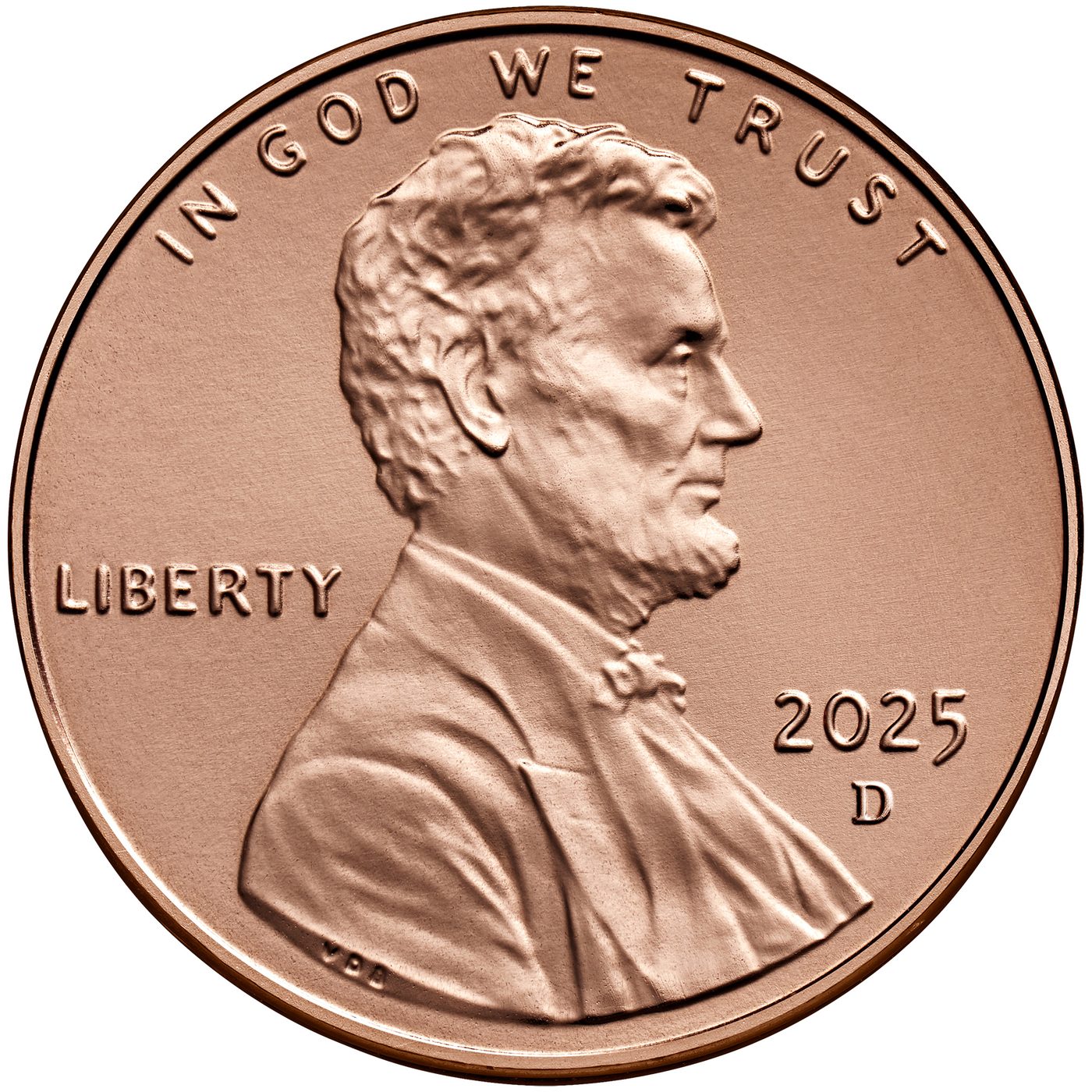
Even the humble cent got its turn. To mark Abraham Lincoln's 200th birthday, 2009 brought four different reverse designs in a single year, tracing his life from a Kentucky log cabin to the half-built Capitol dome. Then in 2010 the cent received its first permanent new reverse in over half a century: the Union Shield, designed by Lyndall Bass and sculpted by Joseph Menna. Through all of it, the front of the cent never changed — it still carries Victor David Brenner's portrait of Lincoln, first struck in 1909, making it one of the longest-running coin designs in the world.
The coins of this era
Stand at a cash register today and the change in your palm is a quiet museum. The cent carries a 1909 portrait of Lincoln. The nickel's Monticello traces back to Felix Schlag's 1938 design. The dime is John R. Sinnock's 1946 Roosevelt; the quarter is John Flanagan's 1932 Washington; the half dollar is Gilroy Roberts' Kennedy, cut in the weeks after the 1963 assassination. The dollar coins — Susan B. Anthony, Sacagawea, the Presidents — are the newcomers. That is the first thread running through this era: a single fistful of coins, designed across more than a century, still spending side by side.
The second thread is the split that defines modern US coinage. The Mint learned, with the State Quarters, that it could keep the familiar face on the front and turn the back into a rotating canvas. So that's what it did, denomination by denomination. The portrait stays put — Washington, Lincoln, Jefferson, Roosevelt, Kennedy — while the reverse becomes a yearly story: a state, a national park, a woman who changed the country, an American invention. Old face, new tale, struck by the billion. You can read each strand on its own page: the Jefferson nickel, the clad Roosevelt dime, the Lincoln Memorial cent (1959–2008) and the Lincoln Shield cent (2010–2025, now ending as the last penny), the one-year Lincoln Bicentennial cent with its four reverses, and the dollar trio — Sacagawea, Native American, American Innovation — that the bill keeps beating.
But the rotating canvas wasn't only in your pocket. Alongside the everyday coins, the modern Mint ran a second, grander track: commemoratives — coins Congress authorizes for a single occasion, sold to collectors at a premium, with the surcharge funding a cause. They are where the Mint's artists got room to take risks. The early 1990s set the tone with the 1992 Columbus Quincentenary half dollar, the 1993 World War II 50th Anniversary silver dollar, the 1994 World Cup half dollar, and a remarkable 1995 cluster tied to the Atlanta Olympics — the Special Olympics World Games silver dollar, the Civil War Battlefield half dollar, and the Olympic Basketball half dollar. The streak ran on for thirty years: the 2014 Baseball Hall of Fame half dollar became the first curved coin the US ever struck — concave like a tiny ballglove — and recent issues kept widening the lens, from the 2018 Breast Cancer Awareness silver dollar to the 2021 National Law Enforcement Memorial silver dollar, the 2022 Negro Leagues Baseball half dollar, and the 2022 Purple Heart Hall of Honor half dollar.
A third track ran above even that: modern bullion and gold, where the Mint courted investors and the high end of the hobby. The First Spouse gold series (2007–2020) struck a half-ounce coin for each presidential spouse, matched to the Presidential dollar program. One-off showpieces pushed the metal and the craft further still — the 2018 American Liberty $10 gold coin, a tenth-ounce design reimagining Liberty for the 21st century, and the 2020 Pursuit of Happiness $100 platinum eagle, part of a series built around the preamble to the Constitution. These aren't coins you'll ever get in change. They're the era's statement pieces — proof that the same Mint stamping billions of pennies could also turn out a curved silver dollar or a platinum medal of state.
So the people who made all of this span two centuries. The everyday obverses are heirlooms, and their designers are long gone — Brenner on the cent, Schlag on the nickel, Sinnock on the dime, Gasparro on the Memorial cent and the Anthony dollar — but their work is what you hand the cashier. The reverses, the commemoratives, and the bullion are the work of the living. Glenna Goodacre gave the Sacagawea dollar its mother-and-child obverse. Lyndall Bass drew the cent's Union Shield; Joseph Menna, now Chief Engraver, sculpted it. Jamie Franki turned Jefferson to face forward in 2006 — a first for a circulating US coin. A deep bench of Mint sculptor-engravers and outside artists from the Artistic Infusion Program — among them Don Everhart, Donna Weaver, Phebe Hemphill, Susan Gamble, Renata Gordon, Norman E. Nemeth, Joel Iskowitz, Justin Kunz, Emily Damstra, Chris Costello, Thomas D. Rogers, and many more — filled the rotating canvas, the commemoratives, and the gold. The full roster is linked below; it is, in effect, the directory of who shaped American money in the modern age.
So the modern era isn't really about new coins. It's about an old, trusted set of coins learning to change — keeping their faces, telling fresh stories on their backs, throwing off curved silver dollars and platinum eagles along the way, and pulling a country into the habit of looking twice at its own money.
A short timeline
- 1992Columbus Quincentenary half dollar — the modern commemorative wave gathers pace.
- 1994World Cup soccer half dollar marks the tournament's first US hosting.
- 1995An Atlanta-Olympics commemorative cluster: Special Olympics dollar, Civil War Battlefield and Olympic Basketball half dollars.
- 199950 State Quarters launches with Delaware (Jan 4); five new designs a year for a decade.
- 2000Sacagawea 'golden dollar' debuts, obverse by Glenna Goodacre.
- 2004The Wisconsin quarter 'extra leaf' varieties surface from the Denver Mint — the era's most famous circulating find.
- 2006Jefferson nickel gets a new forward-facing portrait by Jamie Franki — a first for a circulating US coin.
- 2007Presidential dollar program begins (runs through 2016); First Spouse gold series launches alongside it.
- 200850 State Quarters concludes with Hawaii — ~147 million Americans had collected it.
- 2009Lincoln Bicentennial: four cent reverses in one year; DC & US Territories quarters issued; Native American dollar program begins.
- 2010Lincoln Shield cent reverse (Lyndall Bass) replaces the Memorial; America the Beautiful quarters begin.
- 2014Baseball Hall of Fame half dollar — the first curved coin the US Mint ever struck.
- 2018American Innovation dollar program launches, with a Statue of Liberty obverse by Justin Kunz; American Liberty $10 gold coin issued.
- 2021America the Beautiful ends; a one-year Washington Crossing the Delaware quarter reverse appears.
- 2022American Women Quarters begin; Laura Gardin Fraser's Washington takes the obverse; Maya Angelou becomes the first Black woman on a US quarter.
- 2025American Women Quarters program concludes; the Lincoln Shield cent ends as the last circulating penny.
Key facts
- Region
- United States
- Span
- 1992–2025 (modern circulating, commemorative & bullion)
- Signature program
- 50 State Quarters (1999–2008) — most successful US coin program
- Cent reverse 2010–2025
- Union Shield, by Lyndall Bass; sculpted by Joseph Menna
- Cent obverse since 1909
- Victor David Brenner's Lincoln portrait (unchanged)
- Dollar programs
- Sacagawea (2000–), Native American (2009–), American Innovation (2018–)
- Modern cent composition
- Copper-plated zinc, ~2.5 g (since late 1982)
- Golden dollar composition
- Copper core clad in manganese brass
- First curved US coin
- 2014 Baseball Hall of Fame half dollar
- Modern bullion / gold
- First Spouse gold (2007–2020), American Liberty $10 gold (2018), Platinum Eagle ($100)
Why it fascinates collectors
This is the era that made collectors out of people who had never collected anything. Most numismatic eras ask you to chase coins that vanished a century ago. This one put the hobby in your hand at the grocery store — and that accessibility is exactly what makes it interesting.
Because billions of these coins were struck, almost none are rare in worn condition. The game shifts to quality. Collectors hunt for coins that escaped circulation entirely — pieces with a sharp strike (a crisp, fully detailed impression from the die, the metal stamp that shapes the coin) and original mint luster. In a sea of mass production, the truly pristine survivor stands out.
Then there are the flukes. The 2004-D Wisconsin quarter's "extra leaf" varieties — an extra curl of corn husk, almost certainly a damaged die rather than an intentional design — sent people sorting through rolls of quarters by hand. The 2019-W cents, the first ever struck at the West Point Mint with a "W" mint mark (the small letter showing where a coin was made), were released only inside collector sets, never into circulation. These are the modern era's treasure-hunt coins: not ancient, not gold, but genuinely scarce in the right form — and findable, which is the whole thrill.
And then there's the era's other half, the part you can't find in change. The commemoratives and bullion were sold by the Mint at a premium and struck in far smaller numbers, often as proofs — coins given a mirror finish from polished dies. A curved silver dollar, a half-ounce of First Spouse gold, a platinum eagle: these reward a different collector, one chasing low mintages and design ambition rather than a lucky find in a roll. Together the two halves make the modern era unusually wide — there's an entry point whether you're sorting pennies at the kitchen table or building a gallery of the Mint's boldest work.
Questions collectors ask
Why did the US Mint start changing the quarter every year?
Congress authorized the 50 State Quarters program in 1997 to honor each state and re-engage the public with US coinage. It worked: by the Mint's estimate, about 147 million Americans collected the quarters, and the program generated roughly $3 billion in seigniorage — making it the most successful US coin program in history.
Are modern circulating coins worth more than face value?
Most are not, because they were struck in the billions and circulate freely. Value concentrates in two places: pristine, high-grade examples that never wore down, and a handful of genuine varieties or errors — like the 2004-D Wisconsin 'extra leaf' quarters. Modern commemoratives and bullion are a separate market, sold by the Mint at a premium from the start.
Is the 'golden dollar' actually gold?
No. The Sacagawea dollar that debuted in 2000 is a copper core clad in manganese brass. The brass gives it a gold-like color and a distinct electronic signature, but there is no gold in it.
When did the Lincoln cent get its current shield design?
In 2010. The Union Shield reverse, designed by Lyndall Bass and sculpted by Joseph Menna, replaced the Lincoln Memorial. The front still carries Victor David Brenner's 1909 Lincoln portrait. Production of the circulating cent ended in 2025.
What was the first curved coin the US Mint made?
The 2014 Baseball Hall of Fame half dollar. Its reverse is convex like a baseball and its obverse concave like a glove — the first domed, or curved, coin in US history, struck for circulation-collector sale rather than everyday change.
What is the 2019-W penny and why is it special?
It was the first Lincoln cent to carry a 'W' mint mark, struck at the West Point Mint. The Mint released the 2019-W cents only as bonuses inside collector sets — never into general circulation — which is why they draw a premium.
Why do today's coins have such old portraits but brand-new backs?
It's the design logic of this whole era. The Mint keeps a familiar, long-running portrait on the front — Lincoln (1909), Jefferson, Roosevelt (1946), Washington (1932), Kennedy (1964) — for continuity and trust, and turns the reverse into a rotating canvas for states, parks, women, and inventions. Old face, new story.
Sources
- US Mint — 50 State Quarters
- US Mint — 50 State Quarters Program Concludes as the Most Successful Coin Initiative in US History (2008)
- US Mint — Sacagawea Golden Dollar Coin
- US Mint — Native American $1 Coin Program
- US Mint — American Innovation $1 Coin Program
- US Mint — A First for the United States: Jefferson to Face Forward on 2006 Nickel
- US Mint — Releases Fourth 2009 Lincoln Bicentennial One-Cent Coin
- US Mint — First Spouse Gold Coins
- US Mint — Commemorative Coins
- US Mint — 2014 National Baseball Hall of Fame Commemorative Coins (first curved US coin)
- US Mint — American Liberty Gold Coins
- US Mint — American Eagle Platinum Coins (Preamble to the Constitution series)
- PCGS — 10th Anniversary of the Lincoln Shield Cent
- NGC — Lyndall Bass and the Lincoln Union Shield
- CoinWeek — Glenna Goodacre, Designer of the Sacagawea Dollar Coin
- PCGS CoinFacts — 2004-D Wisconsin Extra Leaf High Quarter
- Coin World — 2019-W Lincoln Cents Available Only as Premiums
- Wikipedia — Lincoln cent (composition history)
- Wikipedia — Jefferson nickel (Schlag, Franki, Monticello reverse)
- Wikipedia — United States commemorative coins (modern era)
- NPR — Maya Angelou, first Black woman featured on a US quarter