US coin · series

The Susan B. Anthony Dollar: America's First Woman, and Its Most Famous Flop

A dollar coin so easily mistaken for a quarter that the public quietly refused to spend it.

The Susan B. Anthony Dollar: America's First Woman, and Its Most Famous Flop
Scan by Stanislav Kozlovskiy (own scan); coin design by U.S. Mint. Public domain — no attribution required · public domain · source

In 1979 the United States put a real woman on a circulating coin for the first time — the suffragist Susan B. Anthony. Then it made the coin almost exactly the size and color of a quarter. America noticed, and never forgave it.

The story behind the coin

By the late 1970s the U.S. dollar coin had a problem: it was the size of a hockey puck. The Eisenhower dollar, struck since 1971, was big, heavy, and unloved — too bulky for a pocket, too awkward for a vending machine. So Washington decided to shrink it.

The push came partly from the vending-machine industry, which wanted a coin small enough to handle but worth more than a quarter. The Treasury had a bigger hope too: that a durable dollar coin might finally displace the flimsy dollar bill, which wears out in a year or two and has to be reprinted constantly. The savings, on paper, looked real.

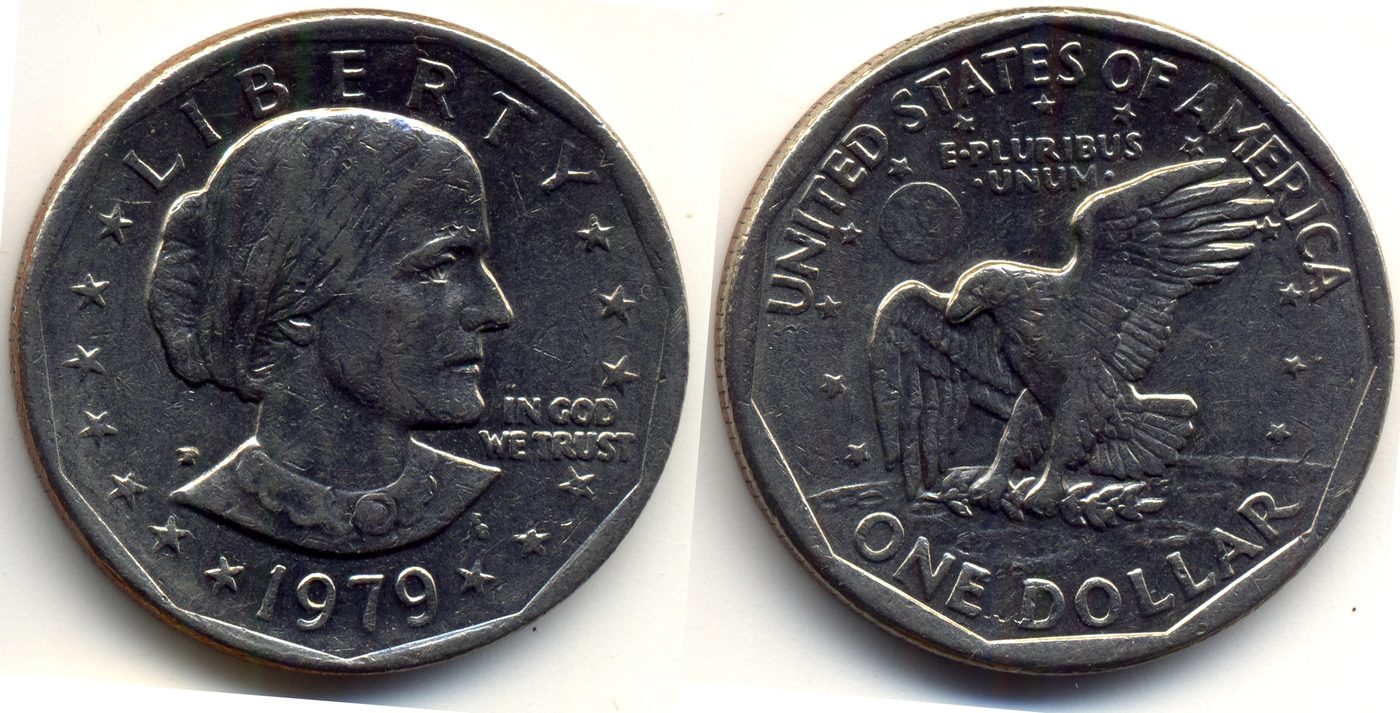
Congress authorized the new coin in 1978, and someone made a choice that turned the whole project into a cautionary tale. The honoree would be Susan B. Anthony — the first real, historical woman ever to appear on a circulating United States coin, a milestone that should have been the headline. Instead, the headline became the size. The new dollar measured 26.5 mm across; a quarter measures 24.3 mm. Same dull copper-nickel color, nearly the same heft, a reeded (grooved) edge on both. In a dim pocket or a fast transaction, people simply couldn't tell them apart — and a coin you might mistake for a 25-cent piece is a coin you do not want to hand over as a dollar.

The public's verdict was swift and brutal. Surveys in 1979 found a large majority disliked the coin. Cash drawers had no slot for it. Cashiers handed it back. Critics nicknamed it the "Carter quarter," after the sitting president. Within three years the Mint stopped striking it for circulation. It would sit in Treasury vaults by the hundreds of millions — until, two decades later, the country suddenly needed dollar coins again and reached for the very coin it had rejected.

The design and who made it

The man behind the coin was Frank Gasparro, the tenth Chief Engraver of the United States Mint — the in-house artist responsible for the dies (the engraved steel stamps that strike each coin). Gasparro designed both sides.

The obverse — the heads side — carries a right-facing portrait of Susan B. Anthony, and getting her face right was its own ordeal. Gasparro had almost nothing to work from: photographs of Anthony at 28 and at 84, young and old. Early portraits drew complaints from both directions. Some women's groups thought the youthful version looked too "prettified"; Anthony's own grand-niece felt the elderly version made her look frail. Gasparro settled on a sterner, middle-aged likeness meant to show Anthony near the height of her work as a reformer — a face nobody had actually photographed.

The reverse — the tails side — is the coin's quiet surprise. It shows an eagle coming down onto the cratered surface of the Moon, an olive branch in its talons. That image is the Apollo 11 mission insignia, originally drawn by astronaut Michael Collins, the command-module pilot who orbited overhead while Armstrong and Aldrin walked below. Gasparro had already adapted Collins's eagle for the reverse of the Eisenhower dollar, and he carried it over here. So the first U.S. coin to honor a 19th-century suffragist also carries, on its back, a tribute to the 1969 Moon landing.

One design detail tried to solve the quarter problem and didn't: an eleven-sided inner border — a hendecagon — framed both sides, hinting at a polygon-shaped coin without actually changing the round, reeded edge. It was a visual nod, not a fix, and it fooled no one's fingers. Look below the eagle's tail feathers and you'll find Gasparro's initials, FG.

Key facts

Years struck
1979–1981, then 1999
Designer
Frank Gasparro (obverse and reverse)
Reverse source
Apollo 11 insignia by astronaut Michael Collins
Composition
Copper-nickel clad (outer .750 copper / .250 nickel) over a pure copper core
Weight
8.10 g
Diameter
26.5 mm (a quarter is 24.3 mm)
Edge
Reeded, with an 11-sided (hendecagon) inner border
Mints / mint marks
Philadelphia (P), Denver (D), San Francisco (S, proofs)
First
First real woman on a circulating U.S. coin
Lowest circulation mintage
1981-P — 3,000,000 (collector sets only)
Famous variety
1979-P Wide Rim (Near Date)

Collecting it

Here is the paradox that makes the Anthony dollar fun to collect: hundreds of millions were struck, almost none circulated, so the common dates survive in pristine condition by the truckload — yet a handful of small varieties are genuinely scarce and chased hard.

The 1979-P Wide Rim (Near Date). Early in 1979, Philadelphia used a die that placed the date snug against a thicker rim. Most 1979-P dollars are the "Narrow Rim" (Far Date), where the date sits noticeably away from the edge. The Wide Rim is the scarce one — easy to spot once you know to look at how close the "1979" crowds the rim. It's not rare, but in top uncirculated grades the price climbs steeply, and a clean high-grade example commands a real premium over its Narrow Rim cousin.

The 1979-S and 1981-S "Clear S" (Type 2) proofs. A proof is a specially struck collector coin made with polished dies for a mirror finish. The San Francisco Mint's "S" mint mark punch wore down, leaving a blurred, filled-in S on most proofs — the Type 1. Late in each run the punch was replaced with a crisp, clearly cut S — the Type 2. The Type 2 coins are much scarcer (collectors estimate only a minority of 1979 proofs carry the clear S) and worth a strong multiple of the ordinary Type 1. The difference comes down to whether the loops of the S are open and sharp or smeared shut — a magnifier settles it.

The 1981 dates. By 1981 the coin was a known failure, so the Mint struck the P, D, and S issues only for annual collector sets, not for spending. That makes 1981 the scarcest year as a group — the 1981-P had the lowest mintage of any circulation-style strike — though because they were saved in sets, finding one in nice condition is easy.

Why high grades can still be scarce. "Saved by the million" doesn't mean "saved carefully." Anthony dollars rattled around in mint bags and rolls, and that contact leaves tiny abrasions across the open fields of the design. Most certified coins grade common up through about MS67 (Mint State 67, on the 70-point scale). For select dates, prices only take off at the very top — MS66 and finer — where a coin with almost no bag marks is genuinely hard to find. So the chase isn't for the date; it's for the surface.

Questions collectors ask

Why was the Susan B. Anthony dollar such a failure?

It was too close to a quarter. At 26.5 mm it was only about 2 mm larger than a 25-cent piece, with the same copper-nickel color and a similar reeded edge, so people constantly confused the two. Surveys in 1979 found most Americans disliked it, cash drawers had no slot for it, and the Mint stopped striking it for circulation after 1981.

Is my 1979 Susan B. Anthony dollar worth a lot of money?

Usually no. Hundreds of millions were struck and most never circulated, so ordinary examples are common and worth little above face value. The exceptions are specific varieties: the 1979-P Wide Rim (Near Date) in high grade, and the 1979-S and 1981-S Clear S (Type 2) proofs — those carry real premiums.

What is the difference between the 1979-P Wide Rim and Narrow Rim?

On the Wide Rim (Near Date), the rim is thicker and the '1979' sits close to the edge. On the more common Narrow Rim (Far Date), the date is set back from the rim with a visible gap. The Wide Rim is the scarcer, more valuable of the two.

How do I tell a Type 1 from a Type 2 proof?

Look at the 'S' mint mark under magnification. On the Type 1 (Filled S), the loops of the S are smeared and partly filled from a worn punch. On the Type 2 (Clear S), the S is crisp with open, well-defined loops. The Type 2 is much scarcer and worth more.

Why was the Susan B. Anthony dollar brought back in 1999?

By the late 1990s vending machines and mass-transit systems were burning through dollar coins, and the planned Sacagawea dollar wasn't ready yet. So the Mint struck the Anthony dollar one more time in 1999, in Philadelphia and Denver, as a stopgap before the new coin arrived in 2000.

What is the eagle on the back of the coin?

It's the Apollo 11 mission insignia — an eagle landing on the Moon with an olive branch — originally designed by astronaut Michael Collins. Frank Gasparro adapted it for the reverse, having already used it on the Eisenhower dollar.

Sources