US coin · series

The Lincoln Shield Cent — the penny that ended the penny

A Union shield struck for 15 years, until the day the United States stopped making cents.

The Lincoln Shield Cent — the penny that ended the penny
United States Mint · public domain · source

In 2010 the U.S. Mint gave the penny a new back — a Union shield, chosen to mark Abraham Lincoln holding the country together. Nobody knew it would be the last design the cent ever wore. On November 12, 2025, the Philadelphia Mint struck the final circulating American penny, and it carried this shield.

The story behind the coin

For a hundred years the back of the Lincoln cent said "wheat," then "the Lincoln Memorial," then — for one busy year, 2009 — it told the story of Lincoln's life in four scenes. In 2010 it settled on something quieter and meant to last: a shield.

The reason was written into law. When President George W. Bush signed the Presidential $1 Coin Act on December 22, 2005, a single clause near the end — Section 303 — ordered that the cent's reverse, starting in 2010, carry an image "emblematic of President Lincoln's preservation of the United States of America as a single and united country." Congress had just spent the 2009 bicentennial celebrating Lincoln the man; now it wanted the everyday coin to celebrate Lincoln's achievement — keeping the Union whole through the Civil War.

So the design problem was unusually specific. How do you put "he held the country together" on a coin the size of a fingernail? The answer the Mint reached for was the oldest visual shorthand in American heraldry: the shield.

What makes this coin quietly historic has nothing to do with how it looks. It is the last one. After the wheat ears, the Memorial, the bicentennial year, and fifteen years of this shield, the cent's run ended. On November 12, 2025, the Philadelphia Mint struck the final circulating United States penny — a tradition reaching back to 1793 — with the Treasury Secretary in the room. A design meant to say "this country endures" turned out to be the one the country chose to retire the penny on.

The design and who made it

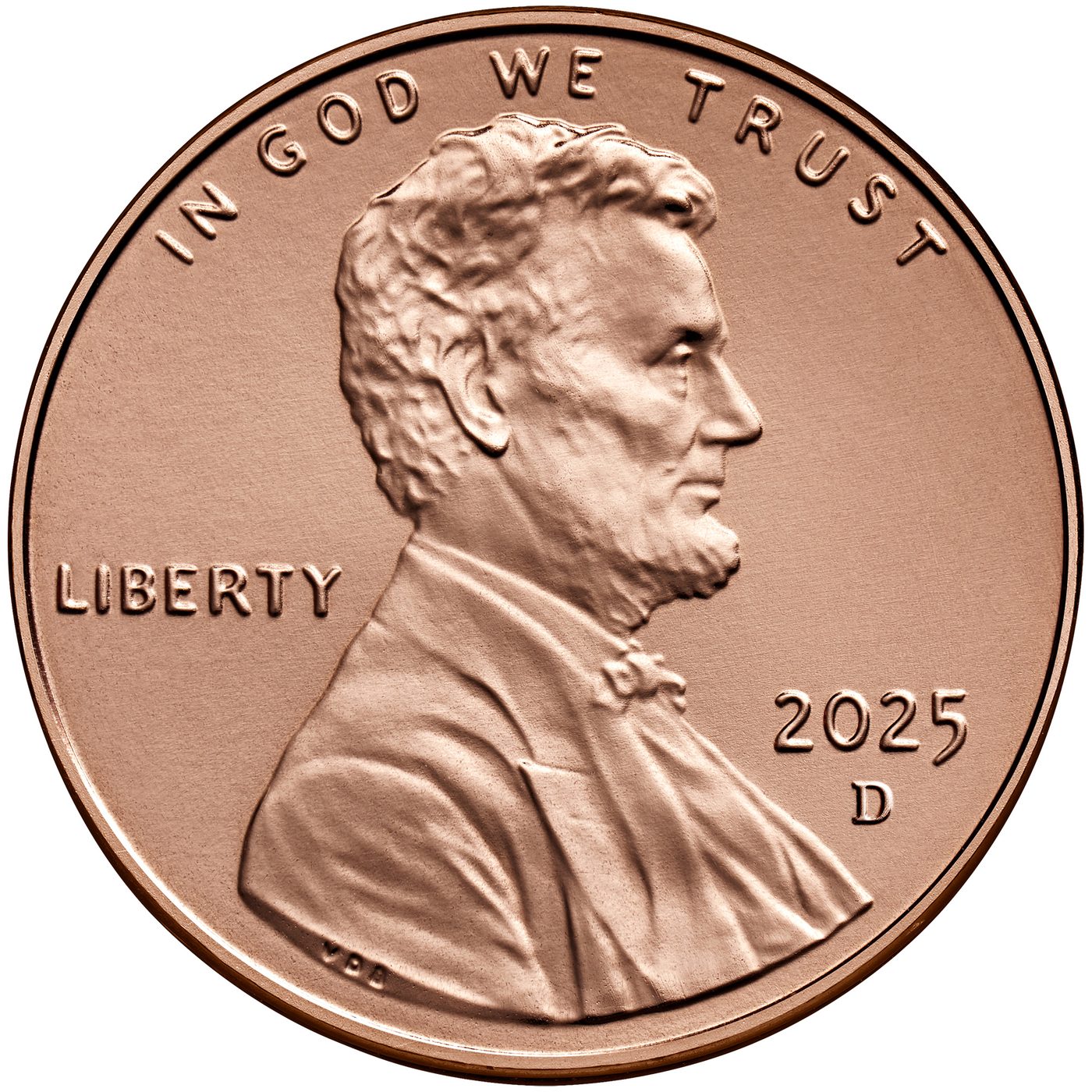
The obverse — the heads side — never changed. It is still Victor David Brenner's profile of Lincoln, the portrait he cut in 1909 for the coin's very first year. For the shield cent the Mint went back to Brenner's original galvano (the master model his work was traced from) and re-engraved fresh dies — so a 2025 penny carries a portrait drawn from the same source as one struck before the First World War.

The reverse — the tails side — is the new part, and it had two hands on it. The design came from Lyndall Bass, a classically trained painter working through the Mint's Artistic Infusion Program, which brings outside artists into coin design. The sculpting — turning a flat drawing into the three-dimensional relief that gets pressed into metal — was done by United States Mint Sculptor-Engraver Joseph Menna.

The shield itself is dense with meaning, and the Mint spelled it out. Thirteen vertical stripes stand for the thirteen original states, "joined in one compact union." A single horizontal bar runs across the top, representing the federal government that binds them — and on that bar sits the motto E PLURIBUS UNUM, "out of many, one." A scroll drapes across the shield carrying the words ONE CENT, with UNITED STATES OF AMERICA arched along the rim. It is a coin about union, said three different ways.

Getting there was a fight. In spring 2009 two Mint advisory bodies split. The Commission of Fine Arts favored a design showing a sheaf of wheat (LP-18); the Citizens Coinage Advisory Committee preferred the Union shield (LP-13). The wheat design was then pulled from the running because it looked too much like a German coin from the 1920s — and the shield won. The final design was unveiled on November 12, 2009, and the first coins reached collectors in a "Preservation of the Union" two-roll set released April 8, 2010.

Key facts

Years struck
2010–2025 (final circulating cent struck Nov 12, 2025)
Obverse designer
Victor David Brenner (1909 Lincoln portrait, re-engraved)
Reverse designer
Lyndall Bass — Artistic Infusion Program
Reverse sculptor
Joseph Menna — U.S. Mint Sculptor-Engraver
Composition
Copper-plated zinc — 97.5% zinc, 2.5% copper
Weight / diameter
2.5 g / 19.05 mm
Legal mandate
Presidential $1 Coin Act of 2005, Section 303
Theme
Lincoln's preservation of the Union — a 13-stripe Union shield
Famous one-year type
2017-P — first and only cent with a 'P' mint mark

Collecting the Shield cent

A mint mark is the small letter that says which facility struck a coin — D for Denver, S for San Francisco, none historically for Philadelphia. That last detail is the heart of this series' one true rarity.

In 2017 the Philadelphia Mint did something it had never done in the cent's entire history: it added a "P" mint mark. The move honored the Mint's 225th anniversary, and it was suggested by Mint employees themselves. The coins went out with no announcement — partly, the story goes, to see how long it would take the public to notice. Billions were struck (roughly 4.36 billion), so the 2017-P is not rare. But it is the first and so far only cent ever to carry a "P," which makes it the one date in the whole series every collector wants. In 2018 the cent went straight back to its usual no-mint-mark Philadelphia format.

Beyond that, the shield cent is a study in why condition, not scarcity, drives modern coins. These pennies were made by the billions and most circulated hard, so worn examples are worth a cent. The chase is for coins that never circulated and were never mishandled — graded at the very top of the scale, with full original red color (collectors call it "RD") and a clean, sharp strike (how completely the design transferred from die to blank). On copper-plated zinc, deep flawless red surfaces don't survive easily, so a top-grade example of an otherwise common date can be genuinely scarce — a tiny population among billions.

Then there is the simple, unrepeatable fact of the final year. Because cent production ended in 2025, the late dates — and especially the last ones — are the bookend of more than two centuries of American pennies. That is a collecting story that did not exist when this design began, and it cannot be made again.

Questions collectors ask

Why does the Lincoln penny have a shield on the back?

A 2005 law (the Presidential $1 Coin Act, Section 303) required the cent's reverse, starting in 2010, to be 'emblematic of President Lincoln's preservation of the United States of America as a single and united country.' The Union shield — 13 stripes for the original states, bound by a single bar representing the federal government — was the Mint's answer to that mandate.

Why does the 2017 penny have a P mint mark?

2017 was the first year in the cent's history that the Philadelphia Mint added its 'P' mint mark, to honor the Mint's 225th anniversary. It was a one-year change — 2018 cents returned to no mint mark. The 2017-P is common (billions were struck) but historic as the only 'P' cent ever made.

Who designed the Lincoln Shield cent?

Two designs, two artists. The heads side is Victor David Brenner's 1909 Lincoln portrait, re-engraved. The shield on the tails side was designed by Lyndall Bass through the Mint's Artistic Infusion Program and sculpted by U.S. Mint engraver Joseph Menna.

What is the Lincoln Shield cent made of?

Copper-plated zinc — 97.5% zinc with a thin 2.5% copper plating. It looks like a copper penny but is mostly zinc underneath, a composition the cent has used since 1982. Each coin weighs 2.5 grams.

Is the Lincoln Shield cent the last U.S. penny?

Yes. The Union Shield was the cent's design when production ended — the final circulating U.S. penny was struck at the Philadelphia Mint on November 12, 2025, with 2024 the last full year of mass production.

Sources