US coin · series

The Lincoln Memorial Cent

The only U.S. coin that puts the same man on heads and tails.

The Lincoln Memorial Cent
United States Mint · public domain · source

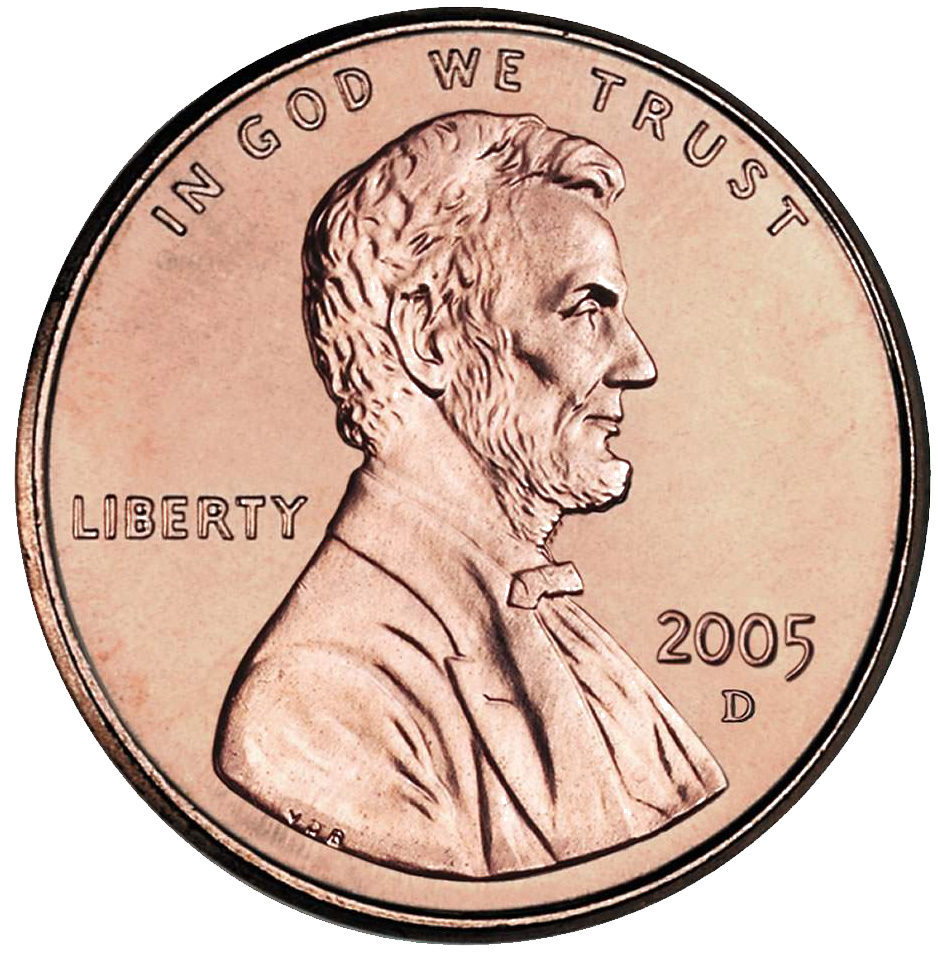
Look closely at a Lincoln Memorial penny and you'll find Abraham Lincoln twice — his profile on the front, and a second tiny Lincoln seated inside the marble Memorial on the back. For 49 years it was the most common coin in America, and almost nobody noticed the man was on it twice.

The story behind the coin

In 1959, the United States turned 150 years past the birth of Abraham Lincoln — and decided the penny should mark it.

The cent already carried Lincoln's face. Since 1909 his profile had filled the front, the first real person ever put on a circulating U.S. coin. The back, though, still wore the two stalks of wheat it had been given that same year. For the sesquicentennial of Lincoln's birth, the Eisenhower administration announced in December 1958 that the wheat would go, and the reverse — the "tails" side — would be redesigned around the Lincoln Memorial in Washington.

The result is a quiet oddity hiding in plain sight. The new reverse shows the Memorial building, and seated deep inside it, between the columns, sits Daniel Chester French's marble statue of Lincoln. So the coin carries Lincoln twice — his profile on the obverse (the heads side), and his statue on the reverse. No other regular U.S. coin shows the same person on both faces. Billions of people handled it for half a century without ever clocking the trick.

The Memorial cent was released on February 12, 1959 — Lincoln's 150th birthday — and stayed in production until 2008, when a four-design bicentennial series replaced it. For most of the late twentieth century, this was simply what a penny was.

The design and who made it

The two sides of this coin were made fifty years apart, by two very different men.

The obverse is the work of Victor David Brenner, a Lithuanian-born sculptor and medalist who modeled Lincoln's profile in 1909. His initials — VDB — caused a national fuss that first year and were removed, then quietly restored in 1918 to the shoulder of Lincoln's coat, where they remain. That portrait never changed for the Memorial cent; Brenner's 1909 Lincoln simply kept going.

The reverse is the work of Frank Gasparro, who would later become the Mint's tenth Chief Engraver. In 1958 the Mint held an in-house competition among its own engravers for the new design. Gasparro's entry won out of 23 submitted. His brief was unusual: render an entire neoclassical building, and the statue inside it, on a disc 19 millimeters across. He pulled it off — you can find the seated Lincoln between the central columns if you look — and tucked his initials, FG, into the lower right of the Memorial's base. Not everyone loved it; the numismatic writer Walter Breen famously dismissed the reverse as "an artistic disaster." Collectors have argued about it ever since.

A word collectors use a lot here is die — the hardened steel stamp that strikes the design into a blank coin. Almost every famous variety on this coin comes down to a die that was made or used wrong, and the rest of this page is mostly the story of those mistakes.

Key facts

Design in use
1959–2008 (Lincoln Memorial reverse)
Obverse designer
Victor David Brenner (Lincoln portrait, from 1909)
Reverse designer
Frank Gasparro (Lincoln Memorial)
Composition (1959–1982)
95% copper bronze; weight 3.11 g
Composition (1982–present)
Copper-plated zinc, 97.5% Zn / 2.5% Cu; weight 2.5 g
Diameter
19.05 mm, plain edge
Mints
Philadelphia (no mark), Denver (D), San Francisco (S, proofs)
Famous experiment
1974 aluminum cent — struck, then rejected and recalled

Collecting it: key dates, varieties, and what's actually scarce

This is one of the most-produced coins in human history, so the value isn't in the ordinary dates — it's in the errors and the few transitional moments when the Mint changed its mind.

The 1982 switch from copper to zinc. For over a century the cent was mostly copper. As copper prices climbed, that became unsustainable — by the early 1980s the metal in a penny was creeping toward the value of the penny itself. In 1982 the Mint changed the core to 99.2% zinc with a thin copper plating. Both versions were struck that year, so 1982 alone yields seven business-strike varieties, split by metal (the copper ones weigh 3.11 g, the zinc ones 2.5 g) and by the size of the date ("Large Date" vs "Small Date"). The prize is the 1982-D Small Date in copper — a transitional coin that wasn't supposed to exist, first confirmed by a collector in 2016.

The doubled dies. When a die is made, the design is impressed into it more than once; if those impressions are misaligned, every coin struck from that die shows ghosted, doubled lettering. The great Memorial-era examples:

  • 1969-S Doubled Die Obverse — the king of the series, and the one with a crime story. When the first examples surfaced in 1970, federal agents seized some as suspected fakes — there genuinely was a ring counterfeiting doubled cents at the time — before the real coins were vindicated. Fewer than a hundred are thought to exist; a finest-known gem sold for $601,875 at auction in 2023.
  • 1972 Doubled Die Obverse — bold doubling on the date, LIBERTY, and the motto. Visible to the naked eye, and the doubled die most collectors can actually hope to own.
  • 1983 Doubled Die Reverse — the entire back is doubled, lettering and building alike. The signature error of the early zinc years.
  • 1984 Doubled Die Obverse — the "Doubled Ear," because the clearest doubling sits on Lincoln's ear.
  • 1995 Doubled Die Obverse — strong doubling on LIBERTY and IN GOD WE TRUST, and the one major doubled die most people could still pluck from circulation, because it turned up in huge quantities.

The "AM" varieties — a spacing mistake worth hundreds. Look at the word AMERICA on the reverse. On some coins the letters A and M nearly touch ("Close AM"); on others they're clearly apart ("Wide AM"). The Mint used one reverse for business strikes and a slightly different one for proofs — the polished collector coins. When a proof die slipped onto the regular presses (or the reverse), you get a transitional error:

  • 1992 Close AM (both Philadelphia and Denver) — a business-strike penny wearing the next design early. Only a handful are known of each.
  • 1998, 1999, and 2000 Wide AM — ordinary pennies struck with a proof-style reverse. The 1999 Wide AM is the scarcest of the three.

Why high grades are genuinely scarce. A coin meant to be spent was never meant to be perfect. Pennies clattered through bags, counting machines, and cash drawers; copper and zinc both spot, tone, and scratch easily. A Memorial cent that survived in full original red color, untouched, at the top of the Mint State scale is far rarer than the billions of mintage figures suggest — which is exactly why condition, not date, drives most of the value here.

The coin that never circulated: the 1974 aluminum cent. With copper prices spiking in 1973, the Mint struck more than 1.5 million experimental cents in a 96% aluminum alloy, dated 1974, to test a cheaper penny. The vending-machine industry objected; doctors warned that an aluminum coin would be nearly invisible on an X-ray if a child swallowed one. Congress balked, and the Mint ordered every example recovered and melted. Only an estimated dozen or so survive — one sits in the Smithsonian — and their legal ownership is still contested. It's the great "what if" of this design.
Questions collectors ask

Why does the Lincoln Memorial penny have Lincoln on both sides?

The front carries Victor David Brenner's 1909 profile of Lincoln. The back, designed by Frank Gasparro in 1959, shows the Lincoln Memorial — and seated inside it is the marble statue of Lincoln. So the same man appears twice. It's the only regular U.S. coin where that happens.

What years was the Lincoln Memorial cent made?

The Memorial reverse was used from 1959 to 2008. In 2009 it was replaced by a four-design series for Lincoln's 200th birthday, and in 2010 by the current Union Shield reverse.

When did pennies stop being copper?

In 1982. The Mint switched from 95% copper to a copper-plated zinc core that same year, so 1982 cents exist in both metals. Copper ones weigh 3.11 grams; zinc ones weigh 2.5 grams — a kitchen scale tells them apart.

What is the difference between Close AM and Wide AM?

It's the spacing of the letters A and M in AMERICA on the reverse. Business strikes were meant to have a Close AM (letters nearly touching) and proofs a Wide AM (letters apart). When the wrong reverse was used — the 1992 Close AM, or the 1998/1999/2000 Wide AM — the result is a scarce, valuable transitional variety.

Is the 1974 aluminum penny real?

Yes. The Mint struck over 1.5 million as an experiment, then rejected the idea and recalled and melted them. Only about a dozen are believed to survive, and ownership of privately held examples remains legally disputed.

Sources