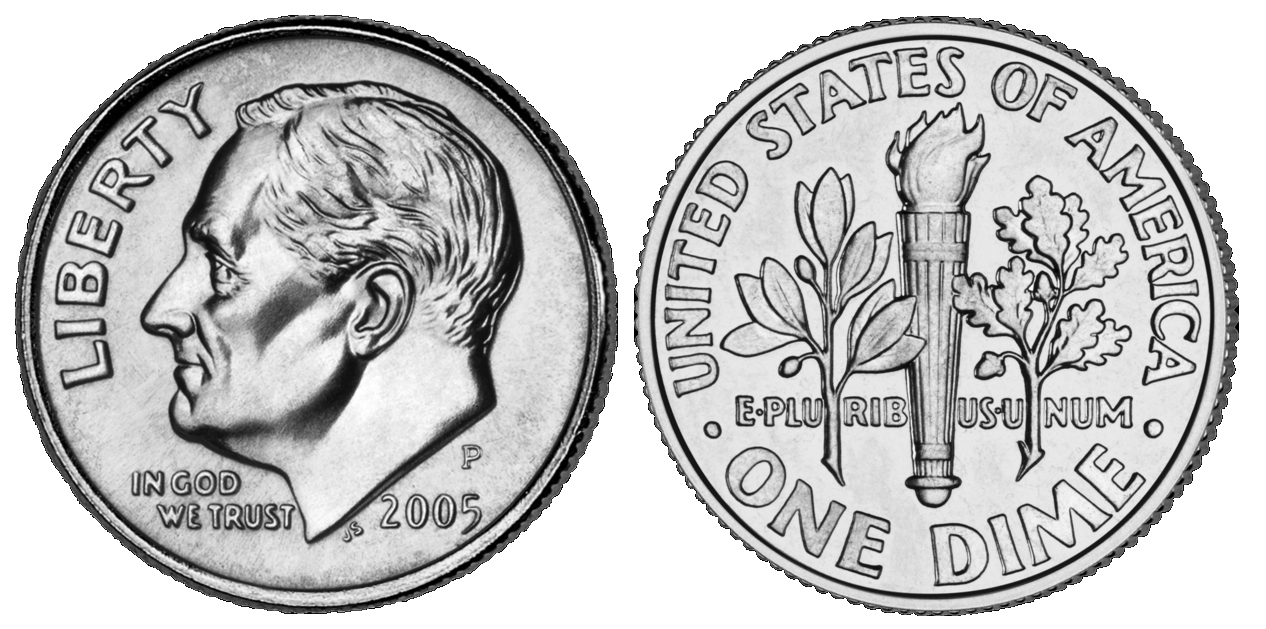
The story behind the coin
By the early 1960s the United States had a quiet panic on its hands. Silver was getting expensive — expensive enough that the metal in a dime was creeping toward the value of the dime itself. When that happens, ordinary people stop spending their coins and start hoarding them. Coins vanish from circulation, and a country can't run on money that won't move.
So Congress acted. The Coinage Act of 1965, signed into law on July 23, 1965, pulled silver out of the dime and the quarter entirely. The Roosevelt dime — already America's workhorse ten-cent piece since 1946 — became the test case. From 1965 on, the silver dime was gone, replaced by a "clad" coin: a copper core wrapped in a copper-nickel skin that looks like silver but costs almost nothing.
This is the coin in your pocket today. The face stayed exactly the same — Franklin Roosevelt still gazes left, the torch still burns on the back — but the body underneath was swapped out. Collectors draw the line right here, calling everything from 1965 onward the clad Roosevelt dime, a distinct type from the silver dimes of 1946–1964 that share its design.
The Mint was nervous that people would hoard the new coins too, just to have a keepsake of the change. So for three years — 1965, 1966, and 1967 — it stripped the mint marks off entirely, hoping featureless coins would seem less collectible. (A mint mark is the little letter — D for Denver, S for San Francisco — that says which factory struck the coin.) The marks came back in 1968, and the collecting world has been hunting them ever since.