Era
The Coins That Went to War
1942–1945: when the U.S. Mint melted the metals out of your pocket change and shipped them to the front.
For two years, the penny in your pocket was made of steel, and the nickel was part silver. The war needed copper and nickel more than your change did — so the coins changed. And decades later, the country struck new coins just to remember it.
The world then
In 1942, copper was a weapon. So was nickel. Both went into the things that win wars — shell casings, armor plate, the engines of bombers — and suddenly there was not enough to go around.
After Pearl Harbor, the United States threw its whole economy at the war. A new agency, the War Production Board, decided where the country's metal went. Households turned in scrap. Tin cans were saved. Gasoline, sugar, and rubber were rationed. And the question reached all the way down to the smallest thing most people touched every day: the coins in their pockets.
A one-cent piece was 95% copper. A five-cent piece was a quarter nickel. Multiply that by the billions of coins the Mint struck each year, and the money supply itself was hoarding metal the war wanted. So the government did something it almost never does: it changed what coins were made of.
The money
Two coins took the hit — the cent and the nickel — and the fixes were as different as the metals they saved.
The 1943 steel cent. For one year, the penny stopped being copper. The Mint struck cents on blanks of low-carbon steel coated in a thin layer of zinc, so they came out bright and silvery instead of brown. Nearly 1.1 billion were made across all three mints — Philadelphia, Denver, and San Francisco. By the National WWII Museum's count, the copper saved that year was enough for roughly 1.25 million artillery shells.
The public hated them. The steel cents were 13% lighter and magnetic, which jammed the slug-catchers in vending machines. Worse, they were the wrong color — people kept mistaking the shiny cents for dimes. And they rusted: punching the blanks sliced through the protective zinc at the edges, so the bare steel underneath corroded. It was a one-year experiment, and it was not repeated.
The silver war nickel. Nickel the metal was needed for armor and aircraft, so it had to come out of the nickel the coin. On March 27, 1942, Congress authorized a new five-cent alloy with no nickel in it at all — and from October 1942 the Mint struck them in 56% copper, 35% silver, and 9% manganese. For the only time in U.S. history, an everyday circulating coin carried silver that the metal it replaced never had.
To make these silver coins easy to find and pull back after the war, the Mint did something unmistakable. It moved the mint mark — the small letter (P, D, or S) showing which mint struck the coin — to a big, bold position above the dome of Monticello on the back. And for the first time ever, Philadelphia got a mint mark at all: the letter P, which had never appeared on a U.S. coin before. Mint Director Nellie Tayloe Ross spelled out the reason in a letter dated September 14, 1942 — the larger mark, she wrote, would "facilitate identification of the coins when they come in as uncurrent."
The coins of this era
This era's coins come in three waves: the change Americans carried during the war, the first coins struck after it as the country exhaled, and the commemoratives that, decades on, were minted to remember it.
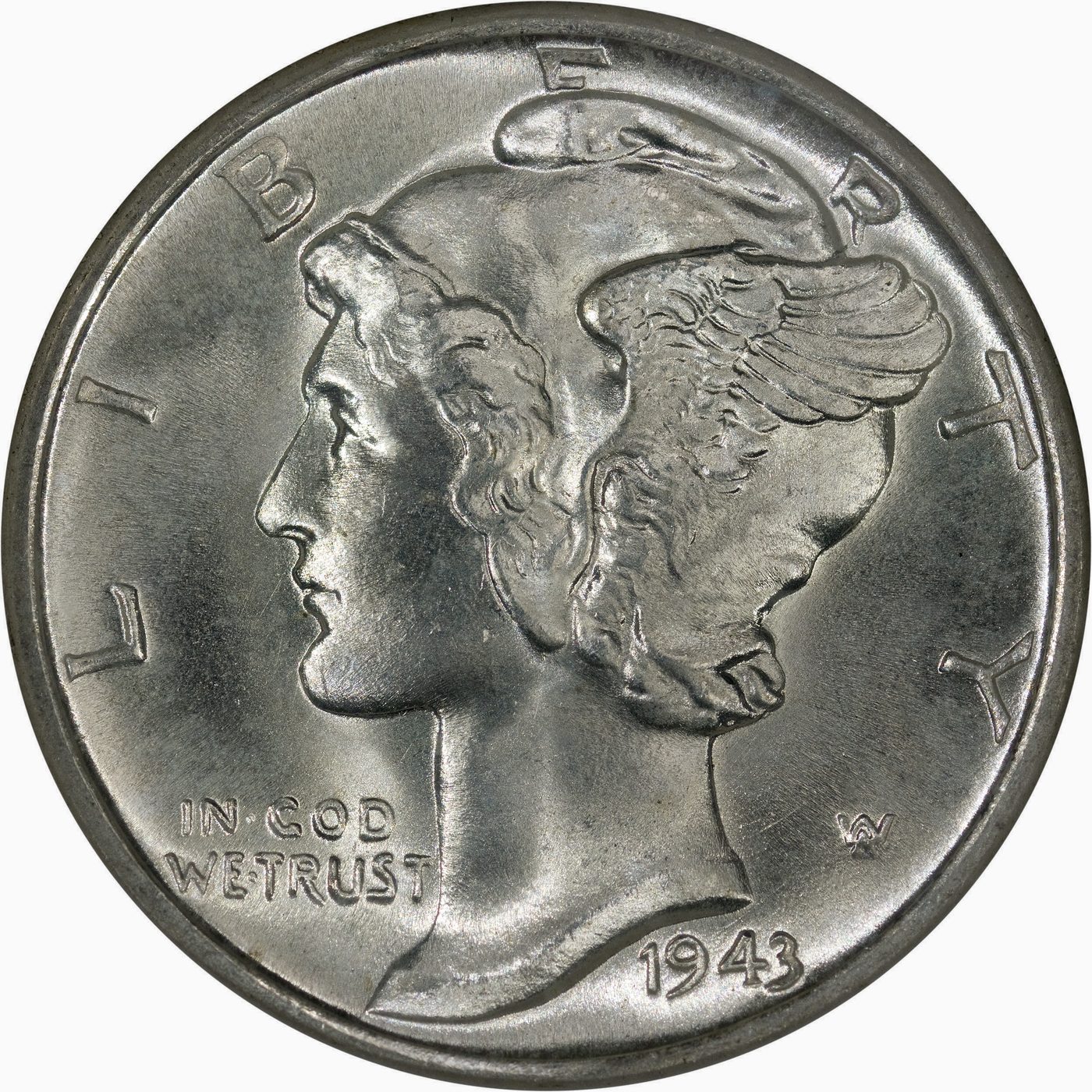
Wave one — the wartime change. Reach into an American pocket in 1943 and you'd find a small museum of the war effort. The headline coins are the two the Mint had to rebuild from scratch: Victor David Brenner's Lincoln cent, struck that year in steel, and Felix Schlag's Jefferson nickel, now carrying silver (catalogued here as its own wartime issue, the silver war nickel, alongside the regular Jefferson series). But the rest of the change told the same story more quietly. The Mercury dime and the Walking Liberty half dollar — both by the great sculptor Adolph A. Weinman — kept their prewar 90% silver, as did John Flanagan's Washington silver quarter. Silver was not the metal the war was starving for; copper and nickel were. So the dime, quarter, and half rode through the war almost unchanged, the steady backdrop against which the steel cent and the silver nickel stand out.
That's the thread that ties the wartime coins together: not a style, but a shortage. These coins weren't redesigned for beauty or for a new president — they were re-engineered, mid-war, to free up the exact metals the front lines needed. The cent lost its copper. The nickel lost its nickel. The silver coins were left alone because the war didn't want their metal. Read the era's coinage as a list of materials and you're reading a wartime supply chain.
Wave two — the first coins of the peace. The war's last act on American money came as the fighting ended. President Franklin Roosevelt died in April 1945, and the Mint retired Weinman's beloved Mercury dime to honor him; John R. Sinnock's Roosevelt silver dime arrived in January 1946 — the first new coin of the peace, but unmistakably born from the war that had just ended. That same year the Mint also struck two commemorative half dollars that belong to the immediate aftermath. The Booker T. Washington Memorial half dollar (1946–1951), by Isaac Scott Hathaway — the first Black American on a U.S. coin and the first U.S. coin designed by a Black artist — and the well-run Iowa Centennial half dollar of 1946 by Adam Pietz, the clean program that helped convince Congress to shut the abused commemorative system down. Both are postwar coins, struck by a country turning from war to ordinary life.
Wave three — the coins struck to remember. Half a century later, the country came back to mint the war on purpose. The 1993 World War II 50th Anniversary program — a clad half dollar, a 90% silver dollar (Thomas D. Rogers Sr.'s D-Day design carrying Eisenhower's order to his troops), and a $5 gold half eagle (the only U.S. coin to hide a word in Morse code) — all dual-dated 1991–1995 for the fifty years from America's entry to Japan's surrender, with surcharges that helped build the National WWII Memorial. And in 2020, for 75 years since the war's end, the Mint struck the End of World War II 75th Anniversary $25 gold coin — half an ounce of pure gold, an eagle turning from the arrows of war toward the olive branch of peace, just 7,500 made, sold out fast (obverse by Ronald Sanders, sculpted by Phebe Hemphill; reverse by Donna Weaver, sculpted by Renata Gordon).
These denominations also carry a much longer lineage behind them, and the modern Jefferson nickel reverse by Jamie Franki keeps Schlag's wartime five-cent piece alive in living memory.
A wartime timeline
- Dec 1941The U.S. enters WWII after Pearl Harbor; the War Production Board soon controls where the nation's metal goes.
- Mar 27, 1942Congress authorizes a new five-cent alloy with no nickel in it — freeing nickel for armor and aircraft.
- Oct 1942The Mint begins striking war nickels in 56% copper, 35% silver, 9% manganese, with a large mint mark above Monticello.
- 1943The cent goes steel: zinc-coated low-carbon steel, nearly 1.1 billion struck, to save copper for the war.
- 1944The cent returns to copper — much of it reclaimed from spent brass shell casings (the 'shell case cents,' 1944–1946).
- Apr 1945President Franklin Roosevelt dies; the Mint moves to replace the Mercury dime with a Roosevelt portrait.
- 1945The war ends; the silver nickel continues through the end of the year.
- 1946The nickel returns to its prewar 75% copper / 25% nickel; the Roosevelt dime debuts in January. The Booker T. Washington and Iowa Centennial commemorative halves are struck.
- 1993The World War II 50th Anniversary program (half dollar, silver dollar, $5 gold) is sold, dual-dated 1991–1995, to fund the National WWII Memorial.
- 2020The End of WWII 75th Anniversary $25 gold coin — 7,500 struck at West Point — sells out, an eagle turning from war toward peace.
Key facts
- Era
- U.S. World War II coinage and remembrance, 1942–2020
- Country
- United States
- Steel cent
- 1943 only — zinc-coated low-carbon steel; ~1.1 billion struck (Philadelphia, Denver, San Francisco)
- War nickel
- Oct 1942–1945 — 56% copper, 35% silver, 9% manganese
- War nickel tell
- Large P, D, or S mint mark above Monticello (first-ever P mint mark on a U.S. coin)
- Unchanged silver
- Dime, quarter, and half stayed 90% silver — silver wasn't the war-critical metal
- Authorizing act (nickel)
- Act of March 27, 1942
- Return to normal
- Cent: copper again from 1944 (shell case cents through 1946). Nickel: prewar alloy from 1946.
- First coins of the peace
- Roosevelt silver dime (Jan 1946); Booker T. Washington and Iowa Centennial commemorative halves (1946)
- WWII commemoratives
- 1993 WWII 50th Anniversary set (half, silver dollar, $5 gold, dual-dated 1991–1995); 2020 End of WWII 75th Anniversary $25 gold (7,500 struck)
- Designers in circulation
- Cent — Victor David Brenner. Nickel — Felix Schlag. Dime & half — Adolph A. Weinman. Quarter — John Flanagan. Roosevelt dime — John R. Sinnock.
Why it fascinates collectors
Most coins tell you about the year on them. These tell you what the country was fighting for. You can hold a 1943 steel cent and know that the copper it wasn't made of went into shells; you can hold a war nickel and know there's real silver in it because the war needed the nickel more. The history is literally in the metal.
That's the rare combination here: the most famous WWII coins are also some of the most affordable. A worn steel cent or a circulated silver nickel costs very little — a child can start a collection with the same coins that explain a world war. Yet the era also produced some of the great American rarities. During the 1943 changeover, a few leftover copper blanks got struck by mistake — the legendary 1943 copper cent, of which only a small number are confirmed, and one Denver example sold for over $1.7 million. The reverse mistake happened in 1944, when a few leftover steel blanks were struck after the Mint went back to copper — the 1944 steel cent, rarer still.
And the era keeps giving at the design level. The 1993 $5 gold half eagle hides the letter V in Morse code — three dots and a dash — the only U.S. coin known to carry Morse on its face. The 1946 Booker T. Washington half made history twice over: the first Black American on U.S. money, by the first Black artist the Mint ever hired. The 2020 anniversary gold coin turns its eagle deliberately toward the olive branch of peace. So the era rewards both ends of the hobby: a pocketful of wartime change tells the whole story for a few dollars, and around it sit error coins, design firsts, and a sold-out gold issue for the collector who wants to go deep.
Questions collectors ask
Why is the 1943 penny silver-colored instead of copper?
Copper was a critical war metal — it went into shell casings and military equipment. For 1943 only, the Mint struck cents on zinc-coated steel blanks instead, which came out bright and silvery. Nearly 1.1 billion were made. They were unpopular: magnetic, lighter than copper, easily confused with dimes, and prone to rust where the punching cut through the zinc coating.
Are wartime nickels really silver?
Partly. From October 1942 through 1945, five-cent pieces were struck in 56% copper, 35% silver, and 9% manganese — because the war needed the nickel metal for armor and aircraft. It was the only time silver went into a regular circulating U.S. coin that never normally contained it.
How can I tell a war nickel from a normal one?
Look at the back, above the dome of Monticello. A war nickel (1942–1945) has a large mint mark there — P, D, or S. The Mint put it there on purpose, so the silver coins could be spotted and pulled from circulation after the war. The large P is itself a first: no U.S. coin had ever carried a Philadelphia mint mark before.
Did the dime, quarter, and half dollar change during the war too?
No — their metal stayed the same. The Mercury dime, the Washington quarter, and the Walking Liberty half dollar all kept their prewar 90% silver right through the war. Silver wasn't the war-critical metal; copper and nickel were. So only the cent (to steel) and the nickel (to a silver alloy) were re-engineered to free up the metals the front lines needed.
What is a 'shell case cent'?
When the cent returned to copper in 1944, much of that copper was reclaimed from spent brass shell casings recovered from military training ranges. These 1944–1946 cents are nicknamed shell case cents — the war's spent ammunition, melted back down into pocket change.
What makes the 1943 copper cent and the 1944 steel cent so valuable?
They're accidents. In 1943 a handful of leftover copper blanks were struck by mistake during the switch to steel — only a small number are confirmed, and one sold for over $1.7 million. In 1944 the opposite happened: a few leftover steel blanks were struck after the Mint had gone back to copper. Both are among the most famous error coins in U.S. history. Most coins that look like them are ordinary coins altered or mislabeled, so genuine examples are authenticated with care.
Are there commemorative coins about World War II?
Yes. In 1993 the U.S. Mint sold a three-coin World War II 50th Anniversary program — a clad half dollar, a 90% silver dollar carrying a D-Day scene and Eisenhower's order to his troops, and a $5 gold half eagle that hides the letter V in Morse code — all dual-dated 1991–1995, with surcharges that helped fund the National WWII Memorial in Washington. In 2020, the Mint struck the End of WWII 75th Anniversary $25 gold coin (half an ounce of pure gold, only 7,500 made), showing an eagle turning from the arrows of war toward the olive branch of peace.
Which 1946 coins belong to the WWII story?
Three. John R. Sinnock's Roosevelt dime debuted in January 1946 to honor the wartime president who had just died — the first new coin of the peace. The same year saw two commemorative half dollars: the Booker T. Washington Memorial half (the first Black American on a U.S. coin) and the Iowa Centennial half (the clean, well-run program that helped end the abused commemorative system). All three were struck by a country stepping out of the war into ordinary life.
Sources
- The National WWII Museum — Steel Cents, Silver Nickels, and Invasion Notes: US Money in World War II
- Wikipedia — 1943 steel cent
- Wikipedia — Jefferson nickel (wartime nickel section)
- PCGS — Why Was the 1943 Steel Cent Made?
- CoinWeek — Jefferson War Nickel, 1942–1945: A Collector's Guide
- Stack's Bowers — The Philadelphia Mint's 'P' Mintmark First Appeared in 1942 on Jefferson Nickels (Nellie Tayloe Ross letter, Sept 14, 1942)
- CoinWeek — Dimes: Winged Liberty ('Mercury') Dime, 1916–1945 (90% silver; designer Adolph A. Weinman)
- CoinWeek — Walking Liberty Half Dollar, 1916–1947 (90% silver; designer Adolph A. Weinman)
- Wikipedia — Roosevelt dime (1946 debut; designer John R. Sinnock)
- Wikipedia — Booker T. Washington half dollar (1946–1951; designer Isaac Scott Hathaway)
- Wikipedia — Iowa centennial half dollar (1946; designer Adam Pietz)
- Wikipedia — World War II 50th Anniversary coins (1991–1995 dual date; designers Thomas D. Rogers Sr. et al.)
- U.S. Mint — End of World War II 75th Anniversary 24-Karat Gold Coin (2020-W; designers Ronald Sanders / Phebe Hemphill / Donna Weaver / Renata Gordon)