US coin · series

The Washington Quarter: a one-year tribute that lasted a lifetime

Born for George Washington's 200th birthday — and the design the Commission of Fine Arts didn't pick.

The Washington Quarter: a one-year tribute that lasted a lifetime
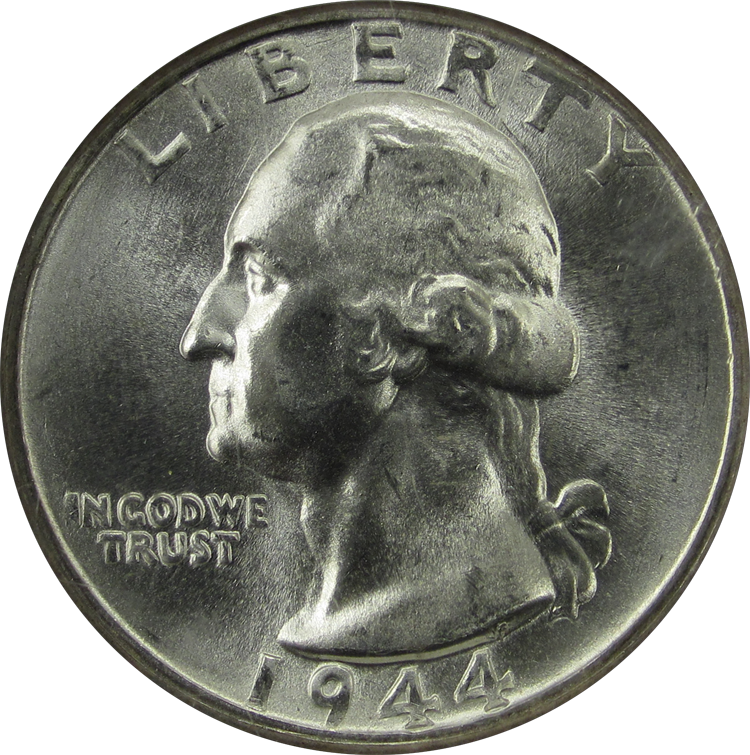
Photograph by Brandon Grossardt (Wikimedia Commons); coin design by John Flanagan · public domain · source

In 1932, the U.S. Mint set out to make a coin for a single year: a quarter to mark 200 years since George Washington's birth. It became the quarter Americans carried for the next three decades — and the first time a real president's face replaced Liberty on a coin meant for everyday pockets.

The story behind the coin

For 140 years, the faces on circulating American coins were ideas — Liberty in a dozen poses, an eagle, an Indian head that was really an allegory in a headdress. The founders had been wary of putting rulers on money; that was what kings did. So Americans handed each other coins stamped with symbols, not statesmen.

In 1932 that broke. Congress wanted to mark the 200th anniversary of George Washington's birth, and a quarter dollar carrying his portrait was the chosen tribute. It was meant to be a one-year commemorative — strike it for 1932, then go back to the old design. The old design was the Standing Liberty quarter by Hermon MacNeil, a beautiful coin that was a headache to strike cleanly.

The one-year coin never went away. The portrait stuck, the Standing Liberty quarter was retired for good, and Washington's profile has ridden the quarter ever since. What was supposed to be a birthday card became the everyday quarter of the Depression, the Second World War, and postwar America — struck in 90% silver, the same as it had been since the founding, right up until 1964.

The design — and the contest it nearly lost

The coin you know was designed by John Flanagan, a New York sculptor who had trained as an assistant to Augustus Saint-Gaudens — the artist behind the most admired American coins ever struck. Flanagan designed both sides. The obverse (the heads side) is Washington in profile, facing left, adapted from a famous 1786 bust by the French sculptor Jean-Antoine Houdon, who had modeled Washington from life. The reverse (the tails side) is a stern, modern eagle, wings spread, perched on a bundle of arrows over crossed olive branches — war and peace, held in one grip.

But Flanagan's design almost didn't happen. A competition drew roughly a hundred entries, and the Commission of Fine Arts twice chose a different artist: Laura Gardin Fraser, one of the finest medalists of the era. Treasury Secretary Andrew Mellon overruled them both times and picked Flanagan. His successor declined to reopen it.

Collectors have argued for decades over why. Some say Fraser was passed over because she was a woman. The historian Q. David Bowers pushed back hard on that — noting Mellon had approved Fraser's designs for other coins before — and called the gender-bias version "modern numismatic fiction." What is not in dispute: Fraser's rejected Washington portrait was finally vindicated. The U.S. Mint used her design on a 1999 commemorative and again, starting in 2022, on the obverse of the American Women Quarters. The design the establishment turned down in 1932 came back ninety years later.

Key facts

Years struck (silver)
1932, then 1934–1964 (none in 1933)
Designer
John Flanagan — obverse and reverse
Obverse
George Washington, after Houdon's 1786 bust
Reverse
Eagle on a bundle of arrows, olive branches below
Composition
90% silver, 10% copper
Weight / diameter
6.25 g · 24.3 mm · reeded edge
Net silver
0.18084 troy oz per coin
Mints
Philadelphia (no mark), Denver (D), San Francisco (S)
Key dates
1932-D (436,800 struck) · 1932-S (408,000 struck)
Proof years
1936–1942 and 1950–1964
Why it ended
Silver removed in 1965; the type went to copper-nickel clad

Collecting it: the dates that matter

Here is the irony that makes the series fun: the first year is the rarest. Philadelphia struck more than five million quarters in 1932, but Denver and San Francisco barely bothered — they each made only a few hundred thousand. The 1932-D (436,800 struck) and the 1932-S (408,000 struck) are the two key dates, and the 1932-S is the lowest-mintage circulation strike in the entire run. Nobody saved them, because nobody knew the design would stick. A worn 1932-D or 1932-S is the coin that separates a casual set from a serious one.

Then there were no quarters at all in 1933. The 1932 production had flooded the channels — in the depths of the Depression, nobody needed more quarters — so the Mint simply skipped a year.

The series also rewards collectors who look closely. The 1934 issues come with subtle differences in the motto "IN GOD WE TRUST" — collectors sort them into "Light Motto" and "Heavy Motto" depending on how the dies were finished. Among the dramatic mint mistakes, the 1943 doubled-die obverse shows bold doubling in the date — a die struck twice, slightly off, so the numbers ghost — and the 1950 Denver and San Francisco over-mintmark coins (a D punched over an S, and the reverse) are favorites for variety hunters. These are scarce; treat any claimed example as something to have authenticated.

Why are high grades scarce on an otherwise common coin? Because for most of its life this was money. People spent it. A 1944 quarter that survived in mint condition is one that somebody pulled from circulation and tucked away on purpose — most didn't. Common dates are easy to find worn and genuinely hard to find pristine, which is exactly the gap a graded, slabbed example is meant to certify.

Questions collectors ask

Which Washington quarters are silver?

Every Washington quarter dated 1932 through 1964 is 90% silver. Starting in 1965, the U.S. switched to a copper-nickel 'clad' quarter with no silver, so a 1964 quarter is silver and a 1965 quarter is not.

Why is the 1932-D or 1932-S quarter worth so much more?

They have the lowest mintages of the whole series — 436,800 for the 1932-D and 408,000 for the 1932-S. The design was meant to be a one-year tribute, so few were struck at Denver and San Francisco and almost none were saved. Scarcity, not age, drives the premium.

Who designed the Washington quarter, and was there a controversy?

Sculptor John Flanagan designed both sides. The Commission of Fine Arts had twice preferred a design by Laura Gardin Fraser, but Treasury Secretary Andrew Mellon chose Flanagan. Whether bias played a role is debated; Fraser's Washington portrait was eventually used on later coins, including the 2022–2025 American Women Quarters obverse.

Why were no Washington quarters made in 1933?

The 1932 striking had over-supplied the country with quarters during the Depression, when demand for new coins was weak. The Mint struck no quarters at any facility in 1933 and resumed in 1934.

Was the Washington quarter the first U.S. coin with a president on it?

It was the first regular circulating quarter to carry a president's portrait, part of a shift away from the allegorical 'Liberty' figures that had dominated American coinage. The Lincoln cent (1909) had already broken that tradition for the penny.

How much silver is in one Washington silver quarter?

About 0.18084 troy ounces of pure silver. The coin weighs 6.25 grams and is 90% silver, 10% copper.

Sources