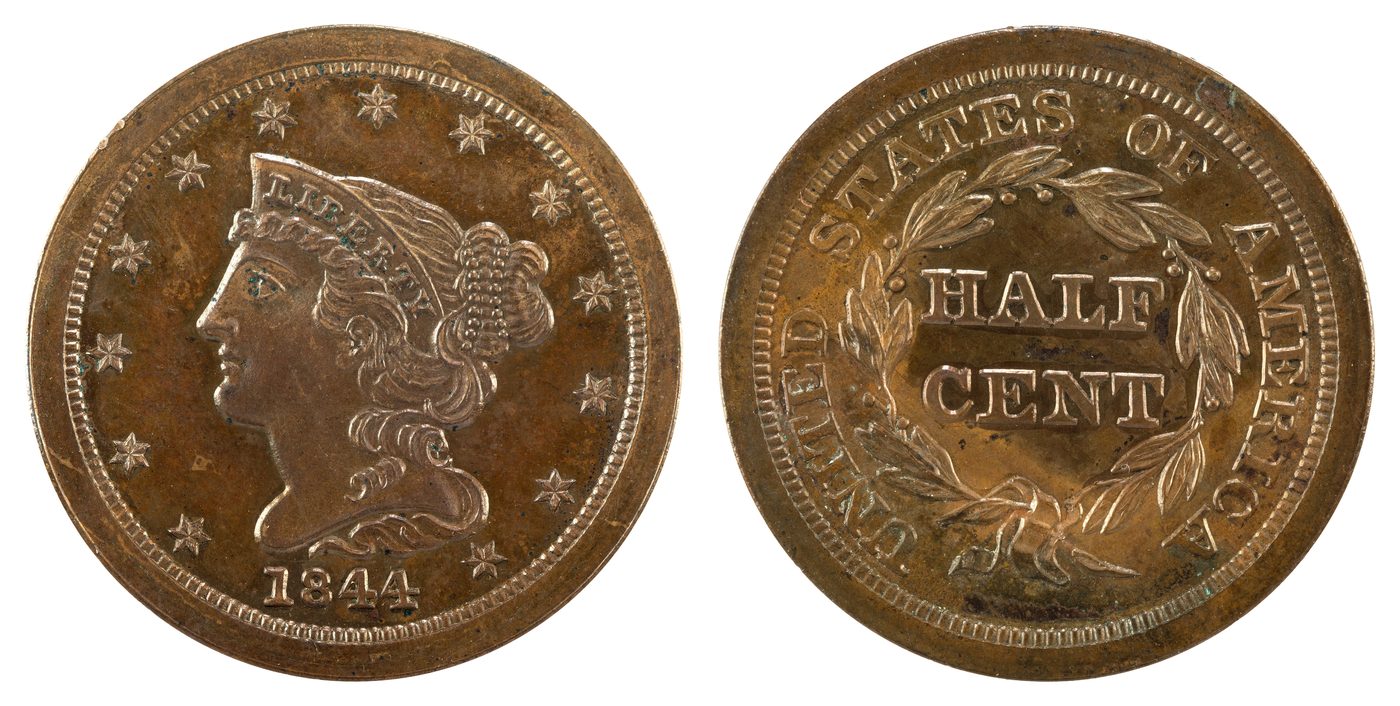
The coin America stopped using
The half cent was the lowest-value coin the United States ever struck — worth a 200th of a dollar — and almost nobody wanted it.
That sounds strange today, but it made sense when the Mint first authorized the denomination in 1792. Early American commerce ran on Spanish silver. Prices were quoted in bits — a "bit" being one Spanish real, worth twelve and a half cents. A coin worth half a cent was the only way to make exact change on those odd fractions. Sound logic. The public just never agreed.
Banks rarely ordered half cents. Merchants didn't ask for them. The Mint often struck them only when it had no copper blanks left over for the larger one-cent piece, and even then it ended up overstocked. So by the time engraver Christian Gobrecht adapted his new Braided Hair portrait to the half cent in 1840, the denomination was already a relic that hadn't caught on in nearly fifty years.
Here is the strangest part. From 1840 through 1848, the Mint struck half cents — but not for circulation. It made them only as proofs: a small number of specially polished presentation coins for dignitaries, officials, and the era's tiny circle of serious collectors. (A proof is a coin struck with extra care from finely prepared dies, made to be admired, not spent.) For nearly a decade, the lowest coin in the land existed mainly as a collector's curiosity. Regular circulation strikes did not resume until 1849.