US coin · series

The Gobrecht Dollar: the coin that put Liberty in flight

An engraver signed his name across the new silver dollar — and started an argument that outlived everyone in the room.

The Gobrecht Dollar: the coin that put Liberty in flight
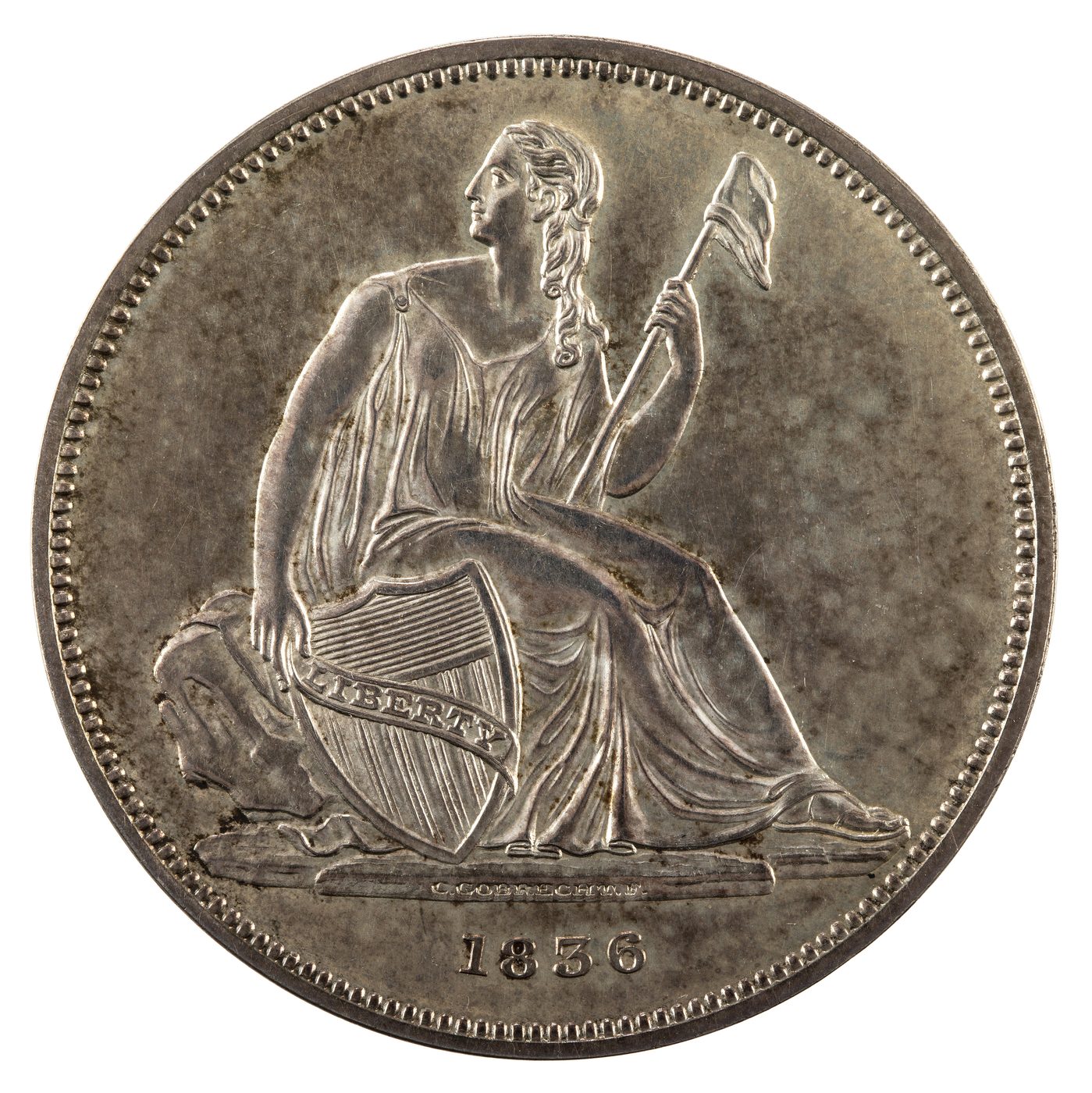
Coin designed by Christian Gobrecht for the US Mint; photograph by Jaclyn Nash, National Numismatic Collection, National Museum of American History… · public domain · source

In 1836 the U.S. Mint hadn't struck a silver dollar for business in over thirty years. When it finally tried again, it produced one of the most beautiful coins in American history — a seated goddess on one side, an eagle in mid-flight on the other — and almost no one was allowed to spend it.

The story behind the coin

By the 1830s the silver dollar had become a ghost. The Mint had effectively stopped making them for circulation in 1804 — the big coins kept getting shipped overseas and melted, so why bother. For a generation, the United States had a flagship coin that mostly didn't exist.

Mint Director Robert Maskell Patterson wanted to fix that, and he wanted to do it with style. Patterson pushed for a silver dollar of real artistic ambition — not a workmanlike copy of European money, but something that announced a confident young republic. He reached outside the Mint for the look, and that decision is why this coin carries three names instead of one.

The result, struck beginning in 1836, was so good it barely circulated. Only a small number were ever made, most with the mirror-bright surfaces of a proof — a coin struck from polished dies onto polished blanks, made to be admired rather than handed across a counter. The Gobrecht dollar was the test run for a brand-new design. The test passed; the coin itself stayed rare.

The design — and the three men who made it

Turn the coin to the obverse — the heads side — and you meet Liberty as you've probably never pictured her: not a profile bust, but a full figure, seated on a rock, holding a liberty cap on a pole in one hand and a shield in the other. That seated goddess came from a drawing by the painter Thomas Sully, one of the finest portraitists in America. On the original 1836 issue she sits in an open field with only the date below her.

Flip to the reverse — the tails side — and the bird is flying. Not the stiff, perched heraldic eagle of every other U.S. coin, but a living eagle climbing through a sky of stars. That motion came from the naturalist and artist Titian Peale, who knew how birds actually move. It is one of the few genuinely dynamic images in the whole history of American coinage.

Both designs were turned into working dies by Christian Gobrecht, the Mint's gifted engraver (soon its Chief Engraver), and the coin carries his name forever. Gobrecht did something bold: he signed the obverse, C. GOBRECHT F. — the "F." short for the Latin fecit, "he made it." On the earliest pieces the signature sat in the field, just above the date, for all to see. That did not go over well. Critics called it conceited for an engraver to stamp his name so plainly across the nation's dollar. Patterson had Gobrecht shrink it and tuck it onto the base Liberty sits on — present, but discreet. By 1838 and 1839 it was gone from the coin entirely.

That small drama left a real collecting legacy. A handful of early pieces — perhaps around eighteen — carry the name boldly below the base in the field and are treated as patterns: the rarest and earliest faces of the design. The far more available Name on Base version (catalogued by specialists as Judd-60) is the one most collectors actually chase.

Key facts

Years struck
1836–1839 (originals); restrikes later, c. 1859–1860
Denomination
Silver dollar ($1)
Engraver
Christian Gobrecht (both dies)
Obverse design
Seated Liberty — from a drawing by Thomas Sully
Reverse design
Flying eagle — from a drawing by Titian Peale
Composition
89.2% silver (some 1836) → 90% silver after the Jan. 1837 standard
Weight
~26.73–26.96 g
Diameter
~39 mm
Official mintage
Roughly 1,900 pieces total across 1836–1839 originals
Surface
Struck as proofs (mirror fields)
Legacy
Its obverse became the Seated Liberty design used 1837–1891

Collecting it: key dates, varieties, and why high grades are scarce

This is a small series, and that's the whole appeal. Across all four dates, official production was on the order of 1,900 coins — a rounding error next to the millions struck of a common date. Every Gobrecht dollar is, by definition, rare.

The dates break down roughly like this. The famous 1836 issue accounts for the bulk: about 1,000 coins struck late that year in the older 89.2%-silver standard, plus roughly 600 more struck in 1837 but still dated 1836 in the new 90%-silver standard. The 1839 is the toughest of the official dates, with only about 300 struck. The 1838 is its own puzzle — pieces dated 1838 are generally regarded as restrikes rather than original circulation issues.

Then there are the restrikes. Around 1859–1860, under Mint Director James Ross Snowden, the Mint struck more Gobrecht dollars from the old dies to satisfy collector demand — a common practice at the time. Telling an original from a restrike is the great parlor game of this series. Walter Breen built a famous test around die alignment: how the eagle's flight lines up with the obverse when you flip the coin. In Breen's scheme, true originals show the eagle flying upward in a particular orientation, while many restrikes show it flying level. Here's the honest part: that theory is disputed. Since the 1980s, "revisionist" researchers have argued some level-flying pieces are originals too. Treat any original-vs-restrike claim as a question for the experts, and lean on a reputable grading service's attribution — the difference can mean a large swing in value.

Why are nice ones so hard to find? Because almost every Gobrecht dollar was a proof made to be kept, handled by collectors for nearly two centuries. Mirror surfaces show every hairline and rub, so truly high-grade survivors — clean fields, sharp strike, original look — are scarce even within an already tiny population. A genuine, properly attributed Gobrecht in a strong grade is a coin people wait years to buy.

Questions collectors ask

Who actually designed the Gobrecht dollar?

Three people. Christian Gobrecht engraved both dies and gave the coin its name. The Seated Liberty figure on the front came from a drawing by the painter Thomas Sully, and the flying eagle on the back came from a drawing by the artist-naturalist Titian Peale.

Why does the coin have a person's name on the front?

Engraver Christian Gobrecht signed it 'C. GOBRECHT F.' — the 'F.' is Latin for 'he made it.' On the earliest coins the signature sat plainly in the field above the date. Critics thought that was vain, so it was shrunk and moved onto the base Liberty sits on, then dropped entirely by 1838–1839.

How rare is the Gobrecht dollar?

Very. Official production across 1836–1839 was only about 1,900 coins total, with the 1839 original the toughest at roughly 300. Almost all were struck as proofs, so high-grade survivors are scarce even within that tiny number.

What's the difference between an original and a restrike?

Around 1859–1860 the Mint struck more Gobrecht dollars from the old dies for collectors. The classic test, from Walter Breen, uses die alignment — how the eagle's flight orients when you flip the coin. Originals are said to fly 'upward,' many restrikes 'level.' But that rule is debated by later researchers, so the safest path is a reputable grading service's attribution.

Is the Gobrecht dollar related to the Seated Liberty dollar?

Directly. The Gobrecht dollar's Seated Liberty obverse was adopted for U.S. coinage and ran for about half a century, including the Seated Liberty dollar struck from 1840 onward. The Gobrecht dollar is where that long-lived design was born.

Sources