US coin · series

The Coronet Head Quarter Eagle

A $2.50 gold coin that wore the same face for 67 years — through the Gold Rush, the Civil War, and the Gilded Age.

The Coronet Head Quarter Eagle
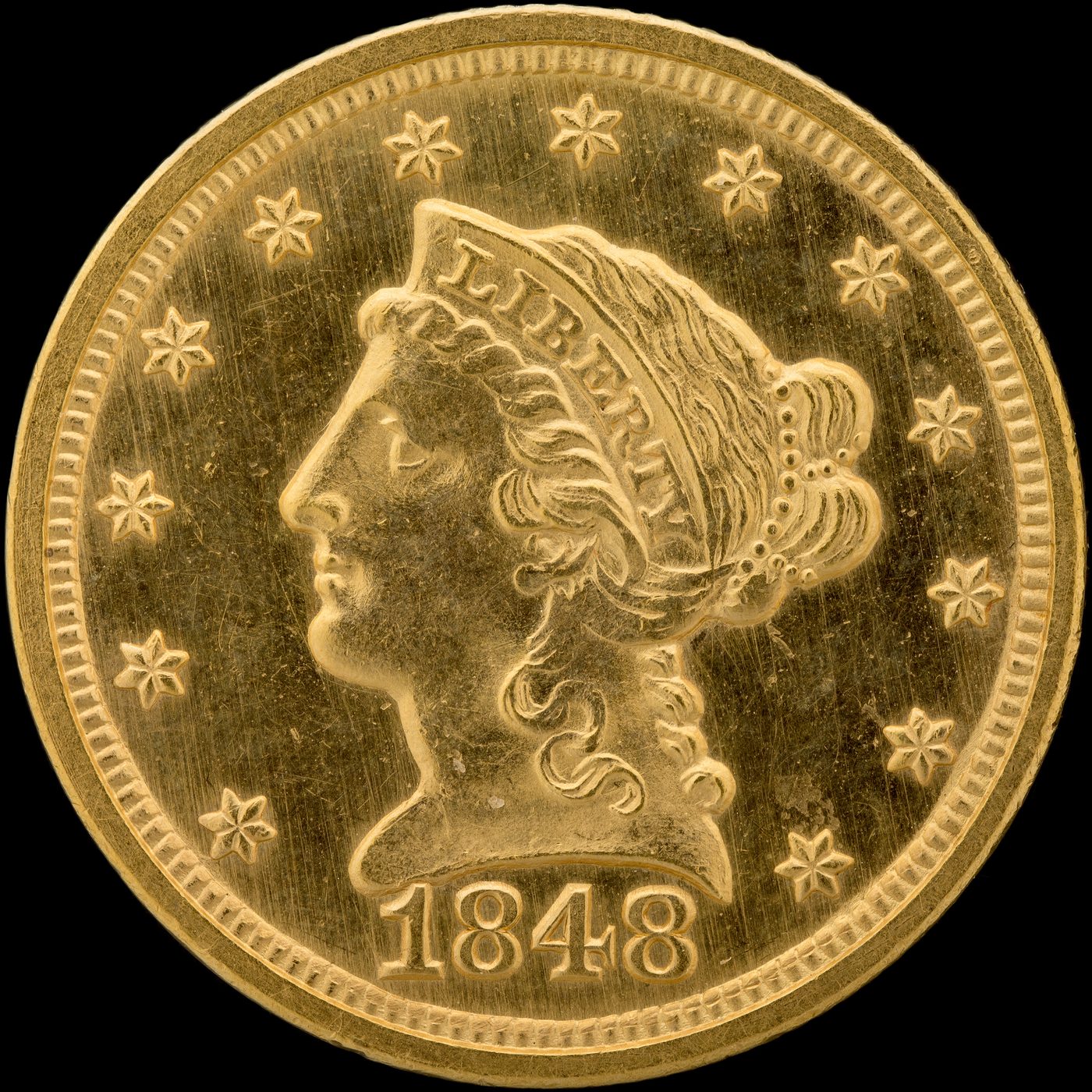
US Mint (coin); photograph by Jaclyn Nash, National Numismatic Collection, National Museum of American History (Smithsonian Institution) · public domain · source

In 1848, the U.S. government took raw gold straight from a California streambed, struck it into tiny coins, and stamped each one with three letters — CAL. — to mark where it came from. Those coins were Coronet Head quarter eagles, and that small stamp made them, arguably, the first American commemoratives.

The story behind the coin

By the 1830s the U.S. Mint had a problem of identity. Its gold coins still wore a head of Liberty adapted from a design first used on copper cents back in 1808 — fine for a penny, but officials wanted something grander for the nation's gold. They wanted a face that looked like the growing republic felt.

The answer came from Christian Gobrecht, the Mint's chief engraver. His Liberty — a profile crowned with a band reading LIBERTY — first appeared on the larger gold eagle in 1838. In 1840 the Mint shrank it down for the smallest gold coin in the system, the quarter eagle, worth two and a half dollars. The "coronet," the small crown on her head, gave the design its nickname.

What nobody expected was how long it would last. The Coronet quarter eagle was struck every kind of year America had to throw at it — boom, war, reconstruction, and the gilded decades after — from 1840 all the way to 1907. That is 67 years of the same basic design, the longest unbroken run of any coin in U.S. history. It outlived its own designer by more than sixty years.

And it was a working coin of a wild era. The same little gold piece was made at five different mints, including two — Charlotte, North Carolina, and Dahlonega, Georgia — built specifically to turn Southern gold into money before the Civil War shut them down for good. Coins from those two mints alone tell the story of the antebellum South in metal.

The design — who made it, and what it says

The obverse — the heads side — is pure Christian Gobrecht. Liberty faces left, her hair gathered in a bun, wearing a coronet inscribed LIBERTY. Thirteen stars ring her for the original colonies, and the date sits below her neck. It is calm, classical, and confident — exactly the dignified symbol the Mint had been chasing for a decade.

The reverse — the tails side — carries a heraldic eagle. A shield rests on its breast, an olive branch (peace) and three arrows (war) fill its talons, UNITED STATES OF AMERICA arcs above, and the value reads 2 1/2 D. below.

One detail sets this coin apart from its bigger gold cousins. After the Civil War, Congress added the motto IN GOD WE TRUST to most U.S. coinage. The quarter eagle never got it. The coin was simply too small to fit the words comfortably, so the Coronet $2.50 went its entire life without the motto — a quiet quirk that distinguishes it from the half eagle and eagle that shared its Liberty.

The coin itself was made of 90% gold and 10% copper (the copper for hardness), weighed 4.18 grams, and measured just 18 millimeters across — smaller than a modern U.S. cent. It was real, spendable gold you could carry in a vest pocket.

Key facts

Years struck
1840–1907
Denomination
Quarter eagle ($2.50)
Obverse designer
Christian Gobrecht (Coronet / Liberty Head)
Composition
90% gold, 10% copper
Weight
4.18 g
Diameter
18 mm
Mints
Philadelphia (no mark), Charlotte (C), Dahlonega (D), New Orleans (O), San Francisco (S)
Total business strikes
11,921,171
Replaced by
Bela Lyon Pratt's incuse Indian Head, 1908
Notable feature
Never carried IN GOD WE TRUST

Collecting it — key dates, rarities, and scarce grades

For a coin made by the millions, the Coronet quarter eagle hides some of the most legendary rarities in American numismatics. The hunt is what makes the series.

The 1848 CAL. is the famous one. When gold was discovered at Sutter's Mill in 1848, the military governor of California shipped 228 ounces of it east. The War Secretary sent it to the Philadelphia Mint, which struck about 1,389 quarter eagles from that California gold and stamped a tiny CAL. above the eagle on each — a mark of origin punched into the coins while they were still in the press. Many collectors call them the first U.S. commemorative coins. A single CAL. has sold for hundreds of thousands of dollars.

The 1854-S is the rarest of all. It was the very first quarter eagle struck at the new San Francisco Mint — and only 246 were made. Of those, fewer than a dozen are known to survive, and none in high grade. It stands beside the 1841 as the great prize of the series.

The 1841 "Little Princess" earned its affectionate nickname in the early 1900s. The Mint kept no record of striking it at all, yet a tiny number exist — experts estimate around twenty pieces, a mix of proofs (specially struck presentation coins, with mirror-like fields) and circulation strikes. Whether some are proofs or business strikes is still debated. Any example, in any condition, sets collectors' hearts racing.

Beyond the headline rarities, the Charlotte and Dahlonega issues are a world unto themselves. These Southern branch mints produced small quantities, often crudely struck, and several dates are genuinely scarce — the kind of coins collectors of "C" and "D" gold pursue for a lifetime.

A word on grade. This was gold that circulated. People spent it, banks bagged it, and over decades the coins wore down. High-grade survivors — sharp, lustrous, barely handled — are scarce for almost every date, because so few escaped a hard working life. That is why condition matters so much here: an ordinary date in pristine, mint-state condition can be far harder to find than its mintage suggests.

The whole run ended in 1907. President Theodore Roosevelt wanted American coins to be works of art, and the next year the old Coronet was swept aside for Bela Lyon Pratt's striking Indian Head design — with the image sunk into the coin's surface rather than raised above it. Gobrecht's 67-year-old Liberty had finally had her run.

Questions collectors ask

What is a quarter eagle?

A quarter eagle is the U.S. $2.50 gold coin. The base unit was the 'eagle' ($10), so a quarter eagle was a quarter of that — two and a half dollars. It's one of the smallest gold coins the U.S. ever made for circulation, just 18 mm across.

Who designed the Coronet Head quarter eagle?

Christian Gobrecht, the third Chief Engraver of the U.S. Mint, designed the Coronet (Liberty Head) obverse. It first appeared on the larger gold eagle in 1838 and was adapted to the quarter eagle in 1840.

Why are some quarter eagles stamped 'CAL.'?

In 1848, gold from the new California Gold Rush was sent to the Philadelphia Mint and struck into about 1,389 quarter eagles, each stamped with a tiny CAL. above the eagle to mark its origin. Many consider them the first U.S. commemorative coins, and they're highly prized today.

What is the rarest Coronet quarter eagle?

The 1854-S. It was the first quarter eagle struck at the San Francisco Mint, with a mintage of just 246 pieces — fewer than a dozen are believed to survive, making it one of the rarest U.S. gold coins of any kind.

Why doesn't this coin say 'In God We Trust'?

The motto was added to most U.S. coinage after the Civil War, but the quarter eagle was too small to fit it comfortably. The Coronet $2.50 never carried the motto for its entire 1840–1907 run.

When and why did the design end?

It was replaced in 1908 by Bela Lyon Pratt's incuse Indian Head, part of Theodore Roosevelt's push to make American coinage more artistic. The Coronet's 67-year run is still the longest of any U.S. coin design.

Sources